- Sluggish domestic demand prompts exports surge
- Production dips amid ongoing war, power shortages
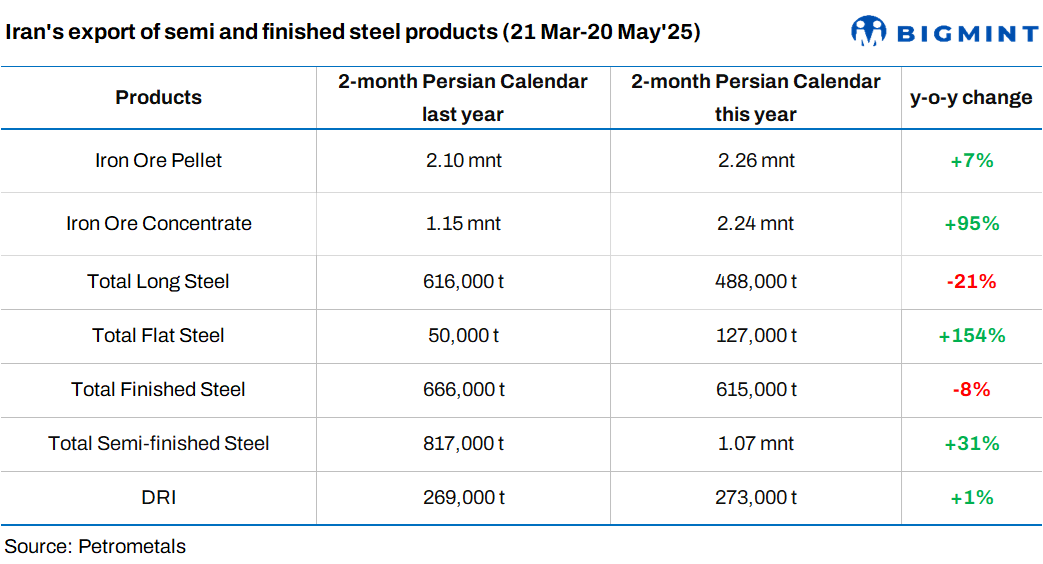
Iran’s semi-finished steel exports in the first two months of the current Persian Year (21 March-May 2025) increased by 31% y-o-y, while production edged down y-o-y 6%, according to data from Petrometals. Despite the ongoing war, power restrictions, and shortages disrupting Iran’s industrial activities, exports have remained resilient, even as production has been adversely affected by the same challenges.
Semi-finished steel exports surge
Iran’s semi-finished steel exports stood at around 1.07 million tonnes (mnt) in the first two months of the current Persian Year, a y-o-y increase of 31%.
However, exports of long products were recorded at 488,000 t, down 21% y-o-y, while shipments of flats increased sharply by 154% y-o-y to 127,000 t.
Iran’s semi-finished steel exports rose at the start of the current Persian year due to a mix of factors: sluggish domestic demand, which prompted a shift to exports; favourable pricing in international markets; and expanded production by key steelmakers despite ongoing energy constraints.
Meanwhile, exports of direct reduced iron (DRI) in the period under review were recorded at 273,000 t, a marginal increase of just 1% y-o-y.

Semi-finished steel production falls around 6% y-o-y
According to Petrometals, Iran’s semi-finished steel output stood at 6.42 mnt in the first two months of the current Persian Year, a decrease of 6% from 6.857 mnt in the preceding year.
Billets and blooms accounted for 4.02 mnt of total semis output, down by 7% compared to 4.32 mnt in the year-ago period.
Production of slabs also witnessed a decrease of 5% to 2.40 mnt as against 2.53 mnt in the corresponding period last year (CPLY).
Notably, DRI production stood at 7.91 mnt in the period under review, a rise of 3% compared to 7.68 mnt in the previous year.
Outlook
In the near term, Iran’s steel industry is likely to stay under pressure due to ongoing power cuts, gas shortages, and the impact of the war. Production may remain low, especially during the summer when electricity supply to industries is heavily reduced. However, exports are expected to stay steady, as the government continues to give this a priority and demand from overseas remains strong. Unless the energy situation improves or the conflict eases, local supply will stay tight, while exports could face some risks if the situation worsens.
Leave a Reply