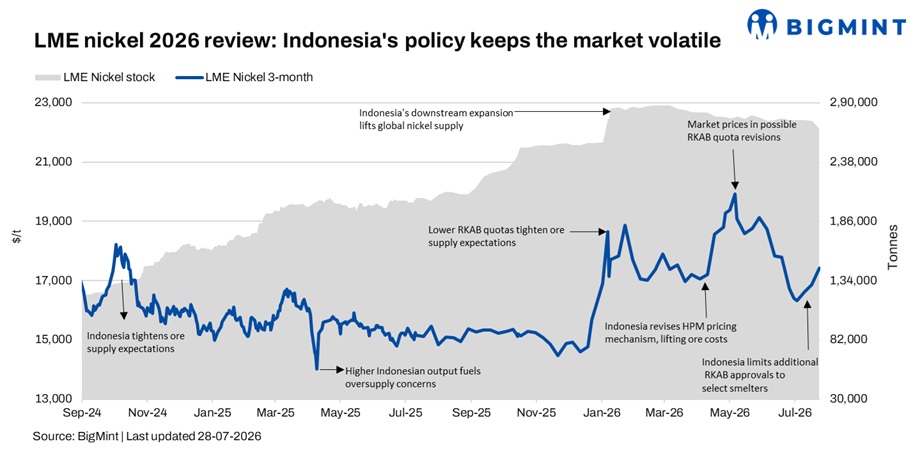
- LME nickel peaks at $19,000/t in May but falls below $17,900/t in Jun
- Elevated LME stocks, poor demand offset Indonesian supply concerns
The London Metal Exchange (LME) nickel market underwent a sharp shift in sentiment during 2026, reversing the supply-driven optimism seen at the start of the year. With Indonesia accounting for nearly 60% of global nickel mine production, its RKAB (mining work plan and budget) approvals remained the single most influential factor shaping global nickel prices throughout the year.
While Indonesia’s tighter mining policies initially supported prices, expectations of higher mine output, elevated exchange inventories, and softer demand from the stainless steel and electric vehicle (EV) battery sectors weighed on sentiment during the second half. Although geopolitical tensions and periodic inventory drawdowns provided temporary support, the market continued to be perceived as well supplied. Consequently, elevated exchange stocks and expectations of expanding downstream production in Indonesia outweighed intermittent supply disruptions, preventing any sustained price recovery despite improving medium-term fundamentals.
Policy shifts reshape market direction
During H1CY’26, LME nickel averaged $17,790/t, up 15% from $15,528/t in H1CY’25, reflecting stronger market sentiment driven primarily by Indonesia’s tighter mining policies and supply-side concerns.
LME nickel opened 2026 at $18,033/t, supported by Indonesia’s decision to tighten annual RKAB approvals to around 250-260 million tonnes (mnt), well below market expectations. The lower mining quotas reduced ore availability for nickel pig iron (NPI) producers, lifted domestic ore premiums, and restored market confidence after two years of persistent oversupply.
The policy’s impact became evident when PT Weda Bay Nickel, one of the world’s largest nickel ore producers, received a sharply reduced 2026 mining quota of 12 million wet metric tonnes (wmt), down from 42 million wmt in 2025. After exhausting its quota in May, the company temporarily suspended mining operations, intensifying concerns over ore availability for Indonesian smelters. The production halt emerged as one of the year’s strongest bullish catalysts, reinforcing expectations of tighter raw material availability across the nickel value chain.
Higher royalty rates on nickel ore and battery materials, Indonesia’s continued push towards downstream processing, resilient NPI prices, and firm stainless steel production in China during the first quarter further strengthened market sentiment. Supported by these developments, LME nickel climbed to a 2026 high of around $19,000/t in May.
However, the rally proved short-lived, with LME nickel prices averaging $17,856/t in June, as improving supply expectations, expectations of higher Indonesian mine output later in the year and elevated exchange inventories gradually outweighed the optimism created by tighter mining quotas.
Inventories remain elevated, limiting price uptrend
Despite several consecutive weeks of warehouse withdrawals, LME nickel inventories remained above 260,000 t, well above historical norms. The elevated stock levels continued to signal abundant physical availability, limiting the market’s ability to sustain higher prices despite periodic geopolitical disruptions and supply-side concerns.
While continued destocking modestly improved market sentiment, inventory reductions were insufficient to materially tighten physical availability. Elevated warehouse stocks reduced the urgency for buyers to secure material, keeping the broader market perception tilted towards abundant supply.
Indonesia strengthens its position in nickel value chain
Indonesia further consolidated its position as the centre of the global nickel industry during 2026. Beyond mining policy, the government accelerated downstream industrialisation through state-backed entities such as Danantara and MIND ID, alongside continued investment from South Korean and Chinese companies. Expansion across NPI, ferronickel, nickel matte, and mixed hydroxide precipitate (MHP) projects reinforced Indonesia’s long-term strategy of exporting higher-value nickel products rather than raw ore.
At the same time, frequent revisions to RKAB quotas, royalty structures and downstream regulations increased market uncertainty. Consequently, Indonesia has evolved from being the world’s largest nickel producer into the primary determinant of global nickel pricing, with policy announcements from Jakarta exerting a greater influence on market sentiment than short-term fluctuations in physical demand.
INSG outlook signals improving market fundamentals
The latest International Nickel Study Group (INSG) outlook indicates a notable improvement in the global nickel market balance during 2026. According to the group’s April 2026 forecast, the market is expected to shift from a surplus of 283,000 t in 2025 to a deficit of 32,000 t in 2026, reflecting tighter Indonesian ore availability following lower RKAB approvals. Global primary nickel production is forecast at 3.715 mnt, while consumption is projected to reach 3.747 mnt, indicating a modest supply shortfall.

The revised outlook marks a significant shift from the INSG’s earlier expectation of a 261,000 t surplus for 2026, highlighting how Indonesia’s tighter mining policy has reshaped the global supply-demand balance.
However, despite the projected statistical deficit, market sentiment remained cautious. Elevated LME inventories, expectations of higher Indonesian mine production following revised RKAB approvals and continued downstream capacity additions meant that participants continued to perceive the market as adequately supplied. As a result, the improving fundamentals translated into only limited support for prices.
SHFE futures reflect weakening downstream demand
China’s Shanghai Futures Exchange (SHFE) nickel and stainless steel futures closely mirrored shifts in domestic demand during 2026. Early in the year, tighter Indonesian ore supply supported SHFE nickel alongside gains in LME nickel. However, seasonal weakness in China’s stainless steel sector, rising inventories and slower downstream procurement gradually weighed on stainless steel futures, even as raw material costs remained relatively firm.
The divergence highlighted growing concerns over weakening end-user demand rather than supply constraints alone. Increasing international participation in SHFE nickel futures also strengthened China’s role in global nickel price discovery, complementing the LME’s traditional benchmark role and reinforcing the influence of Chinese stainless steel demand on broader market sentiment.
Outlook
LME nickel is expected to remain volatile through the remainder of 2026 as the market balances elevated inventories against evolving Indonesian mining policies. Continued warehouse destocking, geopolitical developments, and any improvement in global stainless steel demand could provide intermittent support to prices. However, expectations of higher Indonesian ore production, evolving RKAB approvals, and continued downstream capacity expansion are likely to limit any sustained upside.
Looking ahead to 2027, the nickel market is expected to become increasingly policy driven. Indonesia’s decisions on mine approvals, downstream investment, and export regulations will continue to shape global supply dynamics, while stainless steel demand in China and the pace of EV battery sector growth will determine the strength of consumption recovery.
Although the INSG’s projected deficit points to improving market fundamentals, meaningful price appreciation will depend on a sustained reduction in exchange inventories and disciplined supply growth. Until then, LME nickel is likely to remain highly sensitive to policy announcements from Indonesia, reinforcing the country’s defining role in global nickel pricing.

Leave a Reply