- Improvement in demand from power sector
- Index inches up for mid- & low-CV grades
Prices of Indonesian non-coking coal at Indian ports have experienced a moderate uptick, largely influenced by global rise in prices amid currency depreciation and higher freight rates.
The surge in demand for thermal coal is primarily driven by a few power plants, which are facing dangerously low stockpiles essential for electricity generation. As these plants push for replenishment, the demand for thermal coal has increased, contributing to a rise in coal prices across grades.
Additionally, freight for coal shipments from East Kalimantan to Paradip stood at $13.7/t, increasing by $2.2/t w-o-w. As per sources, one Supramax vessel was booked from Indonesia to India, with shipment scheduled for 11-20 March. Also, INR has depreciated to 87.5 against USD this week versus 86.6 which was last week’s closing price.
Price movements at key ports
Coal prices at Indian ports have shown mixed trends for the different grades. At Kandla, the price of 5000 GAR coal rose by INR 50/t, reaching INR 7,700/t. Similarly, high-GCV 5000 GAR coal at Vizag also saw a slight increase to INR 7,600/t.
However, 3400 GAR coal at Navlakhi saw a more notable increase of INR 150/t, now priced at INR 4,500/t. On the other hand, prices for 4200 GAR coal remained stable at both Kandla (INR 5,850/t) and Vizag (INR 5,750/t), showing little change.
Global coal price trends
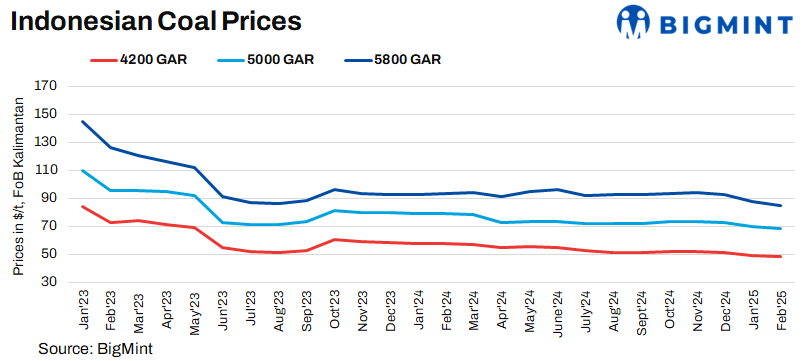
Globally, Indonesian coal prices have shown mixed trends. High-CV 5800 GAR coal fell by $1.66/t, now priced at $82.91/t, while mid-CV 4200 GAR coal saw a slight increase of $0.48/t reaching $48.17/t. Meanwhile, low-CV 3400 GAR coal prices rose by $0.11/t, now at $29.61 per tonne. All prices are free-on-board (FOB).
Outlook – The moderate increase in coal prices at Indian ports can largely be attributed to a rise in demand from the power sector and the subsequent replenishment of coal inventories. However, the mixed price trends across different grades suggest that market conditions remain dynamic both locally and globally.
As per media reports, the government is unlikely to mandate imported coal blending for thermal power plants this summer, unlike previous years, due to sufficient coal stocks, lasting 21 days. This marks the first time in over three years that such a directive may not be issued. If announced, this may govern imported coal price dynamics in the near term.
Leave a Reply