- Lower Chinese, Indian demand impact coal exports
- Progressive hike in coal royalties to impact mining sector
- HBA switch over for exports meets with stiff resistance from China
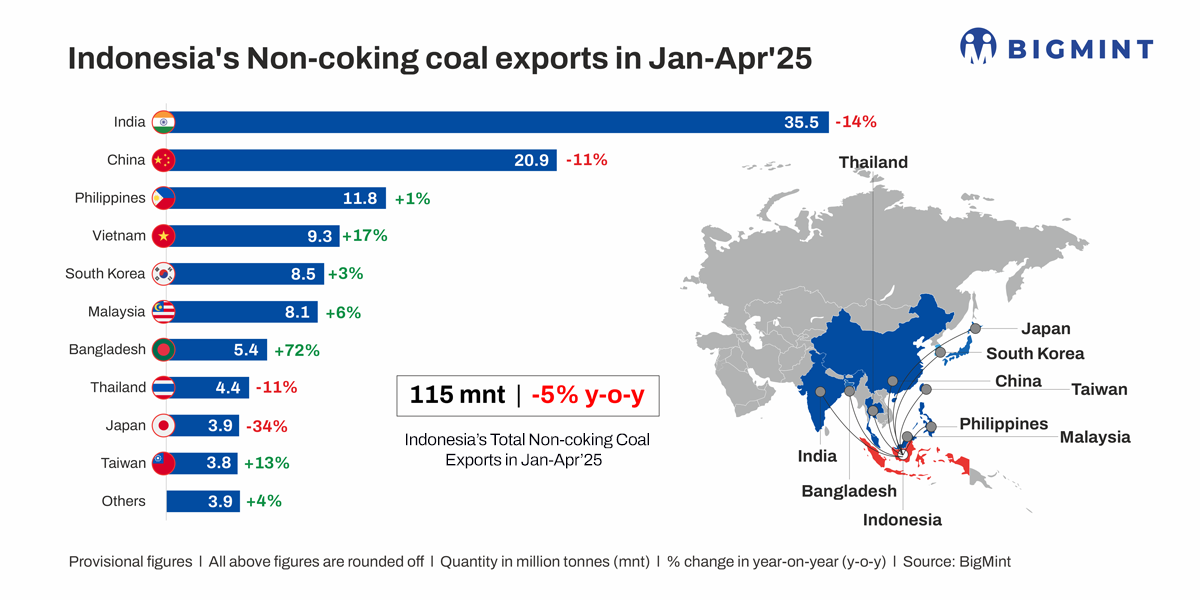
Morning Brief: Indonesian coal exports decreased by 5% y-o-y in January-April 2025 to 115 million tonnes (mnt) compared with 121 mnt in the corresponding period of last year, as per provisional data with BigMint. The country exported 565 mnt of coal in CY’24, an increase of 8% from 524 mnt recorded in CY’23.
Alongside the decline in imports by India and China, the top buyers of Indonesian thermal coal, Indonesian coal production fell by over 2% y-o-y in January-April, as per data.
Why coal exports dropped in Jan-Apr’25?
*Lower demand in China, India: Growth in domestic production in both China and India reduced the demand for coal imports. Beijing’s greater emphasis on boosting local coal mine output, alongside ongoing efforts to reduce air pollution, have been the key drivers behind China’s reduced import appetite, observed a recent media report. Coal production in India increased by 5% y-o-y in FY’25. Therefore, reliance on Indonesian coal decreased. Exports to India fell by nearly 15% y-o-y in January-April.
*Stagnant Asian demand amid China headwinds: Data from sector-based market intelligence companies show that Asian thermal coal demand dropped 3% y-o-y in January-March. Barring Vietnam and Bangladesh, the other Asian countries witnessed a marginal decline in coal usage amid the clean energy transition, as well as the knock-on effect of the gradual slowdown in the Chinese economy, particularly in sectors such as construction, housing and allied industrial activities, which impacted industrial momentum in the neighbouring Asian economies and also coal use.
*Surging royalties may pressure coal production: The Indonesian government Regulations No. 18/2025 and No. 19/2025 on increasing mineral and coal royalties involve adjusting royalties according to license types. Royalties for Mining Business Permits (IUP) have been increased, whereas rates for Coal Contract of Work (PKP2B) and Special Mining Business Permits (IUPK) have been lowered. Experts believe that the new progressive royalty regime on coal and other key minerals such as nickel has been introduced partly to plug the funding deficit restricting renewable energy deployment as per Indonesia’s Nationally Determined Contribution (NDC).

Coal production fell marginally in January-April. However, the Ministry of Energy and Mineral Resources (ESDM) of Indonesia has set a production target of 900 mnt in 2025. Notably, last year Indonesia surpassed the production target by a considerable margin, with total coal output reaching 835 mnt.
*HBA policy tweak and its impact: Starting 1 March, the Indonesian government mandated the use of the Harga Batubara Acuan (HBA), a coal reference price set by the ESDM, for all coal exporters. This policy aimed to strengthen Indonesia’s sovereignty in determining coal prices globally but the fear of a surge in prices has influenced market sentiments.
Both the Indonesian Coal Mining Association and Chinese market sources have divulged to the news media that traders are still following the ICI instead of the HBA after nearly three months of the government’s 1 March mandate.
The impact on existing contracts and the apprehension of a price surge after shift to HBA-determined export pricing have impacted coal export market sentiments.
Outlook
Indonesia’s National Medium Term Development Plan (RPJMN 2025-2029) allows for 700 mnt of coal production annually. The country is producing much higher than that. The government wants to derive benefits from this surplus growth by means of higher royalties. However, a surge in export prices will definitely erode Indonesia’s competitiveness in the global coal market.
Leave a Reply