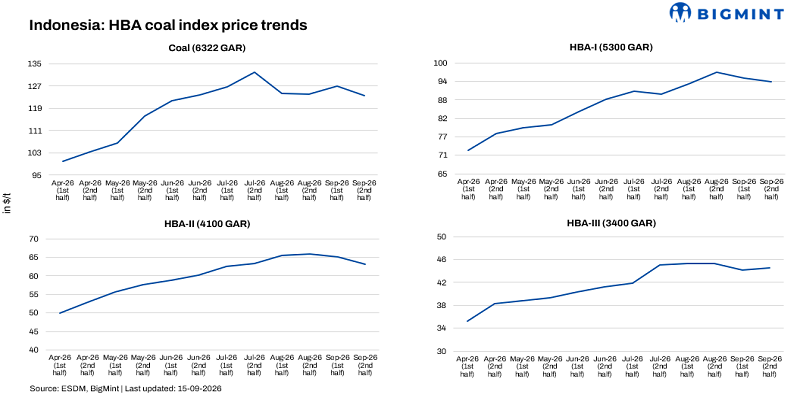
- Softer Asian demand, improving Indonesian supply pressuring HBA prices
- Tight Indian coal stocks and firm power demand are limiting downside
Indonesia’s thermal coal reference prices declined across most grades in the second half of September 2026, indicating a moderation in seaborne coal fundamentals after the firming seen earlier in the month. The correction was led by high-CV and lower-CV benchmarks amid softer buying interest and easing supply-side tightness.
High-CV benchmark retreats as Asian buying moderates
Indonesia’s 6,322 kcal/kg GAR HBA declined 2.6% to $123.54/t in H2 September, from $126.87/t in H1 September. The fall followed the earlier increase in H1 September, when the benchmark had risen 2.3% from H2 August.
The decline reflects less aggressive spot buying, improved availability of competing seaborne coal and reduced upward momentum in regional thermal coal prices. While Asian power-sector demand remains supportive, buyers have become more price-sensitive following the recent rally.
Mid-CV prices correct on demand-side caution
The 5,300 kcal/kg GAR HBA-I fell 1.2% to $93.94/t from H1 September.
The correction reflects cautious procurement by major Asian buyers, particularly amid elevated delivered coal costs and adequate near-term inventories among some utilities. The market has also been adjusting to the possibility of increased Indonesian availability as mining and logistics conditions improve.
Lower-CV grades face broader downward pressure
The 4,100 kcal/kg GAR HBA-II declined 2.9% to $63.17/t, while the 3,400 kcal/kg GAR HBA-III was comparatively stable, easing only 0.9% to $44.53/t.
The sharper correction in HBA-II indicates greater sensitivity to weakening demand for lower-CV thermal coal and competition from alternative origins, while the marginal movement in HBA-III suggests relatively better resilience in the low-CV segment.
Key factors behind HBA correction
- Softer Chinese spot demand: Buyers have remained cautious amid adequate domestic coal availability and subdued procurement urgency.
- Price-sensitive Indian buying: Elevated Indonesian coal prices have encouraged Indian utilities and industrial consumers to adopt a largely need-based purchasing strategy.
- Competition from alternative origins: Russian, South African and Australian coal have limited Indonesia’s pricing leverage in some Asian markets.
- Correction in regional benchmarks: The HBA methodology remains influenced by broader seaborne coal market movements, making the recent easing in regional prices a key factor.
- High replacement costs limiting demand: Although Indian power-plant stocks remain under pressure, high imported-coal replacement costs have restrained aggressive restocking. India still had 59 coal-fired plants at critically low stock levels as of September 9, highlighting the underlying demand support.
Outlook
The Indonesian HBA is likely to remain under moderate downward pressure in the near term, although a sharp correction appears unlikely. Seasonal Asian power demand, tight Indian domestic coal availability and elevated power-sector consumption could provide a floor to seaborne coal prices. India’s power demand recently exceeded 260 GW amid elevated temperatures, supporting continued coal consumption.
However, sluggish Chinese buying, improving Indonesian supply availability and increased buyer resistance at elevated price levels could cap further gains. Consequently, the market is likely to remain range-bound to moderately bearish in the short term, with high-CV grades potentially more volatile than lower-CV benchmarks.
Leave a Reply