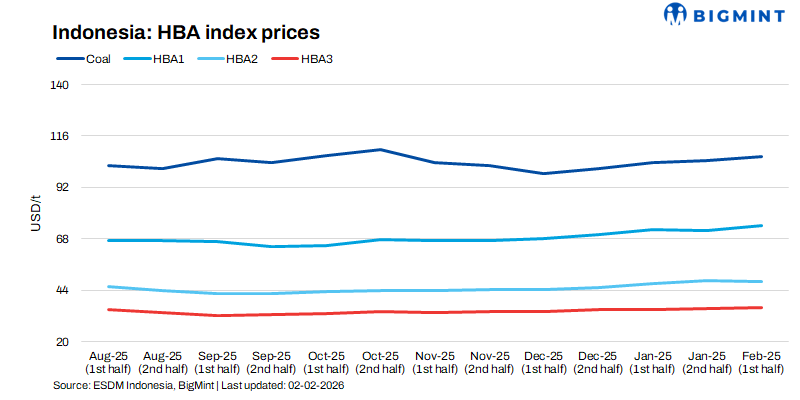
- ESDM raises benchmark prices of all grades except HBA-II
- Strong utility demand supports higher-grade coal prices
Indonesia’s Ministry of Energy and Mineral Resources (ESDM) has announced revised thermal coal benchmark prices (HBA) for the first half of February 2026, raising all but HBA-II. The adjustments reflect differentiated demand trends across calorific segments, influenced by utility procurement activity, regional buying patterns, and cost considerations.
High-calorific value coal: Utility-led price strength
High-calorific value thermal coal benchmarks recorded a notable upward movement during the period. The 6,322 kcal/kg GAR HBA rose by 1.7% compared with the second half of January, reaching $106.1/t.
This increase was primarily supported by stronger import demand from major Asian power utilities, as buyers accelerated procurement to replenish inventories ahead of anticipated demand fluctuations and potential supply-side uncertainties. Stable generation requirements and the preference for higher efficiency coal further underpinned price strength in this segment.
Mid-calorific value coal: Sustained regional demand
Mid-calorific value coal prices also registered firm gains. The 5,300 kcal/kg GAR (HBA-I) benchmark increased by 3.3% to $74/t.
Price support stemmed from consistent buying interest across Southeast Asia, where utilities and industrial consumers continued to favour mid-CV coal for its cost-effectiveness and operational flexibility. This segment remained resilient amid volatile freights and gradual shifts in energy transition policies, reinforcing its position as a balanced fuel option.
Low-calorific value coal: Cost considerations drive stability
Lower-grade coal benchmarks displayed mixed but broadly stable trends. The 4,100 kcal/kg GAR (HBA-II) index remained unchanged at $48.2/t, while the 3,400 kcal/kg GAR (HBA-III) benchmark edged up by 1.3% to $35.8/t.
Demand for low-CV coal was largely driven by price-sensitive markets, where affordability continues to outweigh calorific efficiency. Steady offtake from these regions provided sufficient support to prevent downside pressure, despite broader uncertainties in the thermal coal market.
Outlook
Thermal coal prices are expected to remain largely stable, supported by utility demand for high-CV coal and steady buying of cost-efficient mid-CV grades, while low-CV coal prices are likely to stay stable with limited upside.
Leave a Reply