- High-calorific coal gains on demand for higher efficiency
- Mid-, low-grade tags hit 6-month low amid demand slump
The Indonesian Ministry of Energy and Mineral Resources (ESDM) has released its revised Harga Batubara Acuan (HBA) for the first half of September 2025, revealing contrasting movements across thermal coal grades.
The update reflects regional demand shifts, inventory dynamics, and evolving buyer preferences, providing critical guidance for both domestic and international stakeholders.
High-calorific coal strengthens on demand for higher efficiency
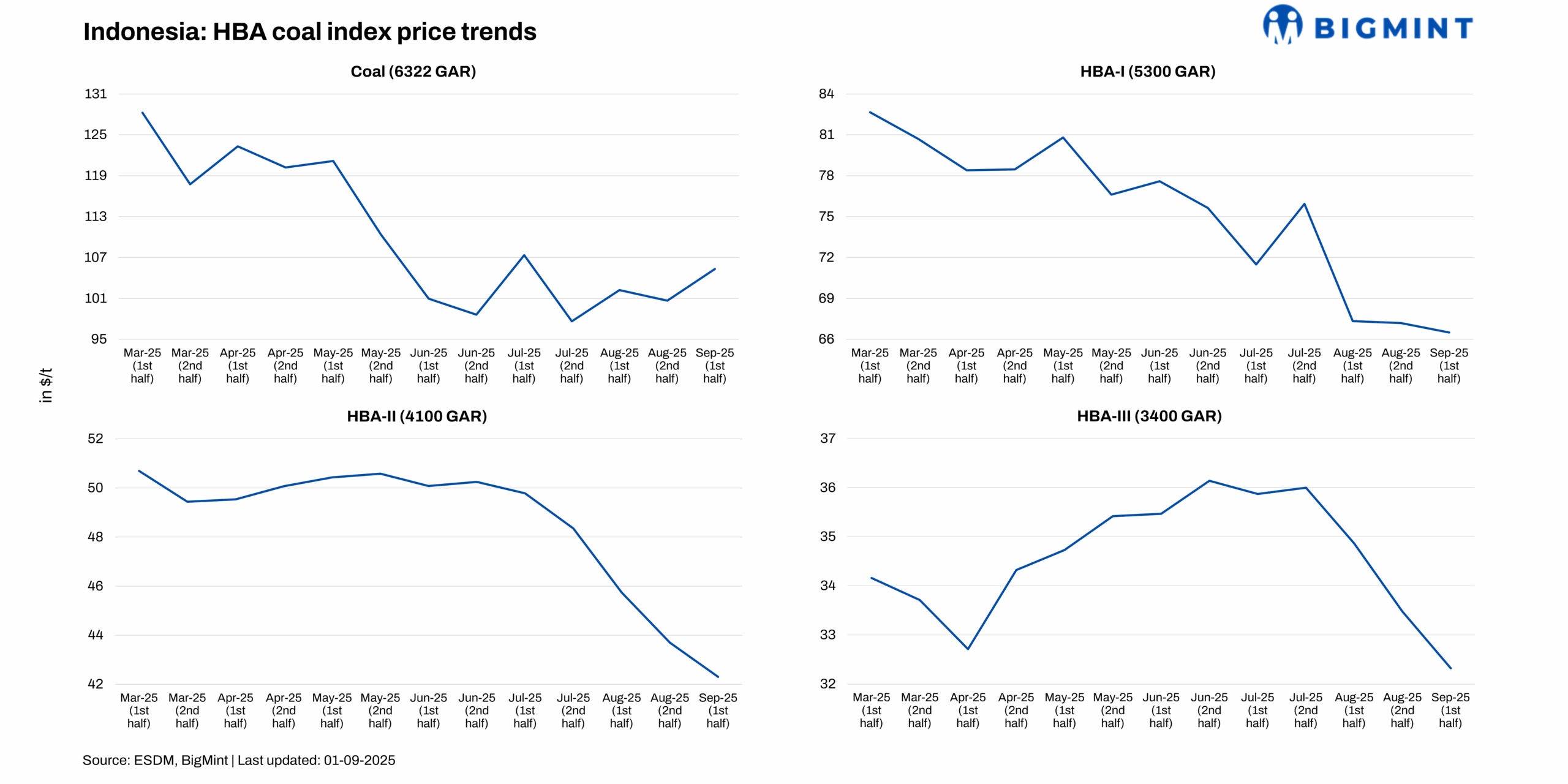
Indonesia’s high-grade thermal coal (6,322 kcal/kg GAR) prices rose 4.6% to $105.33/t compared to the second half of August, supported by strong demand for efficiency and lower emissions, boosting producer margins in environmentally conscious markets.
Mid-calorific coal weakens to 6-month low
The benchmark price for mid-range coal (5,300 kcal/kg GAR, HBA-I) fell 1.04% to $66.50/t compared to the second half of August. This marks the lowest since March 2025, with weak Asian power demand, high inventories, and seasonal slowdowns prompting cautious utility procurement.
Low-calorific coal continues downtrend
Lower-grade coal prices continued to slide, with HBA-II (4,100 kcal/kg GAR) down 3.2% to $42.30/t and HBA-III (3,400 kcal/kg GAR) down 3.5% to $32.32/t as compared to the second half of August, both at their lowest since March 2025 amid weak industrial demand and cautious utility buying.
Industry perspective
The HBA revision reflects the Indonesian government’s push for transparent, market-aligned pricing, with miners optimistic on high-calorific coal profitability, while utilities and buyers remain cautious over rising costs and margin pressures.
Outlook
The revised benchmarks will guide September 2025 trade, with producers benefiting if global demand holds, while buyers may seek alternatives or renegotiations to manage costs, intensifying short-term competition and price sensitivity.
Leave a Reply