- Indonesian HBA benchmarks rise as Asian demand strengthens
- Low and mid-CV coal outperform on cost competitiveness
Indonesia’s Ministry of Energy and Mineral Resources (ESDM) has revised its thermal coal benchmark prices (HBA) for the first half of January 2026, indicating a firm upward trend across all calorific value segments. The revision reflects improving regional demand, particularly from Asia, alongside cautious supply behaviour from Indonesian miners.
High-CV coal: Utility demand drives gains
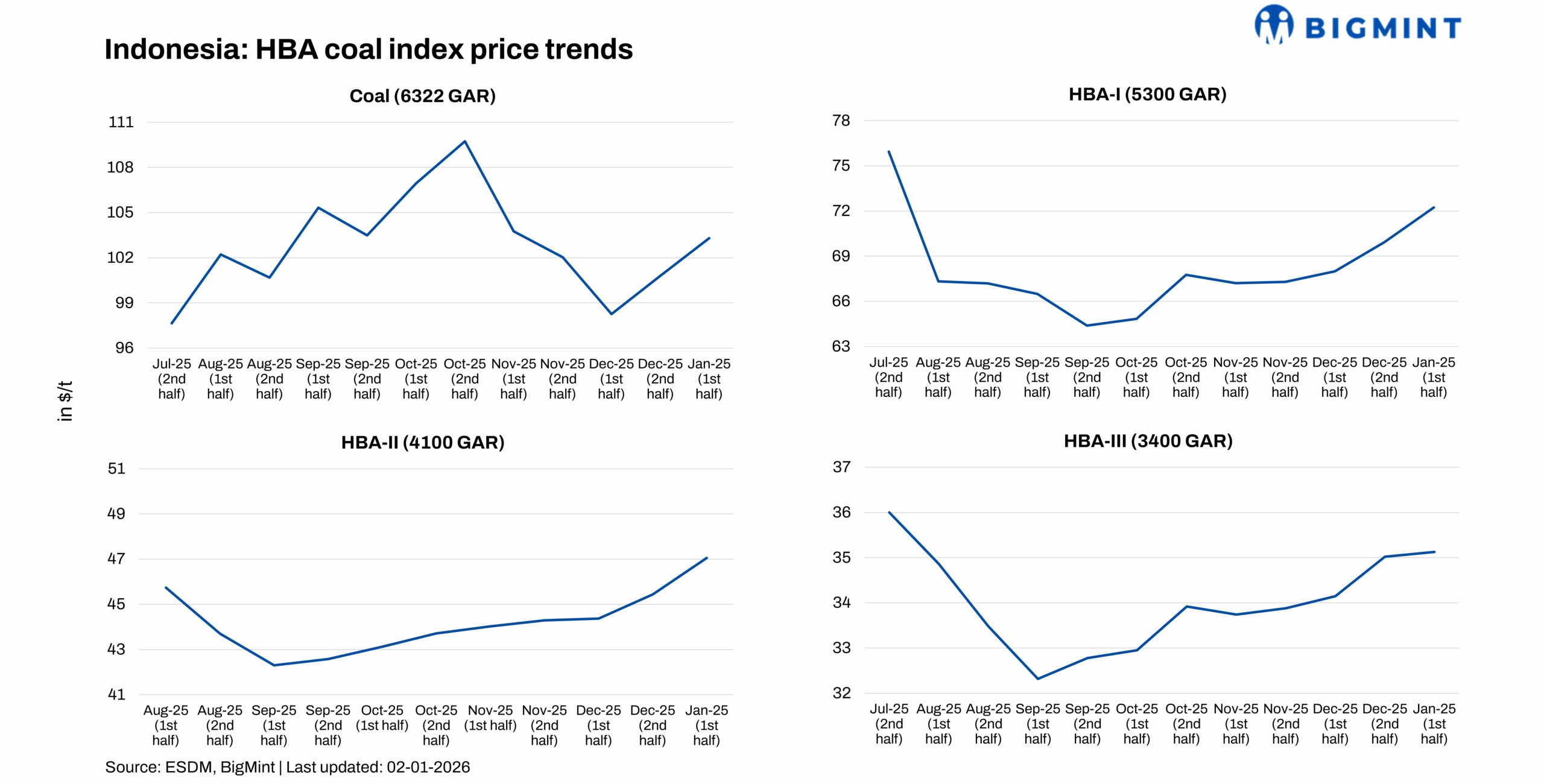
High-calorific value thermal coal prices recorded a notable rise during the period. The 6,322 kcal/kg GAR benchmark increased by 2.5% from the second half of December to $103.3/t. The uptick was mainly due to stronger import appetite from major Asian power utilities, as buyers stepped up procurement to rebuild inventories.
Mid-CV coal: Resilient regional buying
Mid-calorific value coal also posted firm gains. The 5,300 kcal/kg GAR (HBA-I) index rose 3.3% to $72.23/t, reflecting sustained demand from Southeast Asian buyers. This segment continued to benefit from its cost-efficiency and balanced performance, making it a preferred choice for utilities and industrial users navigating volatile freight rates and evolving energy transition policies.
Low-CV coal: Cost advantage supports prices
Lower-grade coal benchmarks extended their upward momentum. HBA-II (4,100 kcal/kg GAR) surged 3.5% to $47.05/t, marking a six-month high, supported by flexible consumption patterns among small and mid-sized industrial users. Meanwhile, HBA-III (3,400 kcal/kg GAR) edged up 0.3% to $35.13/t, indicating steady demand from price-sensitive markets prioritising affordability over calorific efficiency.
Outlook
Indonesian thermal coal prices are expected to remain firm in the near term, supported by steady Asian utility demand and cautious miner selling. However, upside may be limited if post-restocking demand softens or global power generation growth slows, with mid- and low-CV grades remaining relatively well supported due to cost competitiveness.
Leave a Reply