- India’s imports rise 6%, feed industrial demand
- Exports dip amid reduced demand, port congestion
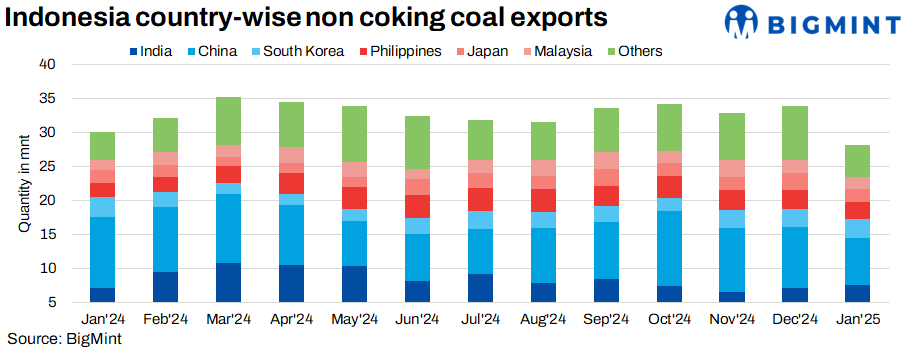
In January 2025, Indonesia’s non-coking coal exports saw a significant 17% m-o-m decline, dropping to 28.18 million tonnes (mnt) from 33.92 mnt in December 2024. This decrease was driven by a combination of fluctuating global demand, logistical challenges, and weather disruptions.
Key Asian markets
India, the leading importer of Indonesian non-coking coal, saw a 6% increase to 7.50 mnt in January, up from 7.09 mnt in December. This growth reflects India’s ongoing reliance on coal to meet the demands of its expanding energy and industrial sectors.
Conversely, China, the second-largest importer, experienced a 23% drop in imports to 6.87 mnt in January from 8.93 mnt in December. This decline is attributed to weaker domestic demand and a shift in China’s energy strategy, including increased use of renewables and greater domestic coal production.
South Korea, the third-largest importer, saw a 7% m-o-m increase Indonesian coal imports to 2.92 mnt in January, driven by solid demand for coal in its energy and industrial sectors. Meanwhile, the Philippines recorded an 11% m-o-m decrease, with imports totalling 2.43 mnt in January, reflecting economic slowdowns and reduced industrial activity. Japan’s imports dropped by 21%, falling to 1.93 mnt from 2.44 mnt in December, largely due to a shift towards alternative energy and declining coal use in industry. Similarly, Malaysia’s imports fell 10% to 1.78 mnt, driven by lower regional demand.
Indonesia’s regional performance
East Kalimantan remained Indonesia’s leading coal-exporting region, with 12.77 mnt of exports in January, though this represented a 22% decrease from 16.41 mnt in December. The decline is attributed to lower demand from key markets and temporary regional logistical challenges. South Kalimantan, the second-largest exporter, saw a 10% m-o-m drop, with exports totalling 9.45 mnt. The overall downtrend reflected similar factors affecting overall export volumes, including port congestion and reduced demand.
Exports from Sumatra and North Kalimantan also decreased, with Sumatra’s shipments at 4.70 mnt (a 16% m-o-m decline) and North Kalimantan contributing 1.25 mnt (a 14% m-o-m drop).
Leave a Reply