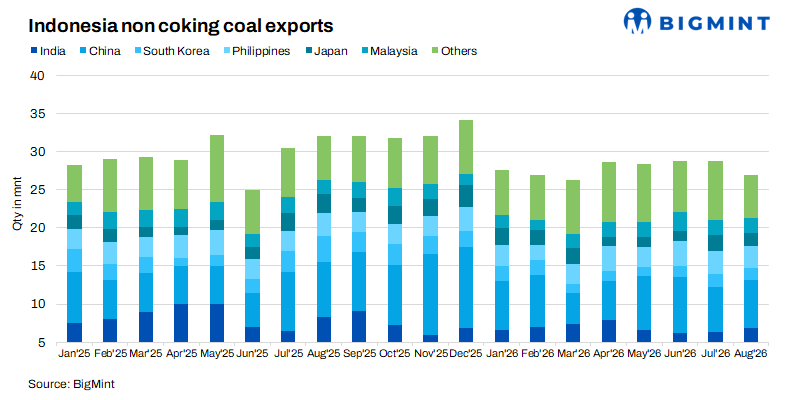
- Tighter production quotas, stricter export oversight prompt drop
- India cuts purchases sharply, China, Vietnam absorb more in Jan-Aug
Indonesia’s non-coking coal exports fell sharply in August 2026, extending a year-to-date decline as tighter production controls and increasingly stringent export oversight constrain the world’s largest seaborne thermal coal supplier.
Exports stood at 26.95 mnt in August, down 16.1% from 32.11 mnt in August 2025 and 5.7% from 28.59 mnt in July.
Volumes had remained relatively stable around 28-29 mnt/month between April and July before weakening in August.
The decline, however, should not be read simply as evidence of weaker Asian coal demand.
Indonesia has deliberately tightened its coal supply framework in 2026. The government reduced miners’ approved RKAB production plans to bring output more closely into line with demand and prevent oversupply, explicitly linking the policy to maintaining commodity prices.
At the same time, Jakarta has strengthened control over coal exports. New regulations introduced from June form part of a transition towards a centralised state-controlled export mechanism for strategic commodities including coal, alongside stricter exporter registration, surveyor verification and traceability requirements.
The result is an Indonesian coal market that is tighter than the export numbers alone suggest.
August shipments ease across major buyers
India remained Indonesia’s largest non-coking coal destination in August at 6.86 mnt, but shipments were down about 18% from 8.34 mnt a year earlier.
China received 6.33 mnt, around 12% below 7.19 mnt in August 2025.
South Korea recorded an even sharper decline to 1.50 mnt from 3.37 mnt, while Japanese shipments fell to 1.66 mnt from 2.49 mnt.
Vietnam again stood out on the upside, with shipments rising to 1.60 mnt from 1.04 mnt, while Malaysia increased modestly to 2.03 mnt. The Philippines remained comparatively stable at 2.91 mnt versus 3.07 mnt.
The destination mix therefore suggests Indonesian sellers are continuing to redistribute available tonnes between markets rather than experiencing a uniform collapse in demand.
Lower Kalimantan loadings account for Aug weakness
The regional loading data provide further evidence of tightening supply.
East Kalimantan exports fell to 11.74 mnt in August from 15.09 mnt a year earlier, a decline of about 22%.
South Kalimantan shipments eased to 9.56 mnt from 11.06 mnt, while North Kalimantan dropped to 0.62 mnt from 1.02 mnt.
Sumatra was the exception, with exports slightly higher at 5.03 mnt versus 4.95 mnt.
The August reduction was therefore overwhelmingly concentrated in Kalimantan, which remains the core of Indonesia’s seaborne coal supply.
This coincides with a much tighter pricing environment. Indonesia’s official benchmark for 6,322 GAR coal stood at $124.44/t in the first half of August, around 21% higher than a year earlier. Prices for the 5,300 GAR and 4,100 GAR reference grades also increased from the second half of July.
Jan-Aug exports down 5.4%, but India explains much of decline
Across January-August, Indonesia exported 222.07 mnt of non-coking coal, down 12.63 mnt or 5.4% from 234.70 mnt during the corresponding period of 2025.
But the country-level changes are highly uneven.

The most important change is India.
Its Indonesian purchases fell by 11.14 mnt, equivalent to almost 88% of Indonesia’s overall January-August export reduction.
But this does not necessarily indicate a comparable fall in underlying Indian coal requirements.
India entered FY’27 with very large domestic coal inventories and has been aggressively drawing down producer stocks. Domestic coal availability also allowed Indian power generators to reduce reliance on imported material: government data show thermal power-sector coal imports fell 27.4% in FY’26, while imports by power plants declined another 24.9% y-o-y in April 2026.
Higher seaborne prices therefore gave Indian buyers an additional incentive to maximise domestic coal use.
China, Vietnam absorb displaced tonnes
China presents a very different picture.
Despite the weaker August comparison, China’s January-August purchases of Indonesian non-coking coal increased 5.9% to 48.86 mnt.
Vietnam increased imports even more strongly, up 20.7% to 17.73 mnt, while Japan was broadly unchanged.
China and Vietnam therefore absorbed almost 5.8 mnt more Indonesian coal than during January-August last year, offsetting part of the reduction from India, South Korea and Taiwan.
This redistribution is important because it shows Indonesia has been able to maintain competition for a smaller pool of export tonnes even as individual buyers respond differently to higher prices.
For the remainder of 2026, the key question may therefore not be whether Indonesian demand recovers, but how much coal Jakarta allows producers to bring to market and how aggressively major buyers respond to the resulting price signals.
Leave a Reply