- Warning comes as export, domestic prices gap widens
- Miners asked to lift domestic share to at least 30% from 2026
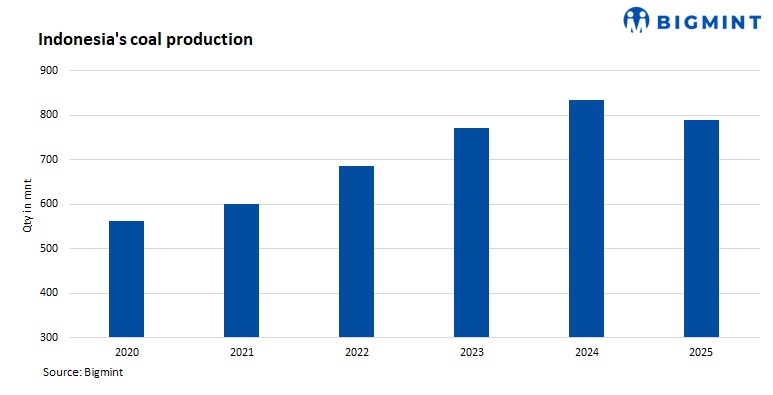
Indonesia is considering barring coal producers that fail to meet annual domestic supply obligations from operating the following year, Mysteel Global has learnt. The proposal adds fresh risk to shipments from the world’s largest thermal coal exporter while output curbs and dry rivers in the country are already keeping supply tight.
Asep Kurnia Permana, director of coal business development at the Energy and Mineral Resources Ministry (ESDM), said at an industry discussion in Jakarta on 18 September that non-compliant firms would have their annual work plan and budget, or RKAB, withheld, several local media reported.
Penalties already in place for non-compliance run from a fine to an export ban, then suspension of mining for up to 60 days, and revocation of the licence, an ESDM official said.
The warning from Jakarta comes in the context of the widening gap between seaborne prices and the $70/tonne (t) ceiling on domestic sales of 6,322 kcal/kg NAR benchmark coal to power plants and $90/t to cement and fertiliser makers; according to Indonesia’s HBA pricing system, exports were mostly recently priced at $123.54/t, as reported. With exports being far more profitable, producers have had little incentive to supply locally.
In terms of volume, the Indonesian government had previously demanded that coal miners supply at least 25% of their annual production plan to domestic users, but from the start of 2026, the ESDM asked large mining companies to lift the proportion to at least 30% if they wanted to have their RKAB plans approved without reduction.
Right now, the granting of RKAB approvals for the current year is progressing but only slowly. The ESDM is still reviewing revised 2026 RKAB applications from about 50 companies, Director General Tri Winarno said, prioritising those filed before a 31 July deadline.
Three subsidiaries of the country’s key producer Bayan Resources — PT Tiwa Abadi, PT Tanur Jaya and PT Fajar Sakti Prima — were granted an extra 15-20 million tonnes in total on 21 September, more than a week after the company had declared force majeure because the revisions had not been issued, as reported. Bayan produced 68 million tonnes in 2025, slightly below its 2025 target of 69-72 million tonnes.
Barge transport during the current drought is another constraint. An El Nino-driven dry spell has left parts of Central Kalimantan’s Barito River unnavigable, with depths on the middle and lower reaching only 3-4 metres, against the roughly 6.5-metre draft of standard 7,500-10,000 tonne barges.
Producers have cut loads to 7,500 tonnes and in places, to 3,000-4,000 tonnes, a reduction that can double per-tonne barging costs, Mysteel Global notes. A miner on East Kalimantan’s Mahakam River is barging at about 60% of capacity, and the Indonesian Employers Association reckons low water on the Barito alone disrupts some 3.9 million tonnes a month.
Mysteel reported that Indonesian 3,800 kcal/kg NAR thermal coal was still offered at $79-81/tonne FOB Kalimantan for Panamax cargoes as of Monday, up from $69-71/t in late August. Currently, Indonesian sellers are holding prices firm, while Chinese buyers are only seeking small volumes with aggressive bids.
On 21 September, Mysteel Global learned that the lowest utility bid for that grade was at RMB 657/tonne ($98/t) CFR South China with VAT, against about RMB 722/t for domestic coal of the same heat value delivered from North China. Such an arbitrage window is still unable to fuel strong import movements though.
Note: The article is published as part of a content sharing agreement between Mysteel Global and BigMint.
Leave a Reply