- High-CV coal weakens, lower grades show resilience
- Outlook stable amid moderate price adjustments
The Indonesian Ministry of Energy and Mineral Resources (ESDM) has announced its revised Harga Batubara Acuan (HBA) — the country’s benchmark thermal coal price index — for the first half of November 2025. The latest update reflects mixed market sentiment, driven by softening global demand and shifting regional supply dynamics.
Overall, the coal market displayed a cautious tone. While high-grade coal prices weakened on the back of subdued import demand from major Asian buyers, mid- and low-grade segments showed relative resilience, supported by stable domestic power sector needs and limited export disruptions.
High-CV coal prices decline
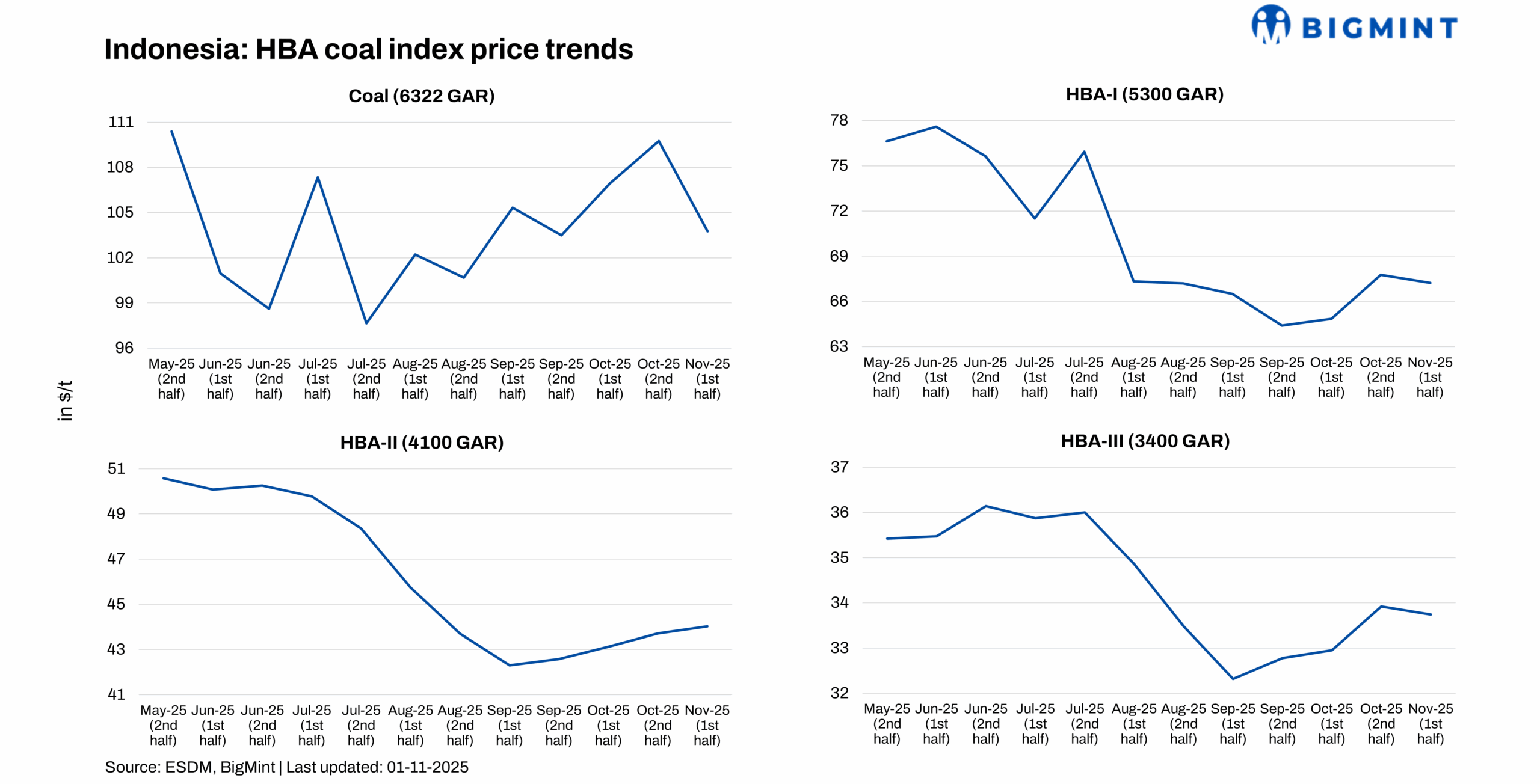
High-calorific value (CV) thermal coal prices (6,322 kcal/kg GAR) fell by 5.5% to $103.75/t from the second half of October.
The fall reflects weak buying interest. High-CV thermal coal is a high-efficiency fuel that generates lower emissions per unit of energy, a factor increasingly valued by environmentally conscious markets.
Mid-CV coal prices dip
Prices of mid-CV thermal coal (5,300 kcal/kg GAR, HBA-I) edged down by 0.8% to $67.22/t compared to the second half of October.
The minor adjustment indicates a relatively balanced sentiment, with stable transactions and cautious optimism prevailing among producers and buyers. Additionally, this modest drop highlights slightly weak electricity demand across Asia, where utilities are securing stable mid-grade supply for power generation.
Low-CV coal shows mixed trends
Among lower-grade thermal coal, HBA-II (4,100 kcal/kg GAR) increased by 0.7% to $44.02/t, while HBA-III (3,400 kcal/kg GAR) slipped 0.5% to $33.74/t.
The divergence reflects contrasting demand patterns — Southeast Asian power plants sought cheaper grades to offset rising fuel costs, while weaker demand from smaller industrial buyers prevented gains at the lower end.
Outlook
The HBA revision for early November 2025 highlights a period of price adjustment rather than sharp volatility. With moderate shifts across all grades, the coal market appears to be entering a stable phase, guided by consistent regulatory oversight.
Leave a Reply