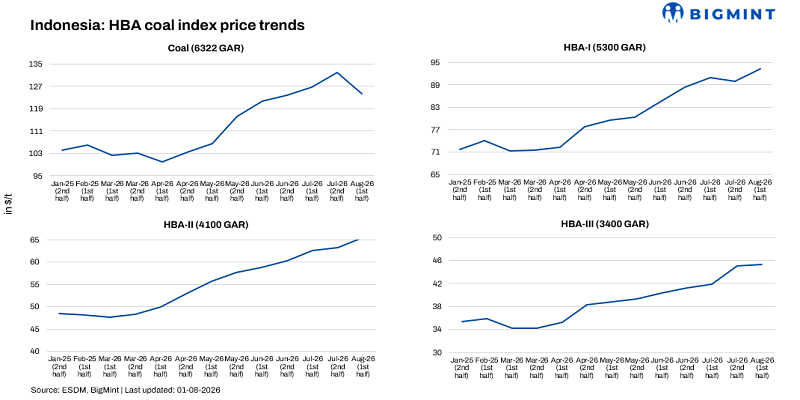
- High-CV prices decline 6% amid profit-taking, weaker spot buying
- Rally in lower-CV prices continues, driven by robust blending demand
Indonesia’s Harga Batubara Acuan (HBA) thermal coal benchmarks showed mixed movements for the first half of August 2026, reflecting shifting market fundamentals across calorific value (CV) segments.
The benchmark 6,322 kcal/kg GAR coal price declined by 6% to $124.44/t from the second half of July, registering its first decline since April 2026. The correction, which followed an extended price rally, was primarily driven by subdued spot buying from key importing countries, adequate inventories among utilities, and profit-booking by market participants. Despite the decline, prices remained historically elevated, supported by persistent supply-side concerns in Indonesia.
Mid-CV coal recovers on improved buying interest
The HBA-I (5,300 kcal/kg GAR) benchmark rose 4% to $93.27/t, reversing the previous decline in the second half of July. The increase was supported by improved procurement from price-sensitive Asian buyers seeking a balance between fuel efficiency and cost, while relatively tighter availability of mid-CV cargoes also contributed to firmer pricing.
Lower-CV coal extends record rally on blending demand
Lower-calorific coal continued to outperform the broader market. The HBA-II (4,100 kcal/kg GAR) benchmark increased by nearly 4% to $65.48/t, while HBA-III (3,400 kcal/kg GAR) edged up 0.4% to $45.27/t, with both benchmarks reaching fresh record highs. Continued demand for economical blending coal from emerging Asian markets, coupled with its cost advantage over higher-grade material, remained the key driver behind the sustained strength in lower-CV prices.
Earlier export reform signals structural market shift
Market sentiment was further influenced by Indonesia’s decision to fully implement its single-gate coal export mechanism from 1 September 2026, around four months earlier than previously expected. The new framework is expected to strengthen regulatory oversight and centralise export transactions, potentially improving pricing discipline and reducing aggressive discounting. The earlier implementation has prompted both exporters and buyers to reassess procurement and marketing strategies, adding uncertainty to near-term supply availability.
Supply constraints continue to support prices
Despite relatively subdued buying activity, supply-side risks continued to provide underlying support to the Indonesian coal market. Below-normal rainfall across Kalimantan and Sumatra has lowered river water levels, raising the risk of disruptions to barge transportation from inland mines to export terminals during the dry season. Additionally, ongoing uncertainty surrounding production quota implementation and cautious selling by miners have limited spot cargo availability, preventing a sharper decline in benchmark prices.
Outlook
Indonesia’s thermal coal market is expected to remain stable to firm in the first half of August. Supply-side risks, including dry-season logistics disruptions and the implementation of the single-gate export mechanism, are likely to support prices despite subdued spot buying. However, any improvement in export availability or weaker regional demand, particularly from China, could limit further price gains, while lower-CV coal is expected to remain relatively resilient on sustained blending demand.

Leave a Reply