- Full implementation comes around 4 months earlier than previously planned
- Stricter pricing oversight may support Indonesian coal prices
Indonesia’s single-gate coal export mechanism will be fully implemented on 1 September, President Prabowo Subianto confirmed on Monday, about four months earlier than previously planned. Market sources noted that the earlier introduction could reshape pricing and supply dynamics for the world’s largest seaborne thermal coal supplier.
Speaking at a cabinet meeting on 20 July, Prabowo said state-owned PT Danantara Sumberdaya Indonesia (DSI) had already processed over $10.5 billion in export proceeds since beginning operations on 1 July. The pricing gap between Indonesian declared export prices and international spot levels had narrowed from an estimated 30-45% range to near convergence, he claimed. Companies that fail to comply with the new system face license revocation, he warned, as CNBC Indonesia reported.
DSI was established on 20 May as the exclusive export intermediary for three strategic commodities: coal, crude palm oil, and ferro alloys. The company centralises contract negotiation, customs clearance, shipping documentation and forex settlement — functions previously handled by individual mining companies in direct deals with overseas buyers, Mysteel Global learns.
Earlier during a speech to parliament on 20 May, Prabowo had said that between 1991 and 2024, under-invoicing, transfer pricing, and capital flight in commodity trade had cost Indonesia an estimated $908 billion in lost state revenue.
Presently, under the transition period through until 31 August, private exporters can continue dealing directly with overseas customers but must submit all contracts, pricing and financial data to DSI’s electronic platform in real time. From 1 September, DSI will assume full control — purchasing cargoes from domestic producers, managing inventory, bearing trade risk and selling to international buyers. All export proceeds must be repatriated, according to the regulation.
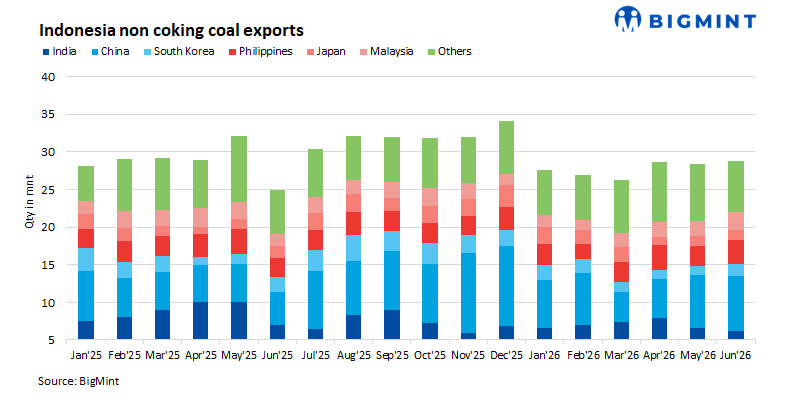
Indonesia, the world’s largest thermal coal exporter, shipped 231 million tonnes (mnt) of coal in the first half of 2026, equivalent to around 63% of its total production of 367 mnt during the period, according to the Ministry of Energy and Mineral Resources.
China remained by far the largest buyer, importing 87 mnt, followed by India at 43 mnt, and the Philippines at 19 mnt.
A Jakarta-based coal trader said the less-than-two-month runway to 1 September left limited room for debugging. “DSI is still building its reporting system and port clearance procedures. If there are teething problems in September, you could see one to two weeks of shipment delays at Kalimantan load ports,” the trader said.
On the pricing front, Indonesia’s Ministry of Energy and Mineral Resources (ESDM) has been investigating price discrepancies in the coal export chain since mid-July, local media Bloomberg Technoz reported. Traders said the probe could push declared export values closer to prevailing spot levels, narrowing the arbitrage that some buyers have relied on. However, how DSI will price coal across a wide quality spectrum — from 6,200 kcal/kg GAR down to 4,200 kcal/kg GAR — remains unclear, sources noted.
Mining industry groups have questioned DSI’s capacity to manage the complexity and volume of Indonesia’s coal export business. Prabowo dismissed the criticism in his cabinet remarks. “I don’t care who you are. We will revoke all permits of those who refuse to comply with the law,” he said.
For Chinese coastal utilities, the next two months will be closely watched. The key questions are whether DSI can complete a smooth operational handover and whether the new export channel will command a meaningful price premium. The answers will likely shape Asian thermal coal trade flows for the remainder of 2026, market sources said.
Note: This article is published as part of a content exchange agreement between Mysteel and BigMint.
Leave a Reply