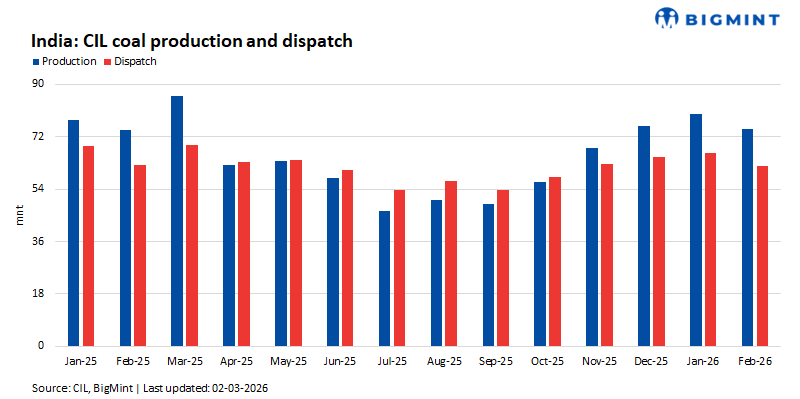
- Coal stocks at mine pitheads surge as production outpaces demand
- Auction bidding remains largely unchanged amid comfortable supply
India has traditionally been one of the largest importers of thermal coal. However, the country’s demand for seaborne coal has remained surprisingly muted in recent weeks despite rising international prices.
The reason lies in the rapid expansion of domestic coal supply.
Coal India Ltd (CIL), the country’s largest coal producer, has significantly increased production and dispatch volumes in recent years. The company is currently pushing aggressively to meet its annual targets, resulting in a build-up of coal inventories across the supply chain.
Domestic stocks are rising
Coal stocks at mine pitheads have climbed sharply as production has outpaced immediate consumption demand. Coal India pithead stocks stood at around 106 million tonnes (mnt) in March 2025 as compared to an estimated 140-150 mnt by March 2026. This substantial inventory buffer has enabled domestic consumers to depend largely on local coal supply rather than imported coal.
Imports become less attractive
International coal prices increased sharply in early March, with indicative landed prices into India heard around $75/t for 4,200 GAR, $88/t for 5,000 GAR, and nearly $104/t for 5,500 NAR on a CFR basis. Despite the price rise, Indian utilities did not accelerate import bookings and remained cautious in the seaborne market. Many power producers continue to prefer domestic coal because it offers more predictable pricing and avoids exposure to volatile freight costs and foreign exchange risks.
E-auction demand remains stable
Another indicator of comfortable domestic supply is the behaviour of buyers in Coal India’s e-auction market. Bidding activity in recent auctions has remained largely unchanged from previous months, suggesting that industrial consumers and traders are not experiencing an urgent shortage of fuel. However, some market participants expect e-auction prices to firm slightly in the coming weeks because auction prices often move in line with imported coal benchmarks.
Import substitution strategy
Coal India is also exploring ways to further reduce India’s reliance on imported coal. The company recently approached several coastal power plants that were originally designed to burn imported coal. The proposal involves supplying domestic coal to these plants as a substitute for imported material. The initiative targets around 12 mnt of coal supply in the next financial year.
However, while a few plants have agreed to test domestic coal, many others remain cautious because their boilers were designed specifically for higher-quality imported coal.
Economic uncertainty adds caution
Another factor weighing on import demand is uncertainty about the broader economic outlook. India imports more than 80% of its crude oil requirements, making the economy sensitive to geopolitical disruptions and rising energy prices.
If tensions in the Middle East persist and push oil prices higher, industrial activity could slow, reducing energy demand. This possibility has made some traders reluctant to commit to large volumes of imported coal at current price levels.
Outlook
India’s growing domestic coal production is gradually reshaping the country’s role in the global coal market. In previous years, Indian demand often provided a strong floor for international coal prices. Today, however, rising domestic supply is insulating the country from global market volatility.
Unless domestic coal production falls short or power demand surges sharply during the summer months, India is unlikely to become a major driver of seaborne coal demand in the near term.
Leave a Reply