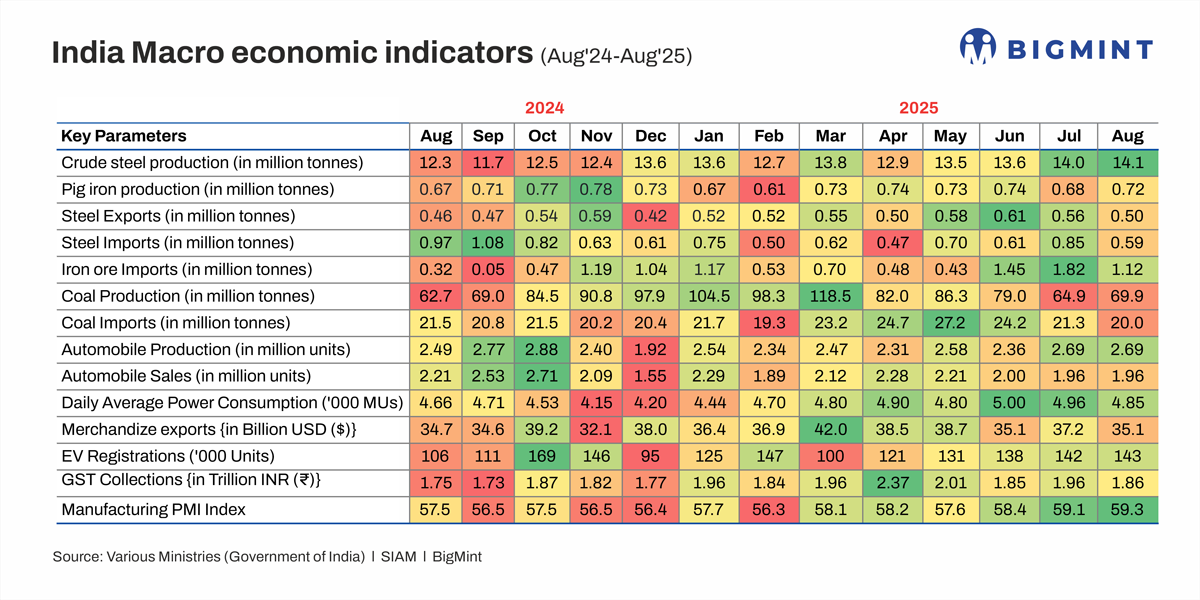
- Crude steel output reaches new high of 14.09 mnt in Aug
- GST 2.0 to accelerate auto production and steel demand
- Thermal power generation, demand softens despite industrial momentum
Morning Brief: India’s economic momentum quickened in Q1FY’26, with real GDP growing by 7.8% y-o-y, higher than most estimates. A pick up in the manufacturing and services sector, combined with steady growth in the agricultural sector helped real GVA expand over this period. An abundant and spatially well-dispersed monsoon not only aided in an increase in Kharif crop acreage sown, but also replenished reservoirs.
External economic activity in the form of trade and capital flows displayed healthy trends. In August 2025, India’s total exports of goods and services recorded a growth of 9.3% y-o-y, driven primarily by a 12.2% y-o-y in services exports. Merchandise exports grew by 6.7% y-o-y.
According to the Department of Economic Affairs’ Monthly Economic Review for August, indicators of economic activity, such as GST e-way bills and PMI, continued to signal strength in the economy. Volume of e-way bills generated increased by 24.1% y-o-y in July-August. PMI Manufacturing and PMI Services reached 17-year and 15-year highs, respectively, in August, reflecting strong underlying trends.
BigMint dissects the steel industry’s macro trends in the backdrop of India’s accelerating economic momentum in August.
Crude steel output reaches new high
India’s crude steel production in August reached 14.09 mnt. Crude steel production witnessed growth of 12.4% y-o-y in the first six months of FY’26, reaching 82.3 mnt compared to 73.2 mnt in the same period last year. This is due to robust infrastructure demand and strong manufacturing activity.
Pig iron production also increased slightly in August. However, raw material supply tightness and price volatility continue to impact the performance of merchant producers. Steel consumption in the April-August period increased by 8.3%, according to government data.
Steel exports, imports drop slightly
Steel exports decreased due to flat demand in the EU, although some restocking can be expected ahead of the winter break and approaching CBAM. Trade restrictions and China’s dominance in prices have also impacted exports.
Steel imports in August fell sharply to 0.59 mnt due to trade protection measures and safeguard initiated by the government and lower cost of domestic HRC prices compared with the landed prices from Japan and China, in particular.
Iron ore imports remain high
India’s iron ore and pellet imports rose sharply to 1.82 mnt in July but moderated somewhat in August. After hitting a six-and-a-half-year high in July, imports still remain on growth trajectory due to mainly increased domestic steel production and demand for price-competitive high-grade pellets from the Middle East.
Coal production rises slightly m-o-m
An extended monsoon and higher rainfall in coal mining areas impacted production in August too, but volumes rose slightly m-o-m to over 69 mnt. According to the Ministry of Coal, production from captive and commercial mines during August in the financial year 2025-26 was recorded at 14.43 mnt, while dispatches reached 15.07 mnt.
The cumulative figures for the financial year 2025-26 up to August reflect a strong year-on-year growth, with production rising by 11.88% and dispatches increasing by 9.12% compared to the same period last year.
Auto production up, GST reforms to trigger growth
According to SIAM, the total production of passenger vehicles, three wheelers, two wheelers, etc. in August was 26,93,049 units. Total production reached a high of 2.69 mnt.
Passenger vehicles sales were 3,21,840 units in August. Total three-wheeler sales were 75,759 units in August and two-wheeler sales were 18,33,921 units. Total sales stayed flat on anticipation of GST cuts and delayed demand due to the approaching festive season.
In particular, the auto sector stands to benefit from, what is being called, GST 2.0. Small cars are now taxed at 18% instead of 28% plus cess, while luxury cars and SUVs have moved to a flat 40% from 28% plus 15-22% cess, making entry-level cars cheaper and premium vehicles moderately simplified in pricing.
Commercial and special vehicles like buses, trucks, ambulances, fire engines, and cranes now attract 18% instead of 28%, lowering fleet and service costs. Electric vehicles remain at a concessional 5%, keeping EV adoption strongly incentivised.
Power demand drops
An extended monsoon and cooler temperatures reducing the need for heating weighed on India’s overall power demand, although demand remained strong in August due to acceleration in industrial momentum. Thermal generation decreased slightly and coal stocks at the domestic coal-based power plants on 31 August stood at 47.45 mnt compared to 37.19 mnt in the same period of last year, with a growth of 27.59%.
Merchandise exports up, EV registrations rise
Merchandise exports grew by 6.7% y-o-y and overall merchandise trade performance is broad-based in terms of composition. India’s total exports of goods and services recorded a growth of 9.3% y-o-y, driven primarily by a 12.2% y-o-y in services exports.
EV registrations increased m-o-m. As per JMK Research and Analytics, in August, sales of high-speed electric two-wheelers (HS E2Ws) in India increased by ~1% m-o-m, totaling 1,04,306 units. In August, registered sales of passenger electric three-wheelers (E3Ws) stood at 54,969 units, reflecting an approximately 9% m-o-m decrease. Year-on-year, sales grew by a marginal ~0.7% compared to August 2024.
GST reforms
Although GST collections fell marginally m-o-m in August, India’s GST reforms are set to usher in a new era for industry. The 56th meeting of the GST Council has brought in broadly a two-rate structure with a Standard Rate of 18%, a Merit Rate of 5% and a special de-merit rate or sin good rate of 40% for a select few goods and services.
According to the government, measures to simplify the GST registration mechanism, particularly for small suppliers making supplies through e-commerce operators and an easier refund mechanism are expected to lower input costs and improve liquidity for companies, while giving a thrust to Make in India.
Outlook
India’s festive momentum is likely to invigorate the economy further despite external tariff headwinds. The strong contribution of personal consumption in GDP clearly reflects this. Steel sector growth is based on increased investments by the leading BF-based producers, as well as the secondary IF-based players. Production is expected to exceed 225-230 mnt by 2030-2031.
The rationalisation of GST came in as the third leg of the tripod of tax reforms, following up on the corporate tax reductions and personal income tax reforms, according to the Department of Economic Affairs. This is expected to trigger domestic manufacturing growth and is conducive to steel demand.
Leave a Reply