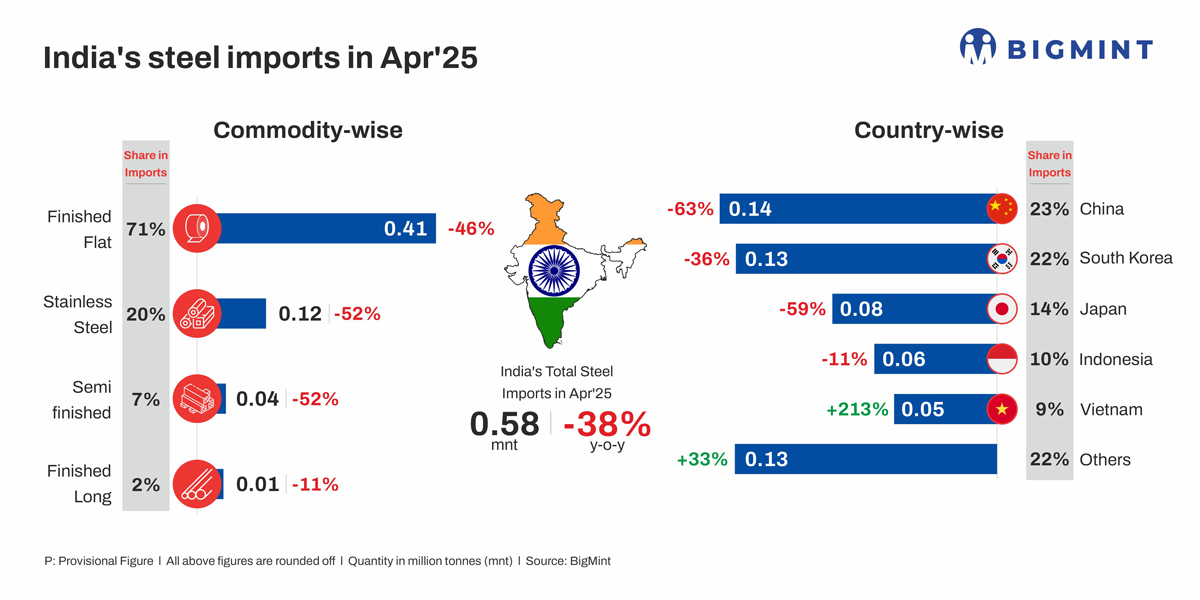
- Steel imports drop 22% m-o-m, 38% y-o-y in Apr’25
- Competitive HRC import prices fail to lure buyers
- Price competitiveness of imports to decline due to safeguard duty
Morning Brief: India’s steel imports (including stainless steel) dropped 21% y-o-y in January-April 2025 to 2.85 million tonnes (mnt), precipitated by a sharp decline in the arrival of flat products amid the imposition of the safeguard duty.
Meanwhile, in April, India’s steel imports totalled 0.58 mnt, down 22% m-o-m and 38% y-o-y.
Commodity-wise highlights
Finished flat steel imports (including flat products of stainless steel) plummeted 22% y-o-y to 2.45 mnt in January-April. Out of 2.08 mnt of carbon steel flat product imports, hot-rolled coil (HRC) volumes were 0.84 mnt, a significant 37% drop y-o-y.
Semi-finished imports declined 24% y-o-y to 0.29 mnt, while finished longs increased 10% to 0.11 mnt.
Separately, India’s stainless steel imports slid 15% y-o-y to over 0.51 mnt in January-April.

Key exporting countries
South Korea was the leading exporter to India, with 0.81 mnt in January-April, a 19% decrease y-o-y. China followed, shipping 0.5 mnt, 55% lower y-o-y.
Shipments from Japan plunged 26% y-o-y to 0.46 mnt, while arrivals from the EU climbed up by a marked 120% to 0.22 mnt.

Factors impacting India’s steel imports in Jan-Apr’25
Safeguard duty buzz drives off import interest: The safeguard duty investigation into surging flat steel imports, announced in December 2024, effectively culled interest in sourcing overseas-origin material.
While the provisional 12% safeguard duty was eventually imposed on 21 April, uncertainty about the applicability of the duty and negative sentiment surrounding imports led to a significant drop in arrivals from China, Japan, and South Korea even before its implementation.
Notably, India has free-trade agreements (FTA) in place with Japan and Korea, which allow them to export material to India duty free. However, given that the safeguard duty overrides FTA allowances, both countries will now need to pay duties on steel exports to India for a period of 200 days.
Competitive import prices fail to rouse buyers: In fact, the negative sentiment was so strong in the market that buyers resisted procuring products from overseas despite them being more cost-effective than domestic steel during the January-April 2025 period. To illustrate, Indian HRCs were priced at an average of INR 49,375/tonne (t) exy-Mumbai in January-April, slightly higher than the landed costs of HRCs from China at INR 48,025/t during the same period. During February-March, the average landed cost of HRCs from South Korea was INR 48,450/t, while there were no firm offers in January and April.
In comparison, during January-April 2024, prices of Indian HRCs were at INR 53,400/t, while those from FTA countries were lower at INR 51,675/t, which led to the spike in shipments from these regions. Chinese HRCs were priced slightly higher than Indian material at INR 55,000/t in the corresponding period of last year.
BIS licences emerge as key non-tariff barrier: Bureau of Indian Standards (BIS) licences are a significant non-tariff barrier to steel imports, and the government is eager to cover all steel products under it for quality monitoring. In March, India tightened its quality standards to stem the increasing influx of lower-priced, subpar steel. The BIS, along with the Ministry of Steel, expanded the number of product categories under BIS standards to 151 as part of their Quality Control Orders (QCOs).
Notably, shipments from Vietnam increased to 0.19 mnt in January-April 2025 compared to 0.11 mnt in the preceding year, possibly due to the renewal of BIS licences of steel giants Formosa Ha Tinh and Hoa Phat Group. However, the safeguard duty will help reduce volumes in the short term.
Additionally, certain Chinese mills’ BIS licences were also not renewed in early-2025. This also contributed to the overall decline.
Outlook
The price competitiveness of imported flat steel products is likely to suffer significantly after factoring in the 12% duty. BigMint’s calculation places the landed cost of HRC imports in April at INR 52,500/t for Chinese material, after taking into account the safeguard duty. This is if we consider an average CNF India value in April of $484/t for Chinese HRCs. Without the safeguard duty, this stands at INR 46,800/t. In comparison, average domestic HRC prices were at INR 51,800/t exy-Mumbai in April. It is to be noted that Japanese and South Korean exporters refrained from making firm offers to India in April.
This steep hike in landed prices will likely rein in import volumes for the time being. Interestingly, while China’s steel exports increased 8.2% y-o-y in January-April, shipments to India plunged 55% over the same period. This indicates the efficacy of the safeguard duty to a certain degree.
Leave a Reply