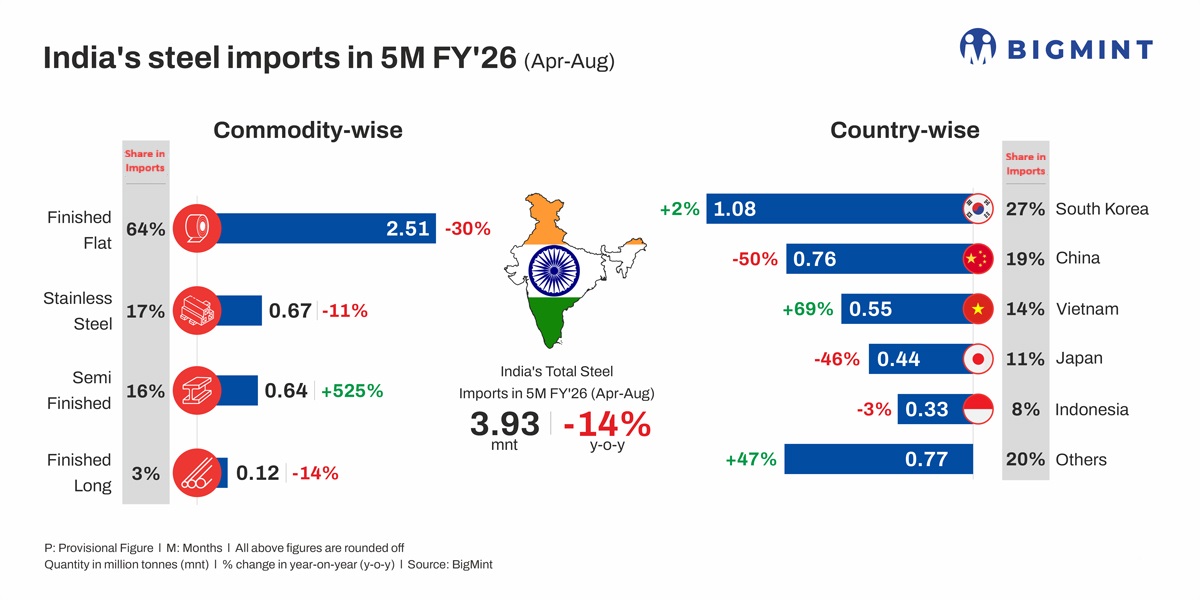
- Chinese exports to India plunge 50%, Japan’s down 46%
- Vietnam overtakes Japan as 3rd-largest exporter to India
- Safeguard duty keeps imported HRCs costlier in Aug’25
Morning Brief: India’s steel (including stainless steel) imports nosedived by a sharper 14% y-o-y in April-August 2025 as compared to a drop of 10% in April-July, as per provisional data maintained with BigMint. The continued decline comes amid a spate of regulatory interventions announced recently.
This followed a decrease of 13% m-o-m and 27% y-o-y in August 2025 to 0.85 million tonnes (mnt). Imports in April-August (5MFY’26) totalled 3.93 mnt as against 4.59 mnt in the corresponding period last year (CPLY).
However, steel imports in 5MFY’26 remain over 20% higher than the 3.23 mnt recorded in 5MFY’24, indicating that volumes continue to be relatively elevated.
Commodity-wise imports
India’s finished flat carbon steel imports declined by 30% y-o-y to 2.51 mnt in 5MFY’26. Hot-rolled coil (HRC) imports, while leading the tally in terms of sub-commodities, plunged by 39% to 1.03 mnt. Electrical steel imports, at 0.71 mnt, and galvanised steel, at 0.40 mnt, were down by 26% each.
Semi-finished steel imports surged manifold to 0.64 mnt, on the back of a steel major’s increased sourcing from its overseas-origin unit. Finished long steel decreased at 0.12 mnt from 0.13 mnt in the CPLY.
Stainless steel imports declined by 11%, with only the flats segment witnessing a major change. Shipments of stainless steel flats were lower by 15% at 0.35 mnt.

Country-wise imports
South Korea was the top exporter to India, with volumes edging up by 2% to 1.08 mnt. It is to be noted that South Korean steelmakers make bulk shipments to India for further processing of steel products in associated Indian mills.
China came in second with 0.76 mnt, a steep 50% plunge. In 5MFY’25, China was the leading source of Indian imports, at 1.52 mnt.
Vietnam overtook Japan as the third-largest source, with imports jumping by 72% to 0.55 mnt. Meanwhile, Japan reduced its exports to India by 46% to 0.44 mnt, while arrivals from Russia quadrupled to 0.23 mnt.

Regulatory interventions help curb steel inflows
Amid a fragile geopolitical landscape and risks of trade diversions, the Indian government has, in the past few months, taken some decisive steps to tighten import flows and prevent an import glut, as seen in FY’25. These measures have helped bring down volumes from China and Japan, the largest and third-largest steel exporters to India in FY’25.
Safeguard duty lifts landed costs of imports: The foremost among these interventions has been the safeguard duty on flat steel imports, recommended for three years at staggered rates of 11-12%.
The safeguard duty has eliminated the cost advantage factor, with HRC offers from China and Japan being consistently higher than domestic prices following the duty’s implementation. For example, in mid-August, for Chinese offers of around $525/t CFR India and Japanese ones of $510/t CFR India, the post-duty landed costs came to INR 58,294/t and INR 52,469/t, respectively. These rates exceeded Mumbai’s INR 50,000/t ($570/t) on 12 August.
DGTR proposes anti-dumping duties: Amid rising imports from Vietnam, the Directorate General of Trade Remedies (DGTR) recommended a fixed anti-dumping duty on imports of hot-rolled flat products from Vietnam for 5 years. Most exporters’ dumping margins were calculated to be within 20-30%.
Meanwhile, to curb mounting electrical steel imports from China, especially of the cheaper non-oriented grade, the DGTR has recommended anti-dumping duty for five years, with rates proposed at $223.82/tonne (t) and $414.92/t. The impact of these measures will become apparent in the upcoming months.
Steel ministry tightens BIS compliance norms: The steel ministry also intends to check the entry of substandard imports with stringent Bureau of Indian Standards (BIS) quality norms. While this is expected to reduce India’s imports, enforcement has been deferred due to industry pushback, so the outlook is uncertain. Moreover, the steel ministry has also provided exemptions to several foreign exporters due to concerns regarding the availability of types of specialised, high-grade steel.
Outlook
In the near term, India’s steel imports are expected to continue declining y-o-y, led by lower shipments from China and Japan. However, concerns remain due to geopolitical uncertainties driven by the US and the persistent global supply surplus — both have heightened risks of export diversions to India.
Overall, the import landscape remains cautious and uncertain, with government actions being the key driver.
Leave a Reply