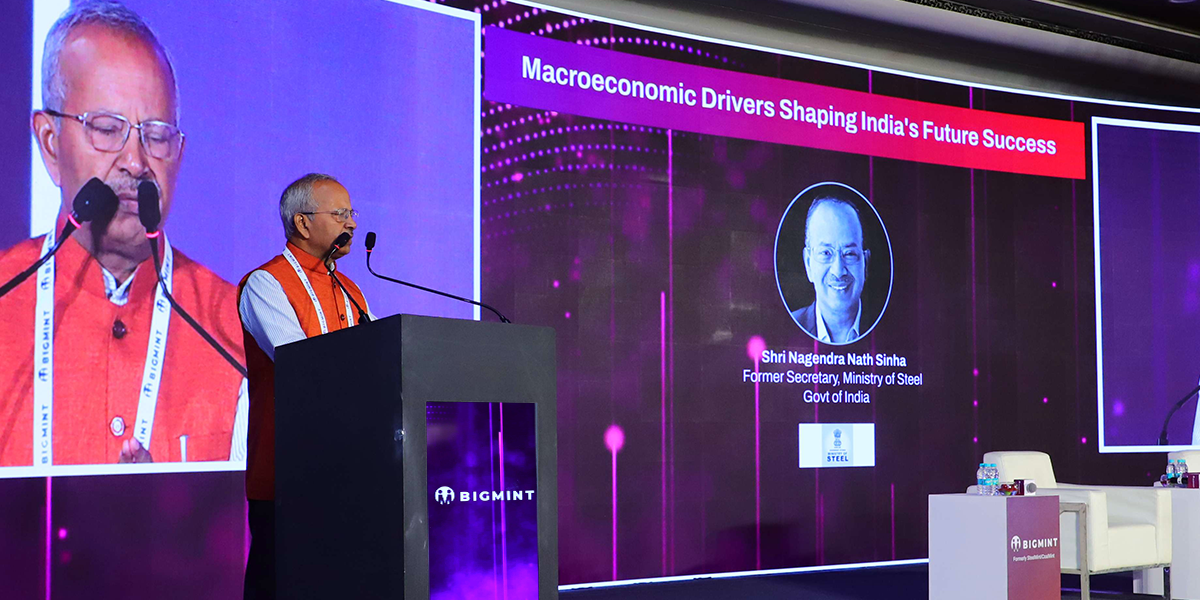
Setting the tone for BigMint’s recently-concluded 7th Indian Iron Ore & Pellet Summit, the 6th Indian DRI, Scrap & Steel Conference and the 4th India Coal Outlook Conference in New Delhi, Dhruv Goel, CEO, BigMint, said, the event aimed to explore the future of Indian steel and raw materials industry and get some insights and possible actions on the same.
The event saw the presence of 70% of India’s iron ore industry, 80% of the pellet industry, 40% of the DRI industry, and around 90% of the country’s imported coking coal buyers.

Nagendra Nath Sinha, former Secretary, Ministry of Steel, Government of India, speaking as the Guest of Honour at the inaugural session, exhorted steel makers to make their plans keeping the guaranteed level of 300 million tonnes (mnt) of crude steel production in mind, with demand growing at over 10%.
Sinha, reminding that the Indian steel industry is the fastest growing in the world, said capacity addition figures need to be recalibrated. He added that consumption growth has been at over 10% over the last three years and two factors are keeping consumption growth at such levels. One is infrastructure, which has grown 7-8% in the last three years, and is expected to grow over 6.5% in the medium term. The second is the elasticity level of 1.2% in growth. However, the government’s own investment in the infra sector has been very significant and growing every year which is giving extra zing to steel consumption and accordingly, the additional capacity, he said.
On capacity growth: Capacity growth has been at around 7.6% in the recent past but there is no reason to believe it would lag behind consumption, Sinha observed, adding that the current steel capacity s around 180 mnt.
He reminded that most of the Indian consumption will be fed by Indian capacities. He informed that some exercise undertaken by the ministry in July 2024, found that capacity is expected to touch 318 mnt by 2030. However, secondary steel capacity addition was minuscule there. Data from the EAF and IF segment was correlated, but it was seen that capacity addition of the secondary sector, as reviewed within the ministry, were not valid. “So, we need to properly recalibrate those numbers and my guess is, capacity will be more than what the ministry has estimated so far,” he said.
On raw material security: The current iron ore consumption is at around 250 mnt. But the issue is how to feed the requirement of 440 mnt for making 300 mnt of steel? For this, capacity clearance of over 600 mnt of ore is required and the ministry is looking at this level. Sinha informed, the Ministry of Steel is working with the Ministry of Mines to see that all measures needed are implemented to achieve the requisite mining capacity. “There would be dialogues with the mines ministry and MoEF and state governments to ensure augmentation of iron ore mining capacity,” Sinha said.
In terms of handling lower and lean grade ore, he said policies in Japan and China can be emulated in India but there are two bottlenecks. One, not giving preference to miners or mills which are beneficiating low and lean grade ores. Therefore, the Ministry of Steel has taken up an important initiative with the Ministry of Mines, and MoEFCC to look at an equalising policy so that those beneficiating are at least on price parity with those who are mining high grade ore. Secondly, the government is keen on piloting technology needed for beneficiation. He reminded that miners are able to upgrade Fe35% ore to 63% with technology.
In terms of coal, he said 60 mnt of coking coal is imported. But when the steel capacity is raised to 300 mnt, imported coking coal volumes are expected to rise to 160 mnt. The Ministry of Coal is also not sitting idle. Its Mission Coking Coal, after washing, can increase domestic capacity and this would mean India will need to import around 120 mnt. “But this is still high compared to what we import today and so we need to diversify the sources and reduce dependency on one country. Not every country will give the kind of coking coal needed but the process of mix and match should allow India to get the volumes needed to support the 300 mnt of production,” he said.
Sinha, dwelling on a fair pricing mechanism, said it is important to have an even set of terms at which coking coal gets imported. “Thus, the government is coming up with a set of policies that aggregate the efforts and initiatives of all steel players to ensure that we work in tandem as countries like Japan and China have done.” He hinted that the terms of trade should be fairer and the industry should iron out the fluctuations seen in prices.
On decarbonisation: Accepting that decarbonisation is a very critical issue, he said Indian steel industry’s GHG intensity is 2.55 tCO2 equivalent per tonne of crude steel but it needs to come down to 2.2 tCO2 equivalent per tonne. The ministry set up 14 task forces on this issue who submitted their reports which will be synthesised into an integrated document and put in the public domain. “The effort is to make a set of national choices to navigate decarbonisation and arrive at prices and costs acceptable to all,” he said.
The National Green Hydrogen Mission has provided a fund of INR 455 crore to the Ministry of Steel and the latter is taking up three pilots. One is on the issue of using green hydrogen fully in making DRI. We did not want to make it player-specific but were keen that the entire steel industry must benefit. So, we asked consortiums to put in their proposal and three have done so. The same are under evaluation and results will be out soon,” Sinha said.
These pilots will pave the way for use of hydrogen solely for making DRI and its capital equipment.
Leave a Reply