- Coal drives India’s mid-July power demand surge
- IEX prices jump as coal stocks decline
India’s electricity market tightened sharply in mid-July 2026 as power demand accelerated, hydropower remained weak and renewable growth could not fully offset the increase in consumption. The resulting supply imbalance pushed coal generation higher and triggered a steep rise in Indian Energy Exchange Day-Ahead Market prices.
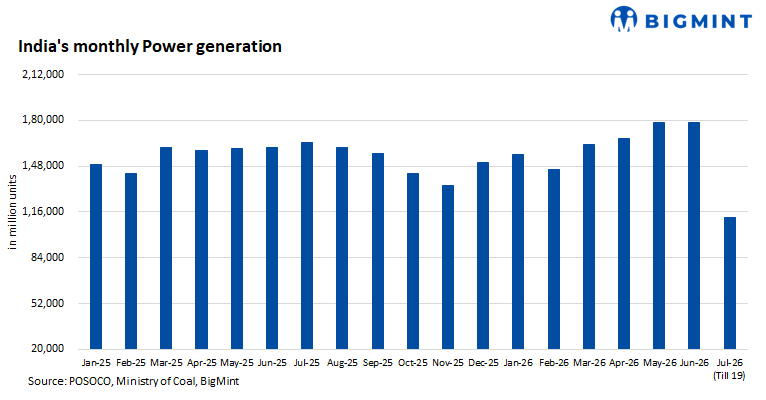
During 1–19 July, total generation reached 112,282 million units (MU), up 11.6% y-o-y. Coal generation increased 12.7% to 71,751 MU, while renewable output rose nearly 38%. However, hydro generation fell almost 22%, removing an important source of flexible, low-cost monsoon supply.

Demand shifts sharply after 12 July
Power demand remained relatively moderate during the first 12 days of July, with daily peaks largely between 225.6 GW and 243.4 GW. Most occurred late in the evening, reflecting the usual pressure created when solar output falls while cooling demand remains elevated.
The market changed abruptly from 13 July. Peak demand rose to nearly 257 GW, crossed 266 GW on 14–15 July and reached 270.2 GW on 16 July. Demand remained close to 270 GW the following day before easing to 244.1 GW on 19 July.
The timing of the peak also moved from late evening to around 3 pm, indicating that the increase was driven by exceptionally strong daytime consumption rather than only the post-sunset loss of solar generation.
Average peak demand during 1–19 July was about 30 GW higher than last year, illustrating the scale of the underlying increase in electricity consumption.
Coal supplied most of the generation response
Daily generation averaged approximately 5,910 MU, compared with 5,295 MU during the corresponding period last year. Coal provided the largest absolute increase. Output averaged 3,776 MU/day, rising above 4,000 MU/day from 15 July and reaching 4,146 MU on 17 July.
Coal accounted for around 64% of total generation and supplied almost 70% of the year-on-year increase in electricity output. The contrast between the two parts of the month was pronounced:

Coal met most of the incremental requirement, while gas generation doubled from a low base, suggesting that higher-cost flexible capacity was required during the tightest days.
Renewables grew strongly, but hydro underperforms
Renewable output rose to 23,073 MU, supported by several days of generation above 1,300 MU. This helped contain market pressure during the first half of July.
However, renewables did not increase sufficiently when demand surged after 13 July. Average renewable generation rose by less than 3% between the two periods, compared with a 9.4% increase in total generation.
Weak hydro was the more significant constraint. Hydro generation fell to 11,295 MU, from 14,420 MU a year earlier, reducing its share of overall generation from more than 14% to about 10%.
A normal monsoon generally increases reservoir inflows and hydro output, providing flexible electricity and reducing the need for thermal generation. That seasonal benefit was largely absent this July.
Monsoon brings temporary demand relief
Early rainfall appears to have reduced cooling demand briefly, with peak consumption falling from more than 242 GW at the beginning of July to 225.6 GW on 5 July.
However, the monsoon’s expansion across the country did not translate into uniform rainfall or sustained temperature relief. The accompanying rainfall assessment points to continuing deficits across parts of central and peninsular India and above-normal temperatures in several regions.
The mid-month demand surge may therefore reflect a combination of persistent cooling load, industrial consumption and increased agricultural pumping in rainfall-deficient areas.
The monsoon simultaneously failed to deliver the expected supply-side benefit because hydro generation remained weak. July therefore experienced neither a sustained reduction in demand nor a meaningful increase in low-cost hydro supply.
IEX market moves from surplus to scarcity
The Day-Ahead Market remained well supplied during 1–12 July. Average sell bids reached around 450,177 MWh/day, nearly twice purchase bids, keeping the average market clearing price near INR 3,251/MWh.

Purchase bids more than tripled while sell bids declined by around 41%. The average clearing price almost doubled even as scheduled volumes fell.
On 16 July, purchase bids reached 1.28 million MWh against sell bids of only 184,541 MWh. The MCP climbed to INR 7,723/MWh, the highest level during the period.
The price increase was therefore driven not merely by stronger demand, but by intense buying interest competing for a shrinking pool of exchange supply.
Coal stocks decline but fewer plants at critical level
Higher thermal generation resulted in a steady drawdown of power plant coal inventories

Stocks fell by 3.09 mnt, or 7%, during 1–19 July. Yet the number of critically stocked plants declined from 32 to 26, suggesting that supplies were being directed more effectively towards vulnerable stations even as national inventories decreased.
Domestic coal stocks accounted for the entire drawdown, falling by around 3.4 mnt, while imported inventories increased modestly.
Inventory cover declined from roughly 14.2 days at end-June to 13.2 days by 19 July. This remains manageable, but continued coal generation above 4,000 MU/day could accelerate depletion unless receipts consistently match consumption.
BigMint assessment
July’s data capture the growing complexity of India’s power system. Demand growth remained exceptionally strong, renewable generation expanded rapidly and the grid successfully met a peak of more than 270 GW. However, weak hydro output meant coal had to provide most of the incremental electricity.
The strain became most visible in the IEX market. Prices stayed moderate while sell-side liquidity was abundant, but surged once demand accelerated and sellers withdrew supply from the exchange.
Coal inventories remain adequate and the decline in critically stocked plants indicates improved distribution. Nevertheless, the continued stock drawdown shows that the system is consuming coal faster than it is rebuilding inventories.
The outlook for the remainder of July will depend on whether rainfall becomes more evenly distributed, hydro generation recovers and coal supplies keep pace with elevated thermal output. Until then, strong demand, weak hydro and constrained exchange availability are likely to keep spot prices volatile.

Leave a Reply