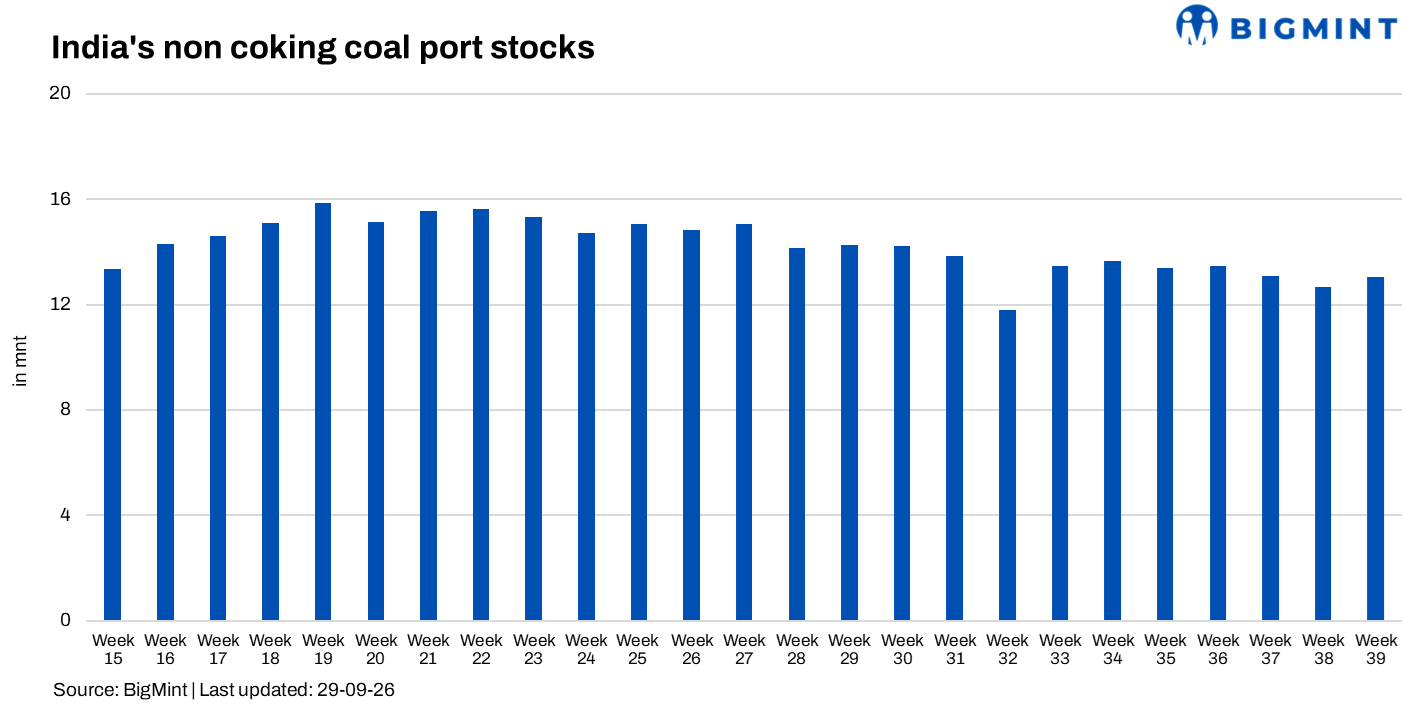
- Total stocks at covered ports decline 0.37 mnt, or 2%, during 20-26 Sep’26
- Coking coal stocks fall 0.75 mnt, non-coking coal stocks rise 0.37 mnt
Coal stock at the major Indian ports covered by BigMint’s week 39 assessment closed at 18.35 mnt on 26 September 2026, down from 18.72 mnt a week earlier. The modest decline in the combined figure conceals a sharper shift between grades: coking coal stocks fell 12.4% to 5.30 mnt, while non-coking coal stocks increased 3.0% to 13.05 mnt.

Stock movements varied sharply by port. Vizag, Mundra and Paradip recorded the largest reductions, together drawing down 0.93 mnt. Accumulation elsewhere, particularly at Magdalla and Kandla, offset much of that decline.

Figs in mnt. Stocks are rounded. The provisional assessment does not cover every Indian port.
Steel-linked ports drive the coking coal decline
Vizag recorded the largest stock reduction of any covered port. Its reported inventory, entirely coking coal, fell 0.46 mnt to 1.03 mnt. Jindal Steel & Power’s listed stock there dropped from about 0.41 mnt to 0.08 mnt.
Paradip’s coking coal stock fell 0.21 mnt to 1.10 mnt, although its non-coking stock rose slightly. Gangavaram’s coking inventory declined 0.07 mnt to 0.76 mnt. Together, these three ports account for almost the entire net fall in coking coal stock. Dhamra remained the largest coking coal stockholding port at about 1.11 mnt, down only 0.03 mnt w-o-w.
Stocks diverge at ports in western India
Mundra’s total stock fell 0.30 mnt to 1.80 mnt, including a 0.26 mnt reduction in non-coking coal. The receiver-level assessment shows lower non-coking holdings for Adani Power, Adani Enterprises and Tata Power.
Other western ports moved in the opposite direction. Magdalla’s non-coking stocks more than doubled to 0.74 mnt, a weekly increase of 0.42 mnt. Kandla gained 0.23 mnt to reach 0.86 mnt, while Dahej rose 0.08 mnt to 1 mnt. Hazira remained the largest overall stockholding port at 2.39 mnt, despite a slight decline.
The pattern adds an important qualification to September’s import story. Non-coking cargoes are heavily concentrated at western and southern ports, far from India’s principal eastern coal-producing belt. Yet imports are not accumulating uniformly in the west: stock is falling at Mundra while rising sharply at Magdalla and Kandla.
Active movement at ports
A decline in stock understates the amount of coal moving onward when fresh vessels arrive during the same week. Comparing the stock assessment with completed coking and non-coking import entries dated 20-24 September gives an indication of activity at major ports.

Figs in mnt. The final column is a partial, indicative calculation, not a reported rail or road dispatch figure. It assumes the identified cargoes entered the stocks measured at each port.
Mundra stands out: despite 0.44 mnt of identified imports, its inventory declined 0.30 mnt. Krishnapatnam and Paradip also absorbed fresh cargoes while reducing stock. Vizag’s 0.46 mnt drawdown points to substantial movement out of its coking coal inventory.
The calculation cannot yet establish actual weekly evacuation or rank ports by clearance speed. The vessel lineup confirms imports only through 24 September; later vessels were still shown as at berth, at anchorage or expected in the snapshot. It may also omit receipts that appear in the stock assessment. Magdalla illustrates the gap: its stock rose 0.42 mnt without a matching completed import in the selected vessel rows. A complete 20-26 September receipts ledger, including relevant coastal cargoes, is needed for a definitive evacuation measure.
BigMint assessment
Week 39’s national stock decline was driven by coking coal at steel linked ports, particularly Vizag and Paradip. Non-coking coal moved in the opposite direction overall, with substantial builds at Magdalla and Kandla even as Mundra’s inventory fell.
BigMint expects the port stock picture to remain uneven in the near term. The steel-linked ports could see further coking coal drawdown if onward movement stays strong. For non-coking coal, the key test is whether fresh September imports clear western ports quickly enough to prevent another build at Magdalla and Kandla. A sustained decline across both grades would show evacuation keeping pace with arrivals; continued accumulation at selected western ports would signal a more localised backlog despite a lower national stock total.
Source and method: BigMint/CoalMint week 39 port stock assessment for 20-26 September, receiver-level week 39 stock workbook, and the vessel lineup compiled through 25 September. Volumes are rounded.
Leave a Reply