- Higher crude steel, ore production give pellets a leg-up
- Capacities increase as mills look to backward integrate
- Pellets gain currency amid rising environmental concerns
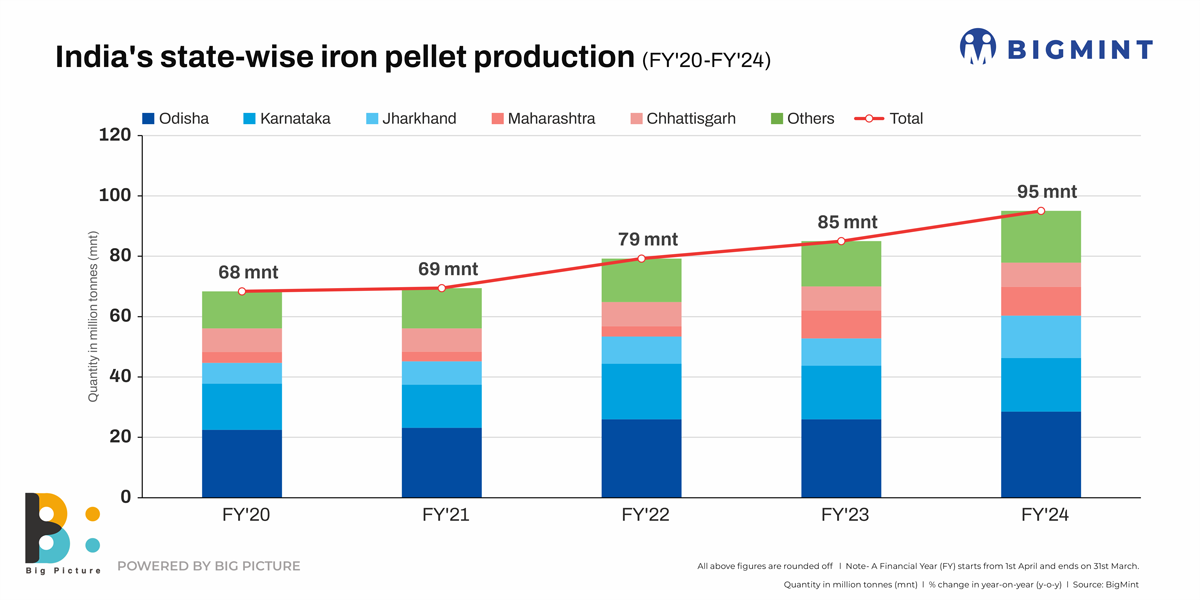
Morning Brief: India’s iron ore pellets production increased nearly 12% in financial year 2023-24 (FY’24), reveals data maintained with BigMint. Volumes rose to 95 million tonnes (mnt) last fiscal as compared to 85 mnt in FY’23.
State-wise break-up: Odisha shows 26% growth y-o-y
Odisha is India’s leading pellets producing state. FY’24 was no exception, with this eastern region state producing 28.50 mnt, a y-o-y growth of 10%. Karnataka followed with 17.8 mnt, almost flat y-o-y against 17.7 mnt in FY’23.
Jharkhand took the third slot, with 14 mnt (9 mnt), showing a growth of 54% while Maharashtra and Chhattisgarh bagged the fourth and fifth ranks with 9.6 mnt and 8 mnt, respectively – both flat y-o-y.
Company-wise break-up:
The JSW Group has maintained its position as India’s top-most pellets producing entity, with volumes last fiscal touching over 25 mnt (24.5 mnt), up a marginal 2% y-o-y.
AM/NS India followed with 10% increase to 14.5 mnt (13.2 mnt). Tata Group took the third slot with production rising a significant 55% to 10.7 mnt (6.9 mnt). JSPL, ranked fourth at 7.3 mnt, recorded a decline of 4% (7.6 mnt).

What factors propelled this growth?
- Increase in capacities: India’s pellet capacity increased to 140 mnt in FY’24 as against 133 mnt in FY’23. India’s pellets capacities are being enhanced with an eye on three factors. One is increased demand. Pellets consumption increased 6% to 82 mnt last fiscal compared to 77 mnt in FY’23. Two, steel mills are increasing captive pellets production capacities in a bid to backward integrate and secure supplies. Three, pellets offer environmental benefits. Fourth, pellets have a quicker delivery cycle, as these are transported via road unlike iron ore which is dependent on rail rakes, which are often in shortage. Lastly, growing shortage of high-grade iron ore lumps makes pellets a more dependable option.
- Pellets a greener option to sinter: Pellets are increasingly becoming a feed of choice because of their lower carbon emissions. It is seen, pellets have higher environmental benefits over sinter. Since climate change is becoming a growing concern, the urgency for adopting greener methods of steel-making cannot be stressed upon more at this juncture. Thus, mills are not only enhancing captive pellet capacities but increasing usage of the same in blast furnace feed. Data reveals, share of pellets in the charge mix has currently increased to 25-27% from the previous 20-25% while sinter’s has dropped to 54% against the earlier 60-65%. Lumps share increased to 19% from 15% previously.
Secondly, DR kilns have a longer campaign life, making pellets a more economical option in the production process.
- Rise in India’s crude steel production: India’s crude steel production increased 13% y-o-y in FY’24 to 144 mnt against 127 mnt in FY’23, boosted by the induction furnace (IF) route, which uses sponge iron as a key raw material for iron-making. And pellets are a key raw material for sponge-makers. Production through the IF route last fiscal grew 25% to 50 mnt against 40 mnt in FY’23 while the electric arc furnaces (EAFs), which also use DRI along with scrap, showed 12% growth to 31 mnt (28 mnt). IF-EAF combined contributed around 82 mnt or more than 56% of the total 144 mnt last fiscal.
- Exports pick-up: Exports of iron ore pellets increased nearly 80% to 11.3 mnt in FY’24 as against 6.3 mnt in FY’23. The surge was a knee-jerk reaction to the lifting of the 45% export duty on pellets in November 2022. The duty had been slapped in May 2022.
- Increased iron ore production: India’s iron ore production increased significantly to 281 mnt in FY’24, up by 10% y-o-y. This factor also boosted pellets production last fiscal amid higher ore availability.
Outlook
BigMint expects both production and capacities to increase in the medium to long term, since mills are increasingly opting for backward integration. Plus, the stress on greener steel-making methods is gaining momentum.