- Elevated global prices, weak rupee, high freights keep buyers on sidelines
- Competitive prices, proximity to India prompt spike in imports from Russia
- Import downtrend may continue in H2, but low hydropower output a risk
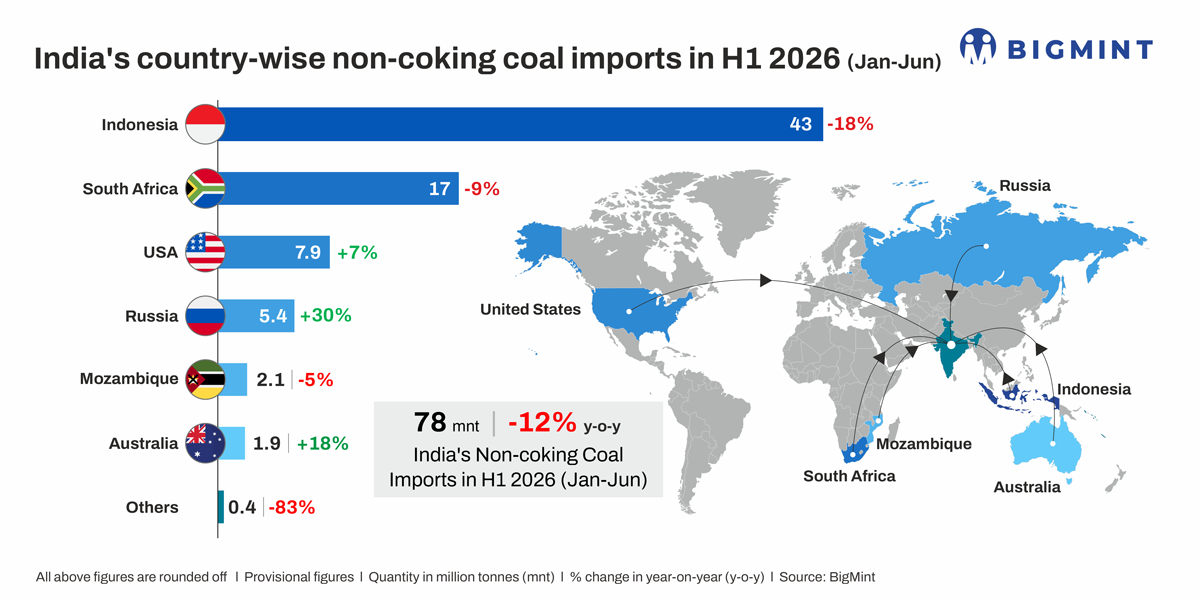
Morning Brief: India’s non-coking coal imports declined by 12.5% y-o-y to 77.61 million tonnes (mnt) during January-June 2026, according to BigMint data. Shipments to India by leading suppliers Indonesia and South Africa fell 17.5% and 9.4%, respectively, as rising renewables generation and comfortable domestic coal inventories continued to keep buyers cautious.
The import slowdown grew more pronounced during May-June, with imports falling 18% y-o-y during the quarter, as geopolitical tensions in the Middle East disrupted shipping routes and pushed up freights, further discouraging purchases from overseas suppliers.
Renewable generation offsets higher power demand
India’s electricity consumption increased by 5.5% y-o-y to 909 billion units (BU) during January-June 2026, driven by above-normal temperatures and strong cooling demand.
Accordingly, power generation increased by 5.9% y-o-y to 989 billion units (BU) during this period. However, coal-fired generation grew only 4% to 699 BU, while renewable generation expanded much faster by 21.9% to 164 BU, accounting for the majority of incremental electricity output.

Surging renewables output significantly limited the increase in coal burn despite record power demand. As a result, thermal coal consumption grew at a much slower pace than electricity demand, reducing the need for additional imports.
Domestic coal supply remains comfortable
Domestic coal continued to displace imported cargoes across most consuming sectors, driven by ample availability and frequent auctions.
Coal India’s production stood at 409 mnt during January-June, down by 3% y-o-y due to operational hurdles. However, dispatches inched up by 1% to 396 mnt, allowing utilities to meet summer fuel requirements without materially increasing imports.

In the second quarter of the year, India’s total production increased by over 1% to 170 mnt, with dispatches rising faster by 3%. Coal dispatches to the power sector increased by 1% to 213 mnt, while those to the sponge iron sector jumped sharply by 56% to over 3 mnt.
Non-coking coal stocks at Indian ports averaged around 13.9 mnt throughout H1CY’26, slightly higher than the year-ago period’s 13.5 mnt. This indicates limited offtake even amid lower imports.
Imported coal-based plants also running on domestic supplies
Another factor weighing on imports is the government’s push to substitute imported coal with domestic supplies at imported coal-based power plants. The government plans for nearly 50% domestic coal usage in these plants, according to media reports.
Imported coal-based plants, with a cumulative 18.7 GW installed capacity, have already begun using domestic coal for 5.7 GW of production, while trials are underway to extend the switch to another 4.3 GW. Operators have modified boilers to handle higher-ash domestic coal and, in some cases, are now using blends containing up to 70% domestic material.
Import economics continue to favour domestic coal
The decline in imports was reinforced by unfavourable import economics throughout the first half of the year.
Seaborne coal prices remained above year-ago levels, driven by a tighter energy market and stronger demand as power utilities sought to substitute natural gas with coal. For example, Indonesian 4200 GAR averaged $58/t FOB Kalimantan in H1CY’26, up 21% y-o-y, while South African RB2 (5500 NAR) averaged around $90/t FOB Richards Bay, up 19% y-o-y.
Indonesian prices also climbed up amid tighter export availability due to uncertainty surrounding mining work plans, production approvals, and domestic market obligation requirements.
Higher freights and a weaker rupee also increased delivered costs following disruptions to Middle Eastern shipping routes after the US-Iran conflict. This widened the price gap with domestic coal, with prices of 4500 GCV up only 2% y-o-y at INR 4,700/t ($49/t) ex-Bilaspur.
Cement demand drives up Russian, US imports
US thermal coal rose 7% y-o-y, supported primarily by demand from India’s cement sector.
Northern Appalachian coal remained a viable alternative for some cement producers owing to its favourable calorific value and pricing relative to petcoke during much of the period. However, imports remained concentrated within this segment and did not offset the broader weakness in India’s thermal coal imports.
Similarly, cement producers also started procuring Russian coal due to competitive pricing and lower freights due to Russia’s relative proximity to India. India’s imports of Russian coal rose 30% y-o-y to a multi-year high, with arrivals exceeding 1.5 mnt in May and June.
Russian Pacific coal (6300 GAR) cargoes were heard at $98/t FOB in early May, while South African (5500 NAR) was quoted at $93/t FOB and US coal (6900 NAR) was in the low-to-mid $130/t range, CFR western coast of India.
Outlook
BigMint expects India’s non-coking coal imports to fall through the remainder of CY’26 despite continued growth in electricity demand and industrial activity.
Even if electricity demand expands by 6-8% this year, coal imports are unlikely to rise as renewable generation continues to capture a growing share of incremental power demand.
Domestic coal production and dispatches are expected to remain sufficient to meet utility requirements, while elevated seaborne coal prices and recent escalations in the Middle East will continue to discourage import purchases. Weak sponge iron margins during the monsoon season could also limit demand for imported South African coal, and softer petcoke prices may reduce the competitiveness of US thermal coal.
However, Russian coal could gain market share owing to its pricing advantage over Indonesian, South African, and US cargoes, as well as shorter sailing distances. A correction in Indonesian and South African coal prices could also encourage selective import buying.
At the same time, the persistence of El Niño raises the risk of weaker monsoon rainfall and lower hydropower generation in H2CY’26. Coal-fired generation rose 14% y-o-y in June to its highest level since November 2023 after hydropower output fell 24.4% because of lower reservoir levels. If thermal generation remains elevated, coal imports may recover modestly, although ample domestic supply is expected to cap the increase.

Leave a Reply