- Imports climb up by 2% y-o-y in Jul’26, first y-o-y increase of CY’26
- Domestic coal supply helps meet demand as power consumption rises
- Lower hydro output, tighter monsoon supplies could lift imports in H2
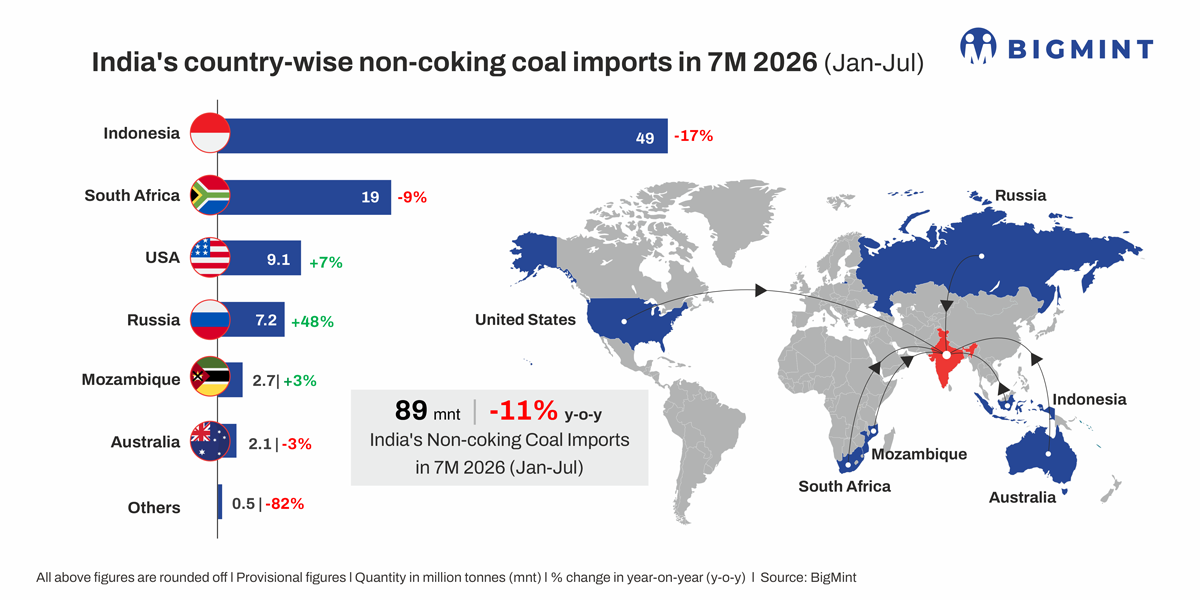
Morning Brief: India’s non-coking coal imports fell around 11% y-o-y to 89 million tonnes (mnt) during January-July 2026, according to BigMint data, as domestic coal continued to meet most of the increase in thermal power demand.
July, however, marked the first y-o-y increase in India’s thermal coal imports in CY’26, with shipments rising nearly 2% to 12 mnt. The increase remained modest compared with the nearly 13% rise in coal-fired generation, suggesting that domestic coal continued to meet most of the additional thermal demand.
The divergence is important for the H2 outlook. India’s power demand is forecast to grow 7% in CY’26, according to the International Energy Agency (IEA), while El Nino risks, depleted water reservoir levels, limited gas-based generation, and constraints in storing and shifting renewable power could keep thermal generation elevated. This could increase pressure on domestic coal production and logistics.
Domestic coal availability appears sufficient to meet power-sector demand, but continued prioritisation of thermal plants could tighten supplies and rake availability for non-power industries. This could prompt sponge iron producers to turn to South African coal to supplement domestic supplies and maintain kiln efficiency.

Ample domestic supply, higher renewable output curb imports in Jan-Jul’26
India’s non-coking coal imports declined 11% y-o-y during January-July 2026, with significantly lower volumes from the two main traditional suppliers. Indonesian shipments declined 17% y-o-y to 49 mnt, while arrivals from South Africa fell 9% to 19 mnt, as power utilities and sponge iron producers shifted towards domestic coal, which remained ample in supply.
According to ministry reports, Coal India Ltd’s production declined 1.8% y-o-y to 459 mnt, while dispatches increased 2% y-o-y to 461 mnt. In early August, coal inventories across the supply chain totalled 147 mnt. The data indicate that domestic coal supply has so far been sufficient to absorb most of the increase in thermal demand.
Higher renewable generation also reduced pressure on thermal power plants. Total power generation increased by 73 billion units (BU) to 1,171 BU during January-July 2026. Output from renewable sources increased 38 BU, while coal-fired generation climbed up by 40 BU, limiting the rise in coal requirement despite higher electricity demand.

Sponge iron producers also remained cautious on imports. Sponge iron output increased by 5-6% to around 35-36 mnt, but producers stayed away from South African coal because of higher delivered costs resulting from elevated freights, geopolitical disruptions, and stronger global prices.
Ex-Paradip RB2 (5,500 NAR) prices increased from INR 9,200/t in January to a peak of INR 11,800/t in March before easing to INR 10,500/t in July. Despite the correction, prices remained well above January levels, keeping imported coal economically unattractive for most sponge iron producers.
South African coal now accounts for 25-40% of the charge mix for sponge iron producers, compared with 60-70% earlier in FY’23. This shift reduced the industry’s exposure to seaborne coal, with domestic coal dispatches to sponge iron producers increasing around 55% y-o-y in Q2CY’26.
Meanwhile, imports from the US and Russia increased by 7% and 48%, respectively, as cement producers continued to favour cheaper fuel sources amid sharply higher pet coke prices and tighter global supply. India’s pet coke imports declined 41% y-o-y to 5 mnt, with July imports falling to just 0.5 mnt, the lowest monthly volume since January 2025 and 61% below July 2025.
Global pet coke supplies began tightening in the final quarter of 2025 and became progressively more constrained following disruptions to Middle Eastern refinery exports. At the same time, higher international pet coke prices prompted Indian cement producers to increase their use of domestic coal and imported US NAPP coal, as well as Russian coal where economics proved more attractive.
Russian coal drives y-o-y increase in Jul’26
Russia was the main source of growth in July, with Indian imports of it rising 152% y-o-y to 1.82 mnt from 0.72 mnt a year earlier. Russian non-coking coal gained share as discounted cargoes and competitive freight economics made it an alternative to higher-cost Atlantic supplies, particularly for India’s cement sector.
Russia’s increase was partly offset by lower shipments from India’s traditional suppliers. Indonesian imports fell 11.6% y-o-y, while South African imports declined 1.5%.
H2 imports likely to recover selectively
India’s thermal coal imports could recover from the January-July decline, but a broad-based rebound is unlikely.
South African coal has the clearest potential to recover if domestic availability tightens, particularly because it remains important for sponge iron and other industrial users.
India’s coal logistics network has come under mounting pressure during May-July as record electricity demand forced the government and PSU mining major Coal India Ltd. to prioritise uninterrupted fuel supplies to thermal power stations. While this has helped maintain comfortable inventories at power plants and prevent electricity shortages during peak demand, it has also created challenges for non-regulated industries that rely on domestic coal.
The impact is particularly visible in the coal-based sponge iron industry. Producers across major manufacturing clusters recently said that domestic coal is available through auctions and linkages, but deliveries have become increasingly unpredictable as railway rake availability has tightened.
The pressure is also visible at ports. India’s thermal coal inventories at major ports declined around 15% w-o-w to 11.79 mnt as of 9 August from 13.86 mnt in the previous week. The drawdown was driven by stronger evacuation of existing cargoes across most major ports, while fresh arrivals remained insufficient to offset offtake.
However, any recovery in imports is likely to remain limited because buyers remain highly price-sensitive after the sharp rise in seaborne coal costs during the first half.
Meanwhile, Russia is positioned to gain further share, supported by competitive cargo prices, shorter sailing distances, and lower freight costs relative to Atlantic-origin material. US inflows could also remain steady amid demand from cement producers.
Indonesian demand may remain weak despite higher coal burn
Indonesia faces a different outlook despite expectations of higher coal-fired generation. In July, the increase in coal-fired generation overtook that of renewable sources, indicating that renewable generation has helped reduce dependence on coal but cannot entirely meet the increase in electricity demand.
The IEA expects electricity demand to rise 7% in CY’26, with below-normal rainfall lifting consumption due to higher cooling and irrigation requirements. The IEA expects coal-fired generation to rise at a similar pace in H2 as in the first half, resulting in around 3% growth for CY’26. It also expects hydro output to remain under pressure, while solar PV and wind generation are forecast to rise 39% and 4%, respectively, during the year.
Hydropower generation declined around 14% y-o-y in July, according to market research. The generation potential of 31 reservoir-based hydropower projects stood at about 14 BU as of 31 July, against potential full-reservoir generation of around 34 BU and around 22 BU a year earlier.
However, higher power demand will not translate one-for-one into imported coal demand. Domestic coal remains the first source of incremental supply, while renewable generation continues to expand rapidly. India added 13.25 GW of renewable capacity during April-June, while the share of renewable generation rose to 17% from 15% a year earlier. Coal India’s production also increased 8% y-o-y in July, underscoring efforts to ensure sufficient supply.
The government has also been pushing imported-coal-based plants to increase their use of domestic material, with plants already modifying boilers and operating domestic coal blends. This reduces the addressable market for imported thermal coal even when overall power demand remains strong.
Outlook
Monsoon conditions are likely to temporarily lift imports in August, but the increase is likely to be limited to South African coal procured by sponge iron producers. Coal production generally rises from September-October as the monsoon retreats, which could curb imports.
The most likely scenario for the remainder of CY’26 is a modest softening in the decline in Indian thermal coal imports from mid-year lows rather than a return to an uptrend. The decline could even sharpen in the final quarter as domestic coal production rises.
Overall, the relationship between Indian power demand and thermal coal imports is becoming weaker. Electricity consumption can continue to grow rapidly while incremental generation is increasingly split between renewables and domestic coal. This means stronger power demand alone is unlikely to trigger a broad recovery in seaborne coal imports. Instead, the scale of any H2 recovery will depend mainly on domestic coal availability, monsoon-related logistics, and the relative delivered cost of imported coal.

Leave a Reply