-
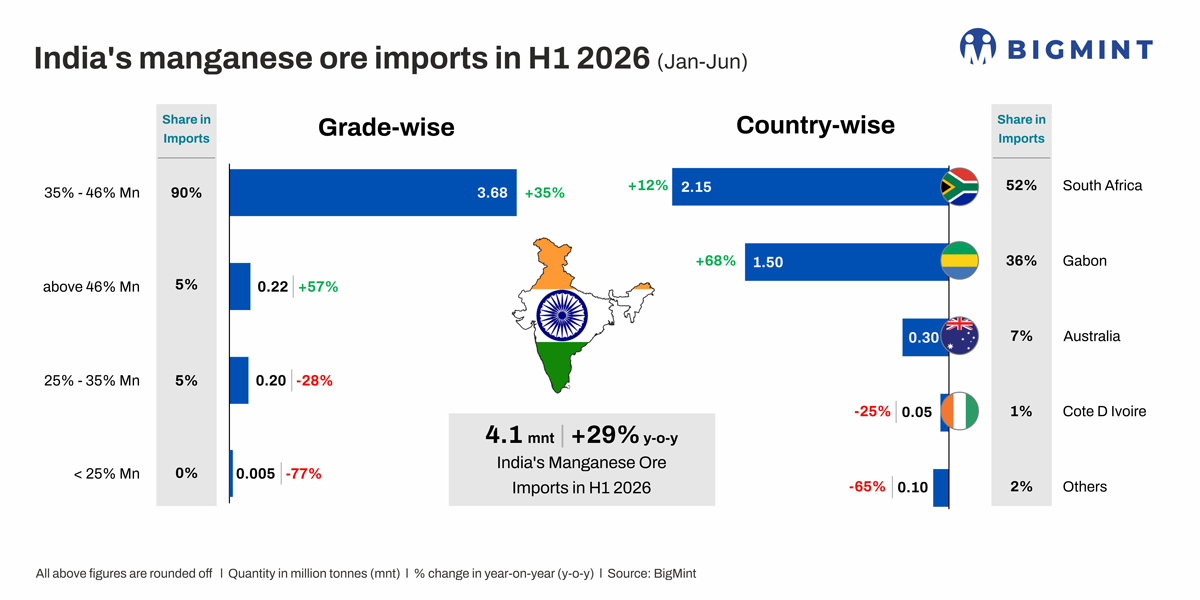
Total imports exceed 4 mnt in H1 CY’26 amid higher crude steel production
-
High-grade manganese ore demand pushes smelters to ramp up imports
-
Higher ferro manganese exports, especially to US, support ore demand
South Africa remained the largest exporting country, with shipments of 2.15 mnt, an increase of 12% y-o-y against 1.92 mnt in H1 CY25. Gabon’s export volumes to India also rose sharply by 68% y-o-y to 1.5 mnt during the period.
Manganese ore imports in CY’25 touched nearly 6.46 mnt on higher domestic crude steel production and surging manganese alloys exports. India is the leading exporter of manganese-based alloys in the world. Total exports of ferro manganese and silico manganese last year were over 2 mnt.
Reasons behind hike in imports
Higher crude steel output supports demand for alloys: India’s crude steel production rose 8% y-o-y to 87 mnt in H1 CY’26. Finished steel production also increased by 8% to 84 mnt. Simultaneously, the use of manganese increased as an essential deoxidiser and alloying element. Domestic manganese alloys production rose from 2.9 mnt in H1 CY25 to 3.6 mnt in H1 CY26, as per BigMint data model. Therefore, demand for manganese ore increased.
Despite domestic manganese ore production increasing from 2.16 mnt in H1 CY’25 to 2.28 mnt in H1 CY’26, grade-related challenges continued to result in increased imports.
Higher ferro manganese exports: India’s ferro manganese exports shot up to a monthly average of 71,000-72,000t* in H1 versus 70,000t* in the year-ago period. Exports to the US increased by 63% y-o-y in H1, supported by a gradual realignment of global supply chains, higher US crude steel production, and stronger preference among buyers to diversify sourcing amid trade policy uncertainties. India capitalised on competitive pricing and stable production, while some competing origins faced supply constraints and higher logistics costs.
However, the Middle East conflict eroded a significant share of India’s exports to the region during the review period. Weak steel demand across several major economies, protectionist trade measures, and elevated freight costs continuing to impact consumption.
Earlier manganese ore inventories at China’s ports remained high, with the overall pace of destocking across the industry being slow. Both traders and producers worked through existing inventories, avoiding the risk of restocking at high prices, and reduced forward and monthly import vessel bookings and arrival plans. Eramet in its quarterly report cited that Chinese port ore inventories rose to 5.2 mnt in end-March (vs. 4.6 mnt in end-December 2025), representing the equivalent of around 10 weeks of consumption.
This urged global miners to turn towards India and cargo inflows increased.

State-owned MOIL raised manganese ore prices, effective 1 April which marked the highest increase in two years. Prices of ferro grades with over Mn 44% content were increased by 15%, while grades below Mn 44% saw a 17.5% hike.
Outlook
Imported manganese ore demand may remain resilient amid ample seaborne availability from South Africa and Gabon and Indian smelters’ preference for high-grade ore to optimise alloy yields and production efficiency. However, subdued manganese alloys demand, comfortable raw material inventories, and cautious procurement are likely to cap any significant upside in imports.
“This analysis is powered by BigMint’s EXIM Intelligence, delivering real-time visibility into global commodity and trade flows.”

Leave a Reply