- Chinese buyers remain cautious, enquiries largely need-based
- Sellers resist lower offers amid better domestic realisations
India’s low-grade iron ore fines (Fe 57%) export market remained largely stable in the week ended 13 August 2026, with limited spot activity and a persistent gap between buyer and seller price expectations.
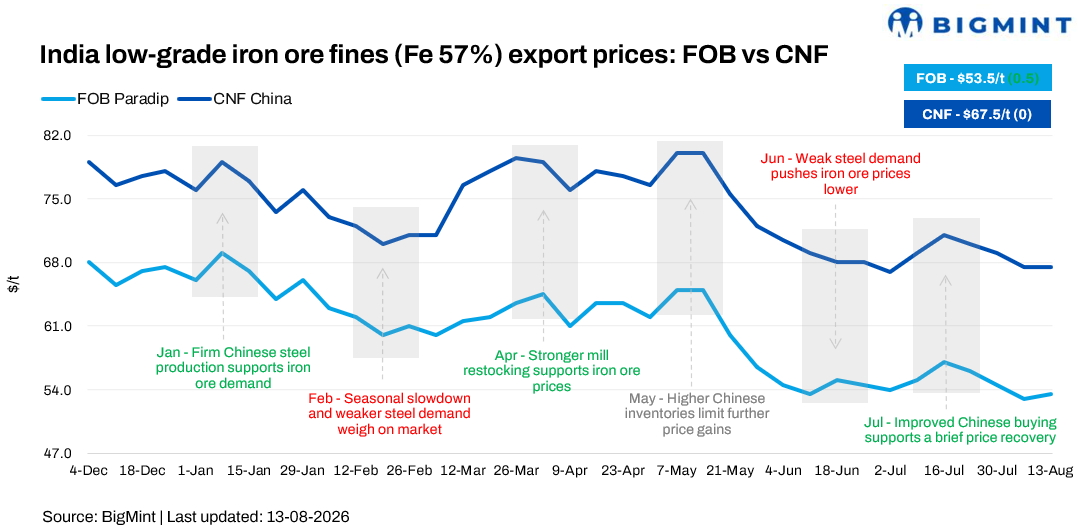
BigMint’s bi-weekly Fe 57% fines export index edged up $0.5/t w-o-w to $53.5/t FOB east coast, equivalent to $67.5/t CFR China, on 13 August. No fresh export deals were reported during the assessment period, as Chinese buyers remained cautious while Indian sellers showed little willingness to reduce offers.
Market participants said quoted levels remained largely indicative, with sellers reluctant to transact below their replacement costs after purchasing material at higher prices. The prevailing discount of around 24-25% has further limited sellers’ willingness to lower offers. Buyers, meanwhile, continued to wait for more workable levels, keeping negotiations thin.
“Such levels can be considered indicative, but they remain largely superficial as sellers are reluctant to transact at these prices after purchasing material at higher levels,” an exporter told BigMint.
Rationale
- No confirmed Fe 57% fines deals were reported during the current publishing window. Consequently, T1 trades received 0% weightage in the index calculation.
- BigMint received 20 indicative price inputs, of which 18 qualified as T2 inputs and accounted for the remaining 100% weightage in the index calculation.
Market scenario
Chinese steel mills continued to adopt a need-based procurement approach, with comfortable inventories and sufficient seaborne availability reducing the urgency to restock. Fresh enquiries remained sporadic, while buyers remained cautious about committing amid uncertainty over the direction of benchmark iron ore prices.
On the supply side, Indian sellers continued to favour price discipline, helped by better domestic realisations. This kept the market in a standoff, with buyers seeking lower levels while suppliers were unwilling to chase deals through aggressive discounts.
“I’m still holding inventory purchased at higher levels, so I’m not willing to sell at current lower prices. The prevailing discount is around 24-25%,” a trader said.
Domestic vs export market
The domestic-export realisation gap narrowed to around INR 550-600/t this week. Export realisations for Fe 57% fines increased INR 100-150/t ($1-1.5/t) w-o-w to INR 2,700-2,750/t ($28-29/t), while domestic offers remain unchanged at INR 3,300/t ($34.6/t) ex-mines.
Despite the narrower gap, domestic sales continued to generate better returns for producers. This reduced the incentive to chase export business, particularly while Chinese demand remained selective.
Global price backdrop
The benchmark Fe 61% iron ore fines index rose $2/dmt w-o-w to $96/dmt CFR China on 12 August, from $94/dmt. Firmer mill buying and improved seaborne sentiment provided some support, although cautious procurement and steel-margin concerns limited the broader price response.
January 2027 DCE iron ore futures also edged up RMB 1.5/t w-o-w to RMB 705/t ($104.5/t) on 13 August. The modest gain points to a relatively stable futures market, with expectations of steady steel demand offset by concerns over mill profitability and the pace of China’s demand recovery.
Outlook
India’s low-grade export offers are likely to remain rangebound with a firm seller bias over the coming weeks. Selective Chinese procurement and competition from alternative origins could restrict upside, but sellers’ reluctance to accept lower prices and firmer benchmark iron ore values may limit further declines.
The direction will depend largely on Chinese restocking activity, seaborne benchmark prices and the domestic-export realisation spread.
Leave a Reply