- Iron ore production growth outpaces rise in crude steel, sponge iron output
- Merchant production rises 28% compared with 7% increase in captive output
- Maharashtra records sharpest increase, followed by Chhattisgarh, Odisha
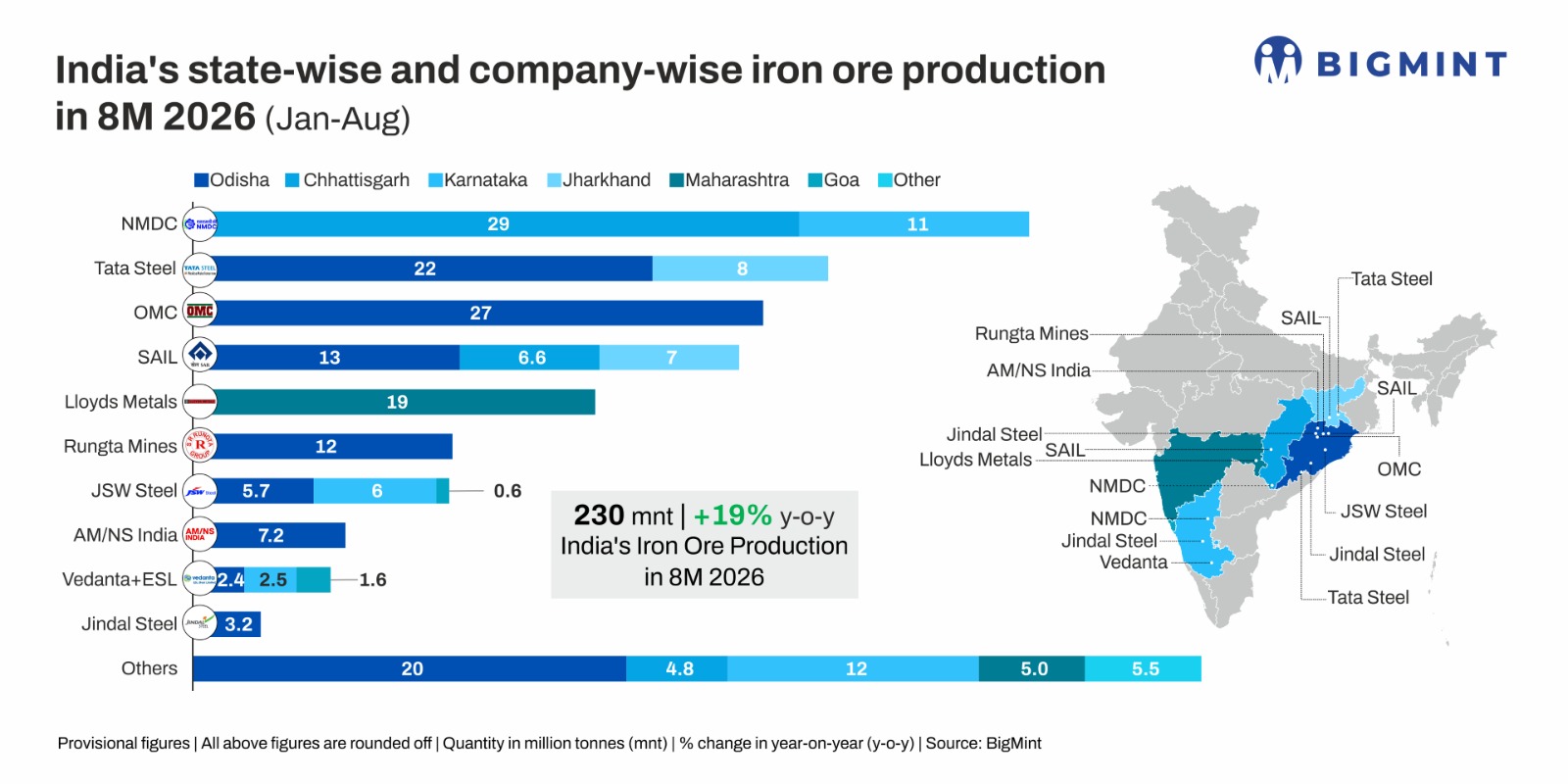
Morning Brief: India’s iron ore production increased 19% y-o-y to 230 million tonnes (mnt) in January-August 2026 (8MCY’26), according to provisional data with BigMint. Production growth was concentrated in Odisha (+13%), Chhattisgarh (+25%), and Maharashtra (+179%). The increase was largely driven by higher output from NMDC, Odisha Mining Corporation (OMC), and Lloyds Metals and Energy, while captive producers’ growth remained uneven.
Merchant production rose 28% y-o-y to 143 mnt in January-August, compared with a 7% increase in captive production to 88 mnt. Merchant miners, therefore, accounted for around two-thirds of the 36 mnt increase in national production during the period.
The faster rise in ore supply has outpaced growth in the steel industry. Crude steel production increased 6% y-o-y to 115 mnt during 8MCY’26, while hot metal production rose 2% to 64.4 mnt and sponge iron output increased 4% to 40.5 mnt.
Merchant miners drive India’s production increase
NMDC remained India’s largest iron ore producer, with output rising 24% y-o-y to 39.5 mnt in 8MCY’26. Production from its Chhattisgarh operations reached 28.6 mnt, while Karnataka output stood at 10.9 mnt. The increase reflects continued ramp-up at mining operations in Chhattisgarh.
NMDC is targeting 60 mnt of iron ore production in FY’27, compared with 53 mnt in FY’26. The company expects higher output from Deposit 14, NMZ, Kumaraswamy, and Deposit 5 to add around 5.3 mnt to production in FY’27, taking output to about 58.5 mnt. A further 1 mnt from Deposit 4 and 0.5 mnt from Deposit 13 are expected to take total production to 60 mnt.
OMC also recorded strong growth, with production increasing 17% y-o-y to 26.9 mnt in 8MCY’26. The Gandhamardan mine was a key contributor, with production rising 46% y-o-y to 7.10 mnt following the change in the mine developer and operator arrangement. Besides this, higher output from Daitari also lifted OMC’s total.
Lloyds recorded the sharpest increase among the major producers. Its production rose 147% y-o-y to 19 mnt in 8MCY’26 from 7.7 mnt a year earlier, as the company ramped up operations at its Surjagarh mines in Maharashtra. The increase follows a substantial expansion in the mine’s approved capacity and improved evacuation through the company’s slurry pipeline. Lloyds’ approved environmental clearance (EC) volume surged to 26 mnt in FY’26 from 10 mnt in FY’25.

Captive miners show more mixed trend
The increase in captive production was much slower than in the merchant segment, with output rising 7% y-o-y to 88 mnt in 8MCY’26.
Tata Steel’s iron ore production increased 11% y-o-y to 30 mnt, while SAIL’s output rose 10% to 25.8 mnt. Tata Steel has expanded production at its Joda East (Odisha) and Noamundi (Jharkhand) mines, and the additional supply has also prompted the steelmaker to consider selling material in the merchant market.
SAIL’s production has also increased by 10% y-o-y to 25.8 mnt, driven by its Chhattisgarh-based mines. In contrast, JSW Steel’s production declined 12% y-o-y to 12.1 mnt. The main weakness came from its Odisha mines, with production from Narayanposhi falling 38% to around 2 mnt and Nuagaon declining 25% to around 3.25 mnt during the first eight months of CY’26.
Both mines were acquired through auctions at relatively high premium levels, and lower output from these assets has weighed on JSW’s overall production. However, the company has started production from the Netrabandha mine in Odisha, which should provide some additional supply as operations ramp up.
Rungta Mines’ production fell 6% y-o-y to 12.3 mnt. Output from Sanindpur (Odisha) declined 11% to 9.6 mnt, while Oraghat (Odisha) production was down by 4.6% to around 2.05 mnt. The company has started operations at the Chandiposhi and Pureibahal mines in Odisha, each with capacity of around 1 mnt/year, but the new output has not yet offset lower production from its existing mines. Consequently, Rungta has also increased its sourcing of ore from merchant miners.
Jindal Steel’s production declined 11% y-o-y to 3.2 mnt. The closure of the Roida-I mine, which was producing ore during the corresponding period last year, has also contributed to the decline.
Mining costs remain constraint for auctioned leases
The slower growth among several captive miners highlights a cost issue that is becoming increasingly important for India’s ore supply. Production from auctioned leases can face higher effective costs, while delays in mine development and the economics of individual leases can affect production decisions.
The Supreme Court on 13 July upheld the government’s method of calculating the Average Sale Price for royalty purposes, ruling that royalty, District Mineral Foundation (DMF), and National Mineral Exploration and Development Trust (NMEDT) payments can remain included in the sale value used to calculate royalty. The court rejected a challenge to the relevant provisions of the 2016 and 2017 mining rules.
The ruling leaves the existing royalty calculation framework in place. For higher-cost auctioned mines, this means the cost pressure associated with the existing ASP methodology is unlikely to ease through a change in the royalty calculation in the near term.
Meanwhile, the government has also tightened the framework to speed up mine operationalisation, though the impact on production is likely to be gradual. The Ministry of Mines notified the Mineral (Auction) Second Amendment Rules, 2026, in March, building on earlier measures that introduced intermediary timelines, performance-security provisions, and monitoring mechanisms for auctioned blocks. The ministry said the measures were aimed at faster operationalisation of mines.
Outlook
BigMint expects India’s iron ore production to cross 350 mnt in CY’26, implying growth of more than 15% from 298 mnt in CY’25. Merchant miners are likely to remain the main source of incremental supply, with NMDC, OMC, and Lloyds accounting for a significant share of the increase.
However, higher domestic production is unlikely to eliminate India’s need for imports, with iron ore and pellet arrivals reaching an 11-year high in August. Demand for high-grade ore, coastal logistics advantages, and higher costs at some auctioned domestic mines will continue to support imports.
Supply disruptions have also added to the pressure, with NMDC’s Karnataka mine sales falling to 4.43 mnt during April-August 2026 from 5.82 mnt a year earlier, while Odisha’s iron ore dispatches fell to a 10-month low of 12.3 mnt in July amid heavy monsoon rains and tighter grade checks. OMC’s dispatches dropped to 3.1 mnt, the lowest since October 2025.
As a result, imports could remain elevated even as domestic production exceeds 350 mnt. The key issue is no longer simply the availability of iron ore in aggregate, but whether the additional supply matches steelmakers’ requirements by grade, location, and cost.
Leave a Reply