- Global iron ore prices fall for 3rd straight month, weakening export realisations
- Low-grade iron ore supply in Odisha remains tight amid stringent checks by govt
- China’s pellet demand strengthens amid rising coke prices, higher lump premiums
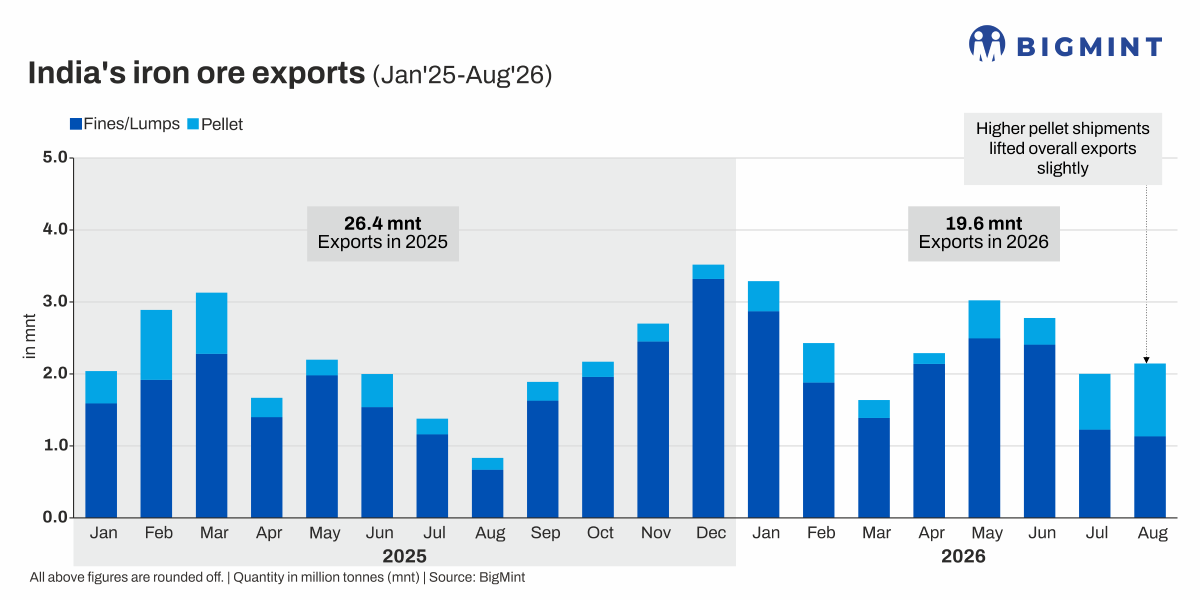
Morning Brief: India’s total iron ore and pellet exports rose 8% m-o-m to 2.15 million tonnes (mnt) in August 2026, supported by a sharp increase in pellet shipments even as iron ore exports continued to decline. Iron ore exports declined 8% m-o-m to 1.13 mnt, the lowest since August 2025, while pellet exports rose 29% m-o-m to 1.01 mnt, the highest since February 2024, according to BigMint data.
While iron ore shipments remained under pressure from tighter availability of low-grade material, monsoon-related disruptions, and weaker global prices, pellet volumes continued to rise due to a series of deals closed in mid-July, when Chinese demand improved slightly and overseas sales offered better realisations.
Iron ore exports remain under pressure in Aug’26
China remained the largest destination for Indian iron ore exports at 0.94 mnt in August, followed by Malaysia at 0.20 mnt. Rungta Mines was the largest exporter at 0.34 mnt, followed by OCL at 0.33 mnt and Lloyds at 0.18 mnt.
Stringent checks limit low-grade supply: India’s iron ore exports declined in August, as supply constraints limited the availability of low-grade material for overseas sales. Stringent checks by Odisha government authorities — aimed at preventing grade misreporting — prevented several miners from offering low-grade ore at lower prices, while the monsoon also affected ore availability, tightening exportable supply.
Iron ore dispatches from Odisha — India’s largest iron ore-producing state — fell to a 10-month low of 12.3 mnt in July. Dispatches from Odisha Mining Corporation (OMC) dropped to 3.1 mnt, the lowest since October 2025. Additionally, merchant miners, including GVPR and S.N. Mohanty, also reported m-o-m declines in dispatches, further tightening domestic availability.

Global iron ore prices decline: Weaker international prices added to the pressure. The average price of 61% Fe Australia-origin iron ore fines fell to $95.7/dry metric tonne (dmt) CFR China in August from $98.2/dmt in July, extending a three-month decline from $108.8/dmt in May. The August average was lower by $2.5/dmt m-o-m, marking the third consecutive monthly decline.
The correction was also visible in India-origin material. The monthly average assessment for 57% Fe iron ore fines, FOB Paradip, fell to $54.6/t in August from $55.4/t in July and $61.9/t in May. Moreover, the gap between export and domestic realisations widened from INR 225/t ($2.4/t) in mid-July to around INR 600/t ($6.3/t) in mid-August. Weaker export realisations, therefore, encouraged exporters to step back from the seaborne market.
Bid-offer gaps, stable Chinese port stocks slow down trade: Additionally, trading activity remained limited as buyers and sellers struggled to agree on prices. Some sellers tried to offer material at lower discount levels, but the persistent bid-offer gap restricted transactions.
At the same time, Chinese iron ore inventories (including fines, lumps, concentrate, and pellets) across 34 major ports remained flat m-o-m at around 159 mnt in August. The stable inventory position reduced urgency among Chinese buyers to increase purchases of Indian ore.

Pellet exports continue to climb up
China absorbed 0.70 mnt of India’s pellet exports in August, while Malaysia accounted for another 0.11 mnt. KIOCL and Rungta Mines were the largest exporters, with 0.27 mnt each, followed by Bengal Energy and Orissa Metaliks at 0.08 mnt each.
Domestic demand remains slow: Pellet exports increased sharply in August as producers diverted more material towards overseas markets amid subdued domestic demand. Export realisations for August-loading cargoes booked in July were around INR 120-130/t ($1.3-1.4/t) higher than domestic levels, according to market sources. Barbil’s pellet prices fell to around INR 8,000/t ($83.7/t) in July 2026, making exports a more viable outlet for producers with available material.
Rising lump premiums push Chinese mills towards pellets: Chinese demand for pellets improved slightly during mid-July, though it remained selective. Although steel demand in China was seasonally weak, mills increased purchases of Indian pellets as lump premiums crossed $20/dmtu, reducing the competitiveness of South African lump ore. Additionally, consecutive rounds of coke price hikes caused mills to restructure their blend mix, supporting demand for Indian pellets.
Lloyds’ pellet production rises: Higher production at Lloyds also supported the increase in export availability. The company produced 1.69 mnt of pellets in Q1FY’27, with its second pellet plant, commissioned in May 2026, reaching full capacity utilisation within four months. The additional production capacity increased supply in the domestic market, leading to greater incentive to export among suppliers.
Outlook
BigMint expects India’s iron ore and pellet exports to decline in September as weak buying interest and limited trading activity weighed on overseas sales during late July and the first half of August.
Consequently, iron ore exports are likely to remain under pressure due to tight availability of exportable low-grade ore, monsoon-related supply disruptions, and cautious buying from China amid subdued steel demand and elevated inventories.
Meanwhile, pellet exports, which provided the main support to August shipments, are also likely to ease. Wider bid-offer gaps and cautious buying slowed fresh bookings, while export economics have become less favourable as overseas buyers resist higher offers.
With steel and raw material prices expected to continue rising in September, sellers are likely to see improved realisations in the domestic market. This could keep exporters’ focus firmly on domestic sales.
Leave a Reply