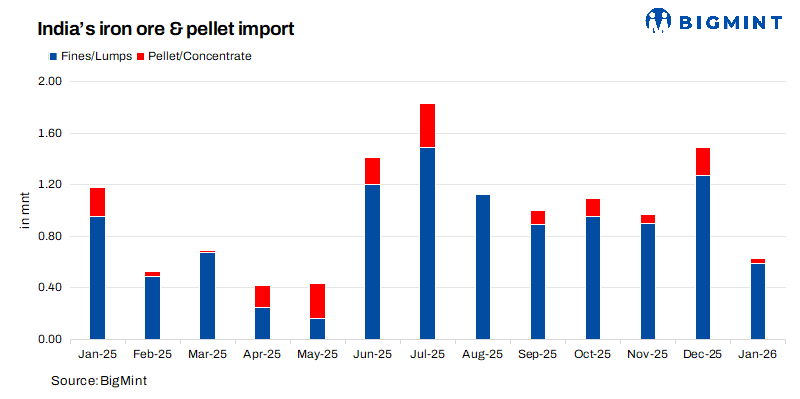
- Pellet imports remain limited amid domestic lumps preference
- Brazil remain top iron ore importer to India
India’s combined iron ore and pellet imports declined sharply in January 2026, with total arrivals falling to 0.63 million tonnes (mnt), down 57.7% m-o-m from 1.49 mnt in December 2025 and 46.2% y-o-y from 1.17 mnt in January 2025, BigMint assessment indicates. Of the total imports in Jan’26, iron ore accounted for 0.59 mnt, while pellet imports were limited to 0.04 mnt, reflecting subdued buying interest and selective trades through the sea market.
Commodity-wise breakup
Iron ore imports in Jan’26 stood at 0.59 mnt, down sharply from 1.27 mnt in Dec’25, registering a 53.5% decline m-o-m. On a y-o-y basis, iron ore imports fell 37.9% from 0.95 mnt recorded in Jan’25. The elevated arrivals in December had largely met near-term requirements, resulting in muted booking activity in January.
Pellet imports witnessed a steep contraction in January, declining to 0.04 mnt from 0.22 mnt in December, translating into an 81.8% fall m-o-m. Imports were also significantly lower y-o-y compared with 0.23 mnt recorded in January 2025. Pellet demand remained weak, with buyers avoiding inventory build-up with lumps was in preference for raw material feed amid uncertain downstream visibility and subdued operating rates.
Party-wise details
BigMint data indicated that JSW Steel Limited accounted for the bulk of India’s iron ore imports in January. JSW imported 0.59 mnt of iron ore in January 2026, sharply lower than 1.27 mnt recorded in Dec’25, pointing to a significant scale-back in overseas procurement. The decline in imports was primarily due to an adequate supply of raw materials over the past couple of months and some expected shipments in March. Meanwhile, other steelmakers were utilising domestic lumps and pellets and were not considering imported materials.
Sourcing and origin trend
Brazil emerged as the dominant supplier in January, contributing 0.54 mnt of iron ore imports. The higher iron (Fe) content of Brazilian ore maintained its priority among buyers, even as sourcing from other regions declined in the first month of CY25.
Port-wise statistics
Import arrivals during January were concentrated at a few key ports. Jaigarh handled the highest volumes at 0.37 mnt, followed by Krishnapatnam at 0.17 mnt, Mumbai at 0.06 mnt, and Kandla at 0.04 mnt. Jaigarh port was among the top due to JSW’s iron ore imports from Brazil.
Outlook
BigMint expects that iron ore and pellet imports will remain stable at current levels over the next month, as additional shipments may be sourced due to the expiration of the domestic miners EC limits. During the Chinese New Year holidays, some shipments might be redirected to India at competitive prices.
Leave a Reply