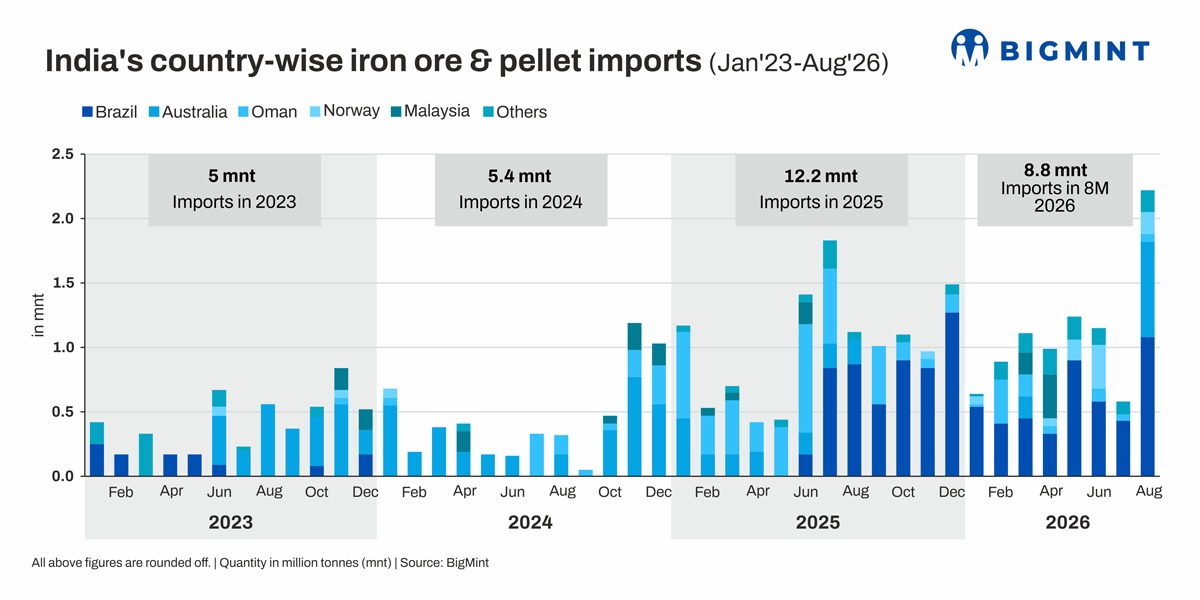
- August imports reach around 2.2 mnt of 1.1 mnt is iron ore
- Supply and dispatch-related issues in key states drive imports
- Imports surge on weakening global prices, strong domestic steel production
Morning Brief: India’s iron ore and pellet imports climbed to an 11-year high in August 2026, reaching 2.22 million tonnes (mnt), according to provisional data maintained by BigMint. The sharp increase was driven by a combination of domestic supply disruptions, lower global iron ore prices, and strong demand for higher-grade raw materials from domestic steelmakers.
Of the total imports, iron ore fines and lumps accounted for approximately 1.7* mnt, while pellet imports stood at around 0.5 mnt.
Brazil remained the largest supplier to India during the month, contributing nearly 0.9 mnt. Meanwhile, Australian iron ore shipments to India resumed after a five-month hiatus, providing additional support to import volumes.
The rise in imports comes against the backdrop of monsoon-related disruptions in key mining regions and a decline in international iron ore prices, which improved the attractiveness of imported material for Indian steel producers.
Factors driving iron ore, pellet imports
- High-grade ore demand by steel major: A key factor behind the surge in iron ore imports was the renewed buying activity by a large primary steel mill for its flagship operations in south India. Demand for high-grade iron ore continued to outpace supply in the domestic market, as availability of quality material remained limited. Market participants noted that only a small number of miners were offering high-grade ore, while steelmakers actively sought consistent-quality. This imbalance allowed sellers to maintain firm prices even when domestic steel market conditions were not positive.

- Domestic supply constraints: Domestic supply constraints were exacerbated by operational and logistical issues at NMDC’s Karnataka mines during May and June. The disruptions affected dispatches and reduced the number of auctions conducted during the period. NMDC’s sales from Karnataka mines during April-August 2026 fell to 4.43 mnt, compared with 5.82 mnt in the corresponding period last year.
Although most of these issues have now been resolved, the earlier shortfall contributed to increased import dependence during August.
- Decline in iron ore prices globally: Another driver was the sustained decline in global iron ore prices. Iron ore fines (Fe 61%, Australia-origin) averaged $95.7/dry metric tonne (dmt) CFR China in August, down $2.5/t m-o-m and marking the third consecutive monthly decline. Prices had fallen from $108.8/dmt in May to $100.7/dmt in June and further to $98.2/dmt in July.
The weakness in prices was largely attributed to a cautious purchase strategy adopted by Chinese steel mills, subdued restocking demand, ample seaborne supply, and weaker steelmaking economics. Lower international prices improved the competitiveness of imported ore relative to domestic supplies which created favourable conditions for imports.

- Drop in Odisha dispatches: Iron ore dispatches from Odisha—India’s largest iron ore-producing state—fell to a 10-month low of 12.3 mnt in July. The decline was caused by heavy monsoon rains and tighter government inspections aimed at preventing grade misreporting. Dispatches from Odisha Mining Corporation (OMC) dropped to 3.1 mnt, the lowest since October 2025. Merchant miners, including GVPR and S.N. Mohanty, also reported m-o-m declines in dispatches, further tightening domestic availability which necessitated imports.
- Availability, quality issues trigger higher pellet imports: Pellet imports also rose significantly during August as domestic pellet availability remained constrained. Monsoon-related disruptions affected the availability of iron ore feedstock for pellet producers, limiting production levels across the sector.
The resulting shortage of pellets, particularly blast furnace (BF)-grade material, prompted steelmakers to increase imports to meet blending and operational requirements. Imported pellets also offered advantages in terms of more consistent iron content and lower impurity levels, making them an attractive option for mills facing challenges in sourcing suitable domestic material.
Outlook
As monsoon-related disruptions ease and domestic mining and logistics operations normalise, followed by improved dispatches from Odisha and the resolution of operational issues at NMDC’s Karnataka mines, domestic availability will most likely be restored which may temper the volume of imports.
However, tight high-grade iron ore availability and logistical problems and steep costs are long-persisting issues which belie any quick resolution. These factors will keep supporting import demand. The major mills are also trying to achieve energy efficiency and reduction in carbon emissions. These factors will sustain the demand for high-grade ore imports amid shrinking domestic supply. Low prices, too, will favour imports amid increasing steel production by the domestic mills. Pellet imports may stay supported until domestic supply normalises.
*Correction: Iron ore fines and lumps fig were changed to 1.7 mnt from 1.1 mnt.
Leave a Reply