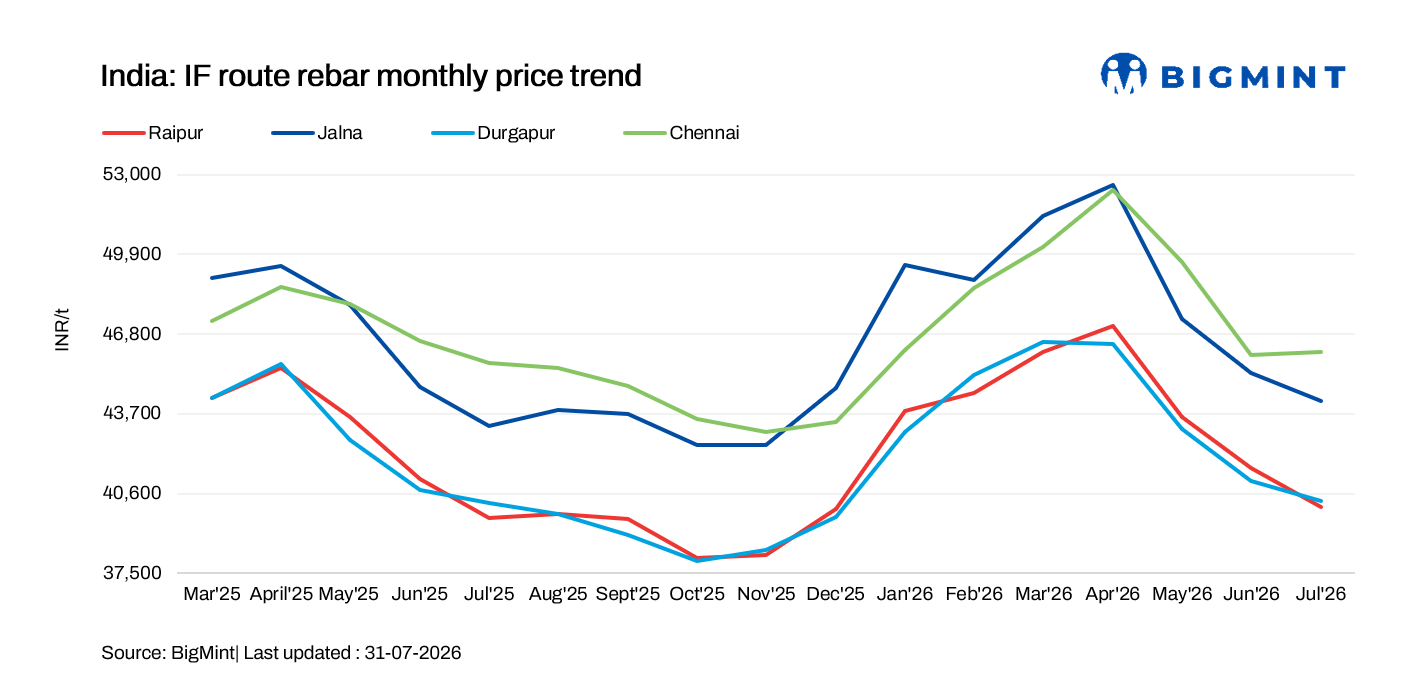
- Regional price trends diverge amid uneven demand
- Raw material costs remain firm amid supply tightness
India’s induction furnace (IF)-route rebar prices displayed a mixed trend across major markets in July. While prices weakened across the central, eastern, and northern regions, the western and southern regions staged a recovery supported by improving demand conditions and higher production costs.
Bengaluru and Mumbai recorded the strongest price gains of INR 2,700/t and INR 1,900/t, respectively, supported by easing monsoon disruptions, improved construction activity, stronger order bookings, and reduced spot discounts by mills. Firm billet prices, driven by tight domestic scrap availability, further reinforced the upward trend. In contrast, Muzaffarnagar and Patna registered the steepest corrections of INR 1,500/t and INR 1,300/t, respectively, amid moderate buying activity and weaker semi-finished steel prices.
Buying activity across the country remained largely need-based throughout the month, with procurement ranging from low to moderate. Mill inventories hovered at around 15 days, while order booking visibility was limited to 3-5 days. Meanwhile, the price gap between BF-route and IF-route rebar narrowed to around INR 5,100/t in July from INR 6,900/t in June.
Region-wise price movements
The western region witnessed a positive price trend, with IF-route rebar prices increasing by INR 200-1,600/t across major markets, except Ahmedabad, where prices declined by INR 400/t. Mumbai led the gains with an increase of INR 1,600/t, followed by Goa and Jalna.
Market activity remained weak during the first half of the month as heavy rainfall curtailed construction activity. However, demand improved in the latter half following the easing of monsoon disruptions, resulting in healthier order bookings and improved mill pricing power. Tight domestic scrap availability, particularly in Mumbai, lifted billet prices and supported higher rebar offers.
The southern region recorded the strongest recovery, with prices rising by around INR 1,000-1,500/t m-o-m, led by Hyderabad and Chennai.
The uptrend was primarily driven by a sharp increase in sponge iron prices, which significantly raised production costs for secondary steelmakers and prompted mills to revise rebar offers upward to protect margins. Although procurement remained largely need-based due to monsoon-related disruptions, relatively better market activity compared with other regions supported the price increase.
In the central region, IF-route rebar prices declined by around INR 900/t during the month as moderate buying activity and resistance to higher prices continued to weigh on the market.
Despite firm raw material costs, supported by limited pellet availability, mills reduced offers to stimulate buying interest. Procurement remained largely need-based, resulting in slower offtake and elevated mill inventories throughout the month.
The eastern region market remained under pressure, with prices declining by an average of INR 835/t to around INR 40,281/t, extending the correction for the fourth consecutive month.
Flooding across the North-East disrupted construction activity and reduced regional steel consumption, while excess material was redirected to the north where monsoon conditions restricted demand. Seller losses of around INR 1,000-2,000/t and inventories of 7-8 days continued to exert pressure on prices.
The northern region witnessed the sharpest correction, with IF-route rebar prices declining by INR 1,000-2,700/t across major markets amid weak, need-based procurement.
Although prices in Mandi Gobindgarh briefly recovered during mid-July following production disruptions caused by power outages, the gains could not be sustained as demand remained sluggish. Additionally, competitively priced TMT from Durgapur, offering a landed cost advantage of around INR 2,000-3,000/t, intensified competition and restricted any meaningful price recovery.

Raw material price trends
The raw material market remained mixed during July. Sponge iron prices strengthened amid tight availability caused by monsoon-related disruptions to production and logistics across key manufacturing hubs. However, moderate demand from the finished steel segment limited billet procurement, preventing producers from fully passing on higher input costs.
Consequently, billet prices corrected across several regions despite elevated sponge iron prices, as weak downstream demand continued to cap finished steel prices.
Taking Raipur as the benchmark, billet prices declined by INR 500/t m-o-m to INR 38,350/t ex-works as of 31 July. In contrast, sponge iron (PDRI FeM 80% ±1) increased by INR 1,350/t m-o-m to INR 25,250/t ex-works during the same period.
BF rebar sentiment
BigMint’s BF-route rebar prices increased by INR 2,200/t w-o-w to INR 50,900/t ex-Mumbai as of 31 July, supported by tighter spot supplies following scheduled maintenance at major integrated steel plants.
Lower distributor inventories and improved project procurement encouraged active replenishment, strengthening overall market sentiment. Project rebar prices were reported at INR 49,000-52,000/t landed, with booking activity improving amid expectations of further price stability. The near-term outlook remains firm, as maintenance-led supply constraints and healthy project demand are expected to support prices, although higher post-maintenance production could cap further gains.
Outlook
IF-route rebar prices are expected to remain range bound in the near term, as already-thin margins are unlikely to allow mills for further price reductions despite weak ground-level demand. While monsoon-led disruptions and sluggish construction activity are expected to keep buying largely need-based, firm production costs and limited pricing flexibility are likely to prevent any significant downside in prices.
Leave a Reply