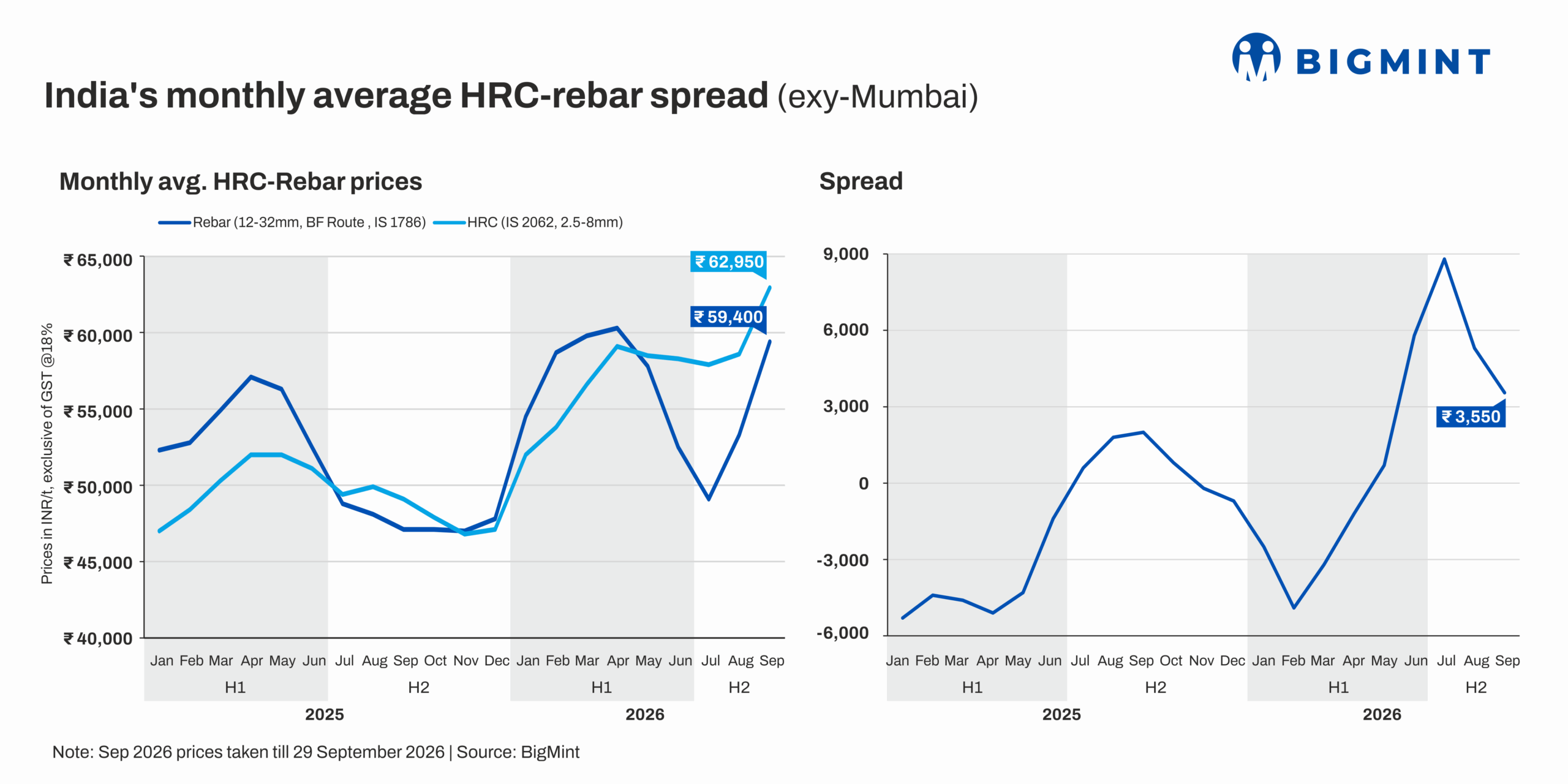
- Monthly average BF-route rebar prices up INR 6,100/t m-o-m, HRC rises by INR 4,350/t
- BF-rebar prices rally on tight supply as major mills record sharp drop in production
- HRC prices at 4-year highs, coking coal surge in Sept’26 boosts steelmaking costs
Morning Brief: India’s steel hot rolled coil (HRC)-rebar price spread narrowed further to INR 3,550/tonne (t) in September from INR 5,300/t in August, as rebar prices increased at a faster pace than HRC amid tightening availability, improving project demand and stronger mill price realisations.
Trade-level BF-route rebar prices increased by INR 6,100/t m-o-m to a monthly average of INR 59,400/t in September, while HRC prices rose by INR 4,350/t to INR 62,950/t, both ex-Mumbai and excluding 18% GST. The spread has therefore moved closer to the lower end of its historical range of around INR 4,000-5,000/t.
The September price movement represents a continuation of the trend established in August. The spread had already fallen sharply from INR 8,800/t in July to INR 5,300/t in August as supply constraints and improving project bookings pushed rebar prices higher. In September, these supply constraints were compounded by the seasonal recovery in construction activity, allowing rebar to outperform HRC for a second consecutive month.
Rebar prices surge on tight supply, project demand
BF-route rebar prices recorded a sharp increase in September, extending the rally that began in August. The primary driver was tight availability across the supply chain, as several integrated mills continued to operate with constrained production and remained selective in accepting fresh bookings.
Two major producers reported sharp reduction in production due to coke constraints and the delay in setting up of new blast furnaces.
The supply situation was particularly tight in the project market. Mills were cautious about taking large forward orders amid strong existing order backlogs and expectations of further price increases. This limited availability and enabled producers to pass higher list prices through to the trade market more rapidly.
Demand also improved as the monsoon gradually withdrew from different regions and construction activity resumed. Project enquiries and bookings increased through the month, while distributors began replenishing inventories ahead of the festive season and anticipated post-monsoon demand recovery. Lean inventories across both mills and distribution channels further strengthened sellers bargaining power.
These factors resulted in successive price increases during September. Trade-level BF-route rebar prices rose by INR 1,700/t w-o-w to INR 59,000/t on 11 September and subsequently increased by another INR 2,000/t to INR 61,000/t on 18 September. Prices reached INR 62,100/t by 25 September, despite some moderation in the broader longs market.
Revised diameter premiums introduced by some mills for smaller rebar sizes also supported product-level realisations. As a result, rebar prices increased by around 11.4% m-o-m in September, significantly outpacing the increase in HRC prices.
HRC prices reach 4-year highs but still lag rebar in Sept
HRC prices also recorded a strong increase in September, although the pace of appreciation was lower than in rebar. The monthly average HRC price increased by INR 4,350/t to INR 62,950/t, supported by mill-led price revisions, controlled dispatches and relatively tight spot availability.
Major domestic producers raised HRC prices during the month, with mid-month increases of around INR 750-1,750/t helping to lift transaction prices across the trade market. The announcements triggered a rise in market enquiries as distributors and end-users sought to secure material ahead of further revisions.
Supply remained relatively controlled as mills continued to prioritise automotive and large B2B customers. This reduced availability in the trade channel, while distributors continued to operate with moderate or lean inventories. The absence of a significant spot market supply overhang allowed higher mill prices to be transmitted into the trade market.
Demand, however, remained more moderate than in rebar. Buying was largely requirement-driven, with selective restocking supported by expectations of additional mill price hikes. Demand conditions varied across regions, with relatively healthy buying in western India, cautious demand in the north and gradual improvement in the south, particularly from the OEM segment.
Increased HRC export prices offer support: Strengthening domestic realisations continued to support India’s HRC export market. Indian export prices to the EU increased by $65/t during September offering support to domestic prices. By late September, HRC prices remained firm despite some weekly consolidation. The sharp monthly increase started to encounter some buyer resistance. The key difference with rebar was therefore not a lack of support for HRC, but the stronger ability of rebar producers to pass through higher costs amid tighterphysical availability and improving construction demand.
BF-BOF steelmaking costs surge
The key factor pushing prices higher during September was obviously higher energy and fuel costs. BigMint’s analysis of a reference blast furnace-basic oxygen furnace (BF-BOF) model estimates crude steel cost at INR 39,700/t in September, up approximately INR 6,000/t, or 17.7%, y-o-y. Costs increased by around INR 2,500/t, or 6.6% m-o-m in September, the largest monthly rise this year.
Analysis shows that the surge in coking coal costs and the simultaneous surge in coke and PCI coal prices accounted for 86% of the total cost increase. Higher costs pushed mills to raise prices, albeit at a proportionally greater pace than the surge in production costs.
Premium coking coal prices increased sharply from around $240/T CNF Paradip in the first week of August to over $300/t CNF in September before moderating marginally. The increase in prices have to do with supply factors in China and the tight premium segment market. This has been the key reason for the steel price surge in September.
Outlook
For rebar, the key supporting factors are the continued recovery in construction activity following the monsoon, lean inventories and limited prompt availability from integrated mills. Pre-festive project bookings remain strong and mills continue to restrict forward commitments; therefore, rebar could retain relatively strong pricing power.
However, a return of additional mill capacity would reduce the tightness that has supported the market over the past two months.
For HRC, domestic prices are likely to remain supported by firm mill offers, controlled dispatches and raw material costs. However, the scope for further sharp increases could be constrained by buyer resistance at elevated prices and, of course, spread with landed imports. In October, whether HRC-rebar spread moves further below the historical INR 4,000-5,000/t average will depend primarily on the duration of rebar supply tightness and the strength of the post-monsoon construction recovery relative to HRC demand from manufacturing and downstream industries.
Leave a Reply