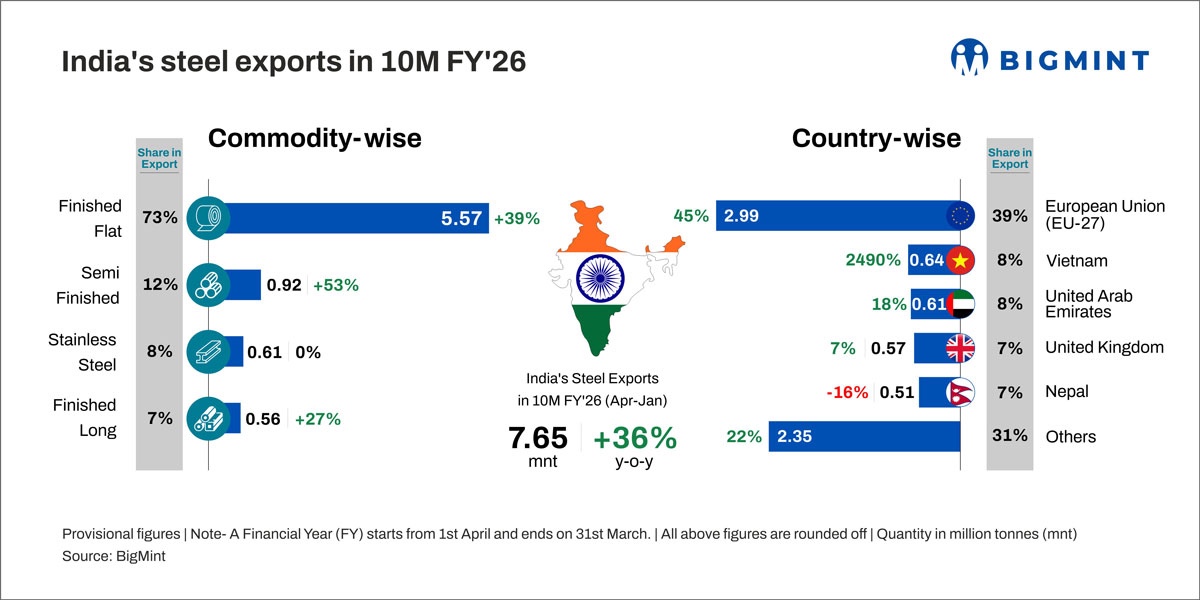
- Trade disruptions keep Indian HRC exports subdued
- Persistent uncertainty clouds near-term export outlook
Indian hot-rolled coil (HRC) export activity remained largely at a standstill across key overseas markets during the week, as escalating geopolitical tensions continued to disrupt critical shipping corridors. Heightened security risks along routes such as the Red Sea-Suez Canal and the Strait of Hormuz have led to widespread vessel diversions, extended transit times, and a sharp rise in freight and war-risk insurance costs.
With limited visibility on logistics and delivery timelines, market participants have largely refrained from issuing fresh offers, while buyers continue to remain cautious. The prevailing uncertainty, coupled with persistent shipping disruptions, continues to weigh on market sentiment and constrain HRC trade flows.
HRC offers to Europe: Indian HRC export offers to Europe remained absent during the week, as escalating security risks across key shipping corridors continued to disrupt trade flows. A growing number of vessels are avoiding the Red Sea-Suez Canal route, opting instead for longer voyages via the Cape of Good Hope, extending transit times to Europe by approximately 15-20 days. This has disrupted delivery schedules and sharply increased freight and war-risk insurance costs, undermining export viability.
European buyers have adopted a cautious stance, increasingly favouring domestic sourcing over imports. Concerns are rising that route diversions, particularly for Asian-origin cargoes, could delay arrivals beyond the implementation of proposed safeguard measures in July 2026.
At the same time, overseas coil availability into the EU has declined, as elevated freight costs and logistical disruptions continue to weigh on trade flows. While some Asian mills are offering on an FOB basis, they remain unwilling to absorb the additional risks associated with highly volatile freight rates.
Although delivery delays are unlikely to exceed one month, even moderate disruptions are critical given the timing of the EU’s revised quota regime. Under the proposed framework, import volumes could decline by 47%, alongside a doubling of safeguard duties to 50%. Uncertainty around country-specific allocations and potential caps within global quotas has further heightened caution, particularly for Q3 arrivals where delays could increase the risk of breaching tighter limits.
HRC offers to Middle East: Indian HRC export activity to the Middle East remained largely subdued w-o-w, with no firm offers reported amid escalating geopolitical tensions disrupting regional trade flows. Market participants remained cautious, citing heightened logistical risks and limited visibility on near-term developments.
The Strait of Hormuz, which handles around 20% of global oil and LNG trade, has emerged as a critical flashpoint. Rising missile and drone threats, along with attacks on merchant vessels, have severely disrupted shipping operations, driving a sharp increase in freight rates and war-risk insurance premiums, further undermining export viability.
Shipping lines and insurers have adopted a cautious stance, with several vessels avoiding the route and some carriers suspending operations in high-risk zones altogether. As a result, trade flows have been materially impacted, with delays and persistent uncertainty weighing on market sentiment.
A Middle East-based source noted: “Disruptions around the Hormuz corridor have significantly affected cargo movements, particularly to and from the UAE. This has led to production cuts and raised the risk of temporary shutdowns due to raw material shortages. While few FOB offers may still be available from some mills, freight remains highly volatile and unpredictable. In addition, difficulties in securing war-risk insurance for fresh shipments have further elevated transaction risks, resulting in cross-border activity largely coming to a standstill.”
Similarly, Chinese HRC export activity to the Middle East remained muted, with no firm offers reported during the week. Ongoing disruptions continue to constrain flows to China’s key export destination, which typically absorbs 25-30 million tonnes (mnt) of steel annually.
Meanwhile, May 2026 HRC contracts on the Shanghai Futures Exchange (SHFE) edged up by RMB 18/t ($3/t) w-o-w to around RMB 3,321/t ($482/t) on 24 March, compared with RMB 3,303/t ($479/t) on 17 March.

Outlook
Indian HRC export activity is likely to remain under pressure as ongoing geopolitical tensions continue to disrupt key shipping routes, keeping freight rates elevated and logistics highly uncertain. Limited visibility on delivery timelines and volatile war-risk insurance costs are expected to discourage mills from issuing fresh offers.
Leave a Reply