- Competitive domestic prices limiting bookings
- Elevated freight and weak demand keep import activity subdued
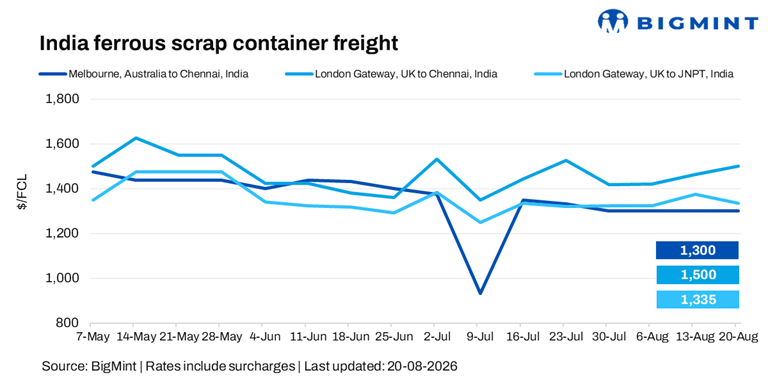
India-bound ferrous scrap container freight rates remained diverse in the week ended 20 August. India’s ferrous scrap import market remained subdued, with booking activity expected to stay low through August and mid-September. Despite relatively steady finished steel demand during the monsoon, Indian mills continued to rely mainly on domestic scrap and pig iron, limiting their need for imported material.
The containerised scrap market faced mounting shipping-side constraints, with continental vessels reportedly overbooked and shortages of equipment and vessel space restricting cargo movement. Longer transit times and volatile fuel costs further increased landed import costs, making overseas scrap less competitive against domestic alternatives.
Buyers remained reluctant to build inventories or commit to long-voyage cargoes amid ongoing global trade and geopolitical uncertainty. With Indian mills relying more on domestic scrap, low booking volumes are expected to keep shipowner participation subdued, limiting upside in freight rates despite tight vessel availability on some routes.
Route-wise sentiment

Market highlights
- CFI rises 2.42% w-o-w: The Shanghai Containerized Freight Index (SCFI) rose 2.42% w-o-w to 3,355.24 on 14 August 2026 from 3,276.14 on 7 August, driven by firmer transpacific rates. Asia-US West Coast and East Coast rates increased, while Asia-Europe and Asia-Mediterranean trades remained under pressure.
- Bunker costs decrease w-o-w: Bunker prices declined w-o-w by $20/t (2.3%) w-o-w to $820/t on 20 August from $840/t. The decline appears to be a short-term correction rather than a broad bearish shift, as geopolitical risks and supply concerns continue to keep crude and marine fuel markets elevated.
Outlook
India-bound ferrous scrap freight is likely to remain mixed across origins in the near term. Europe-India rates are expected to remain firm, particularly on London Gateway-Chennai, as tighter vessel availability and carrier pricing continue to support freight. In contrast, Australia-India rates are likely to remain broadly stable, with balanced tonnage availability offsetting subdued Indian demand.
With scrap bookings remaining limited, a broad-based freight rally is unlikely. Atlantic routes may retain a firmer bias, while Pacific routes could remain range-bound, unless Indian buying activity or vessel availability changes materially.

Leave a Reply