- Domestic deliveries to power plants decline by 6% m-o-m
- Imported coal movement rises 5%, mostly directed to steelmakers
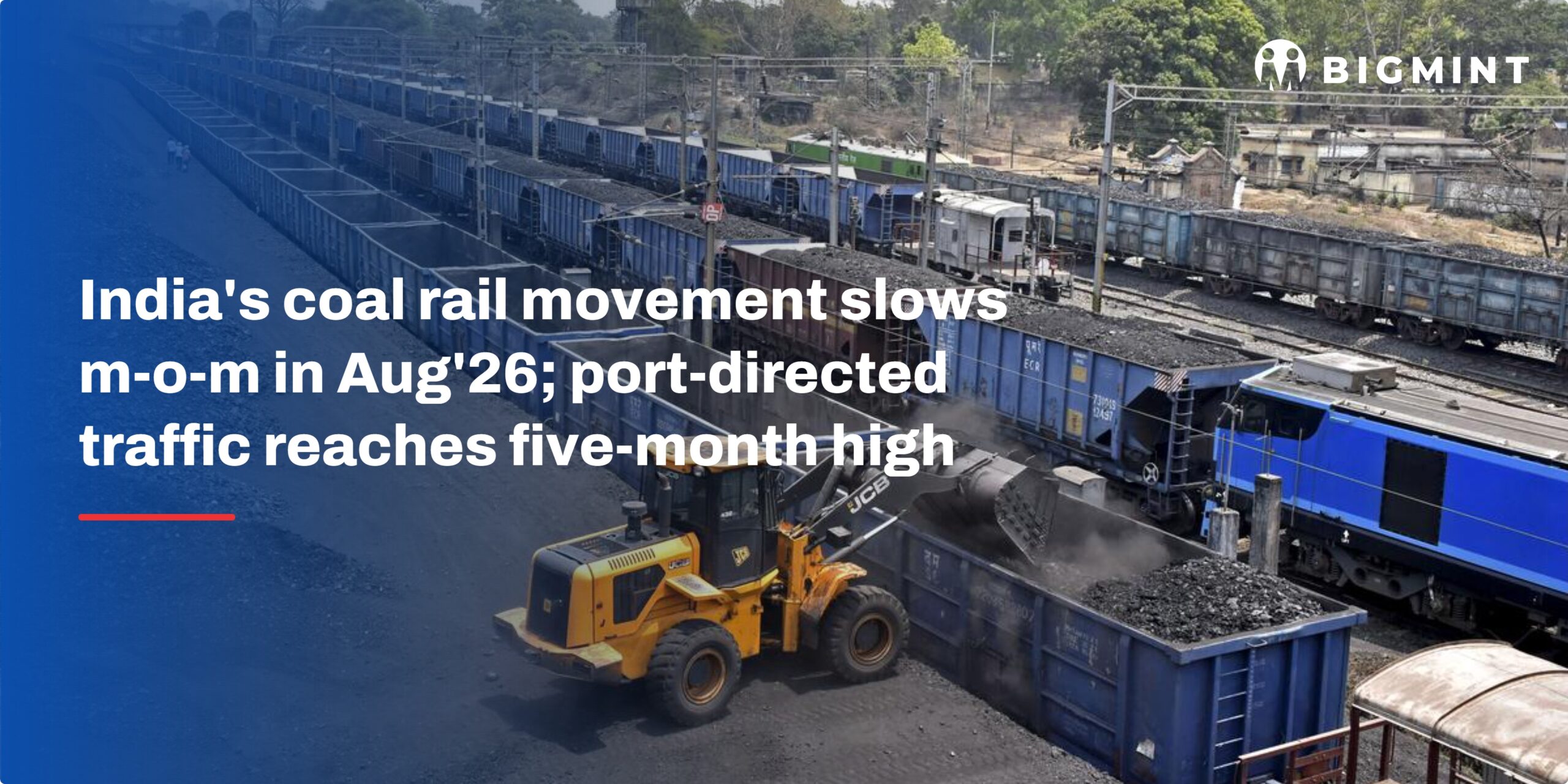
India’s coal railway movement moderated in August 2026, with domestic dispatches and deliveries to power plants declining m-o-m, while imported and port-directed coal traffic strengthened, with the latter reaching a five-month high. August also saw a halt to the steady uptrend in the power sector’s share seen in April-July.
Railway data cover 1.017 million wagons in August. Assuming 59 wagons and 3,900 tonnes (t) per rake, this represents approximately 17,240 rake-equivalents and 67.24 million tonnes (mnt) of coal.
Domestic movement weakens
Total coal movement fell by 3.1% m-o-m from 69.37 mnt in July. Domestic coal declined more sharply by 3.9% to 60.40 mnt.
Imported coal increased by 4.7% to 6.84 mnt, raising its share of traffic from 9.4% to 10.2%. However, imported movement remained below the levels recorded during April and May.

The slowdown intensified during August. Average movement fell from approximately 577 rake-equivalents/day during 1-10 August to 542 during 21-31 August, a decline of 6.1%.
Domestic traffic dropped by 7.4% between these periods, while imported traffic increased by 6.3%. This indicates that the late-month weakness was concentrated in the domestic supply chain.
Power-sector concentration retreats
Domestic coal transported to power plants totalled 53.93 mnt in August, comprising 46.54 mnt of programmed and 7.39 mnt of non-programmed movement.
This represented 89.3% of domestic coal traffic and 80.2% of total movement. Including identifiable imported-coal deliveries to generators, the power sector’s overall share is estimated at approximately 81.7%, down from 85% in July.
Domestic deliveries to power plants declined by 6.2% m-o-m, faster than the reduction in overall domestic traffic. August therefore interrupted the continuous increase in power-sector concentration recorded between April and July.
Nevertheless, the five-month network remained overwhelmingly power-led. Around 286.2 mnt, or approximately 83% of coal moved during April-August, was destined for electricity generation.
Port-directed coal reaches five-month high
Domestic coal delivered to identifiable port terminals increased to 6.75 mnt in August, equivalent to approximately 1,732 rake-equivalents. This was the highest monthly volume during April-August and an increase of 2.9% from July.

*Haldia, Kidderpore, Krishnapatnam, and Kandla. Figures are rake-equivalents derived from wagons, not an exact count of physically operated trains.
The growth occurred despite the decline in overall rail traffic. Port-linked domestic coal increased from approximately 9.5% of total movement in July to 10% in August.
Paradip dominated the rail-to-port network, receiving 23.62 mnt during the five months — around 73% of identified port-directed coal. Monthly movement through Paradip remained close to 4.8 mnt from May onwards.
Dhamra received 2.50 mnt during April-August, while Visakhapatnam and Gangavaram handled 4.35 mnt. Together, the three east coast port clusters accounted for 30.47 mnt, or nearly 95% of identified port-directed traffic.
The records establish that coal reached the terminals, but do not identify subsequent vessel loadings or final destinations. These volumes should therefore be treated as potential coastal-movement coal rather than confirmed coastal shipments.
Nevertheless, the data reveal a sizeable and strengthening rail-to-sea supply chain. Coastal distribution can help move coal from eastern and central mines to consumers in southern and western India while reducing pressure on long-distance, cross-country railway routes.
Eastern corridors remain critical
South East Central Railway and East Central Railway each handled approximately 16.4 mnt in August, followed by East Coast Railway at 12.16 mnt.
At the divisional level, Dhanbad handled 16.40 mnt, Bilaspur 15.13 mnt and Khurda Road 10.86 mnt. The three divisions together accounted for around 63% of August traffic.
During April-August, East Central Railway moved 85.79 mnt of domestic coal and South East Central Railway 81.21 mnt. Their combined share exceeded half of domestic traffic, illustrating the network’s dependence on a limited number of eastern corridors.
MCL leads dispatches; NTPC remains largest recipient
Mahanadi Coalfields was August’s largest consignor, dispatching 12.96 mnt. South Eastern Coalfields followed with 6 mnt, Central Coalfields with 5.52 mnt and Northern Coalfields with 5.22 mnt.
Seven Coal India subsidiaries collectively contributed around 39.25 mnt, or 58.4% of August movement.
NTPC remained the largest consignee at 10.71 mnt, equivalent to 15.9% of total traffic. Mahagenco received 3.95 mnt, followed by Adani Power at 2.87 mnt, Uttar Pradesh Rajya Vidyut Utpadan Nigam at 2.67 mnt and Rajasthan Rajya Vidyut Utpadan Nigam at 2.30 mnt.
Imported traffic remains steel-heavy
East Coast Railway handled 50.8% of imported traffic in August, followed by Southern Railway at 21.9%.
Tata Steel, SAIL and JSW Steel together received approximately 48.8% of imported coal moved by rail, demonstrating its metallurgical and industrial bias. Identifiable deliveries to Adani Power and IL&FS Tamil Nadu Power accounted for around 13.9%.
Outlook
August revealed two divergent trends: domestic deliveries to power plants weakened, while imported and port-directed traffic strengthened. The latter indicates that ports are becoming increasingly important not only as import gateways but also as redistribution hubs for domestic coal.
The principal logistics risk remains concentration. A handful of producers, railway divisions and eastern corridors support a geographically dispersed consumer base. As power demand, stock-building requirements and coastal coal movement compete for capacity, maintaining throughput across Dhanbad, Bilaspur, Khurda Road and their port connections will remain critical.
Leave a Reply