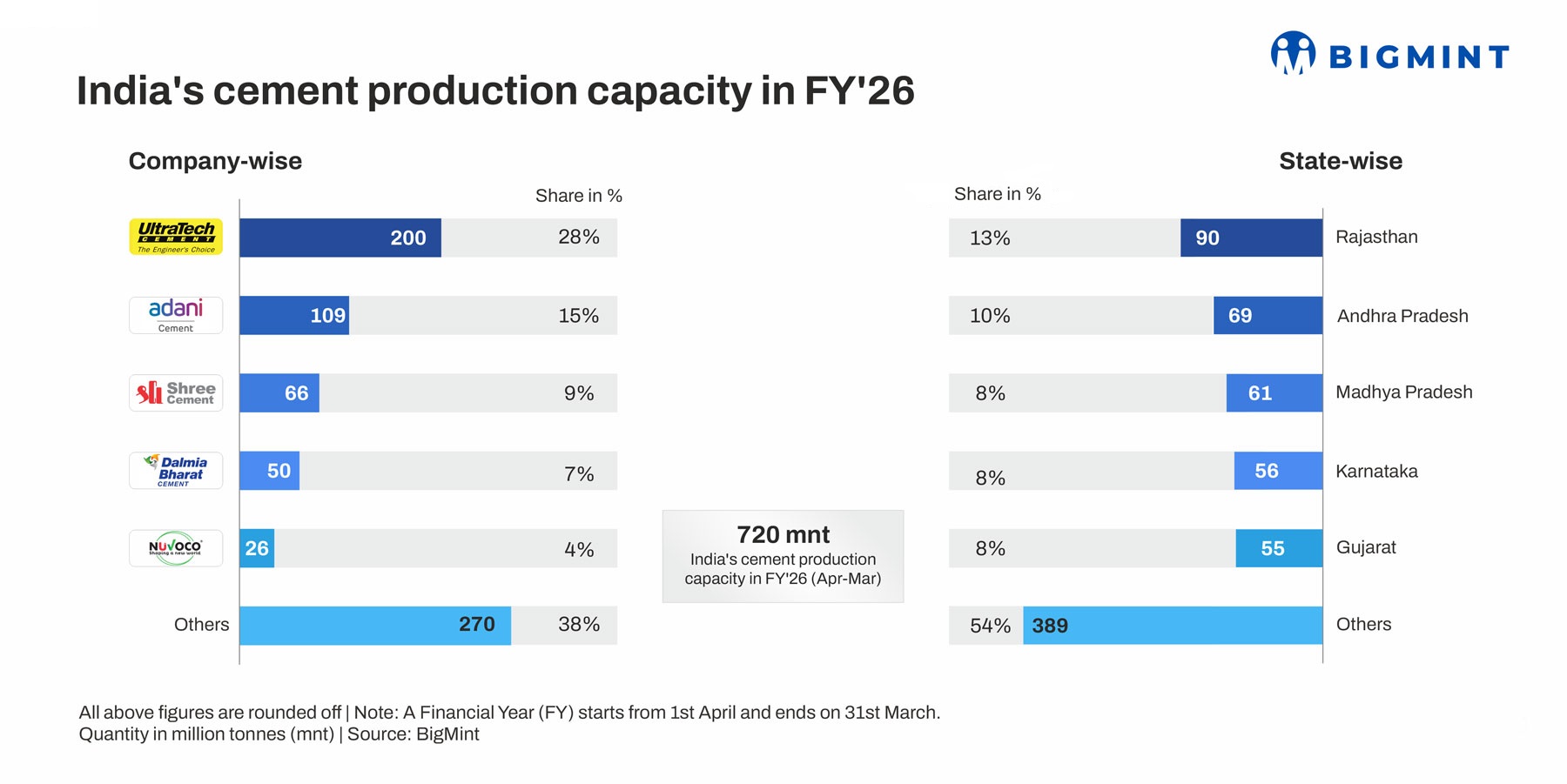
- UltraTech retains top position with 200 mnt capacity
- Rajasthan largest cement-producing state with 90 mnt capacity
India’s cement industry continued its expansion momentum in FY26, with total installed capacity reaching around 720 million tonnes (mnt), according to data maintained with BigMint. Capacity growth was largely driven by aggressive brownfield expansions, acquisitions, and clinker additions by major cement producers amid strong infrastructure and housing demand across the country.
India’s cement production is estimated at around 490 mnt in FY26, compared with 453 mnt in FY25, registering a growth of around 8% on y-o-y basis.
Strong demand from roads, metro rail projects, commercial real estate, industrial construction, and urban housing supported fresh investments during the year. The sector also witnessed increased consolidation activity as large companies focused on strengthening regional presence, improving logistics efficiency, and expanding market share through acquisitions and integrated capacity additions.
Major companies expand capacities
UltraTech Cement remained India’s largest producer with installed capacity reaching around 200 mnt in FY26. The milestone was achieved following acquisitions of India Cements and Kesoram Cement, along with ongoing expansion projects. The company alone accounted for nearly 28% of total installed cement capacity.
Adani Cement, comprising Ambuja Cements and ACC Limited, emerged as the second-largest player with combined installed capacity of around 109 mnt. The group continued expanding aggressively through acquisitions, clinker optimisation, and network expansion initiatives.
Shree Cement maintained installed capacity of around 65.8 mnt, while Dalmia Cement stood at nearly 49.5 mnt. Nuvoco Vistas maintained capacity at around 25-26 mnt.
Meanwhile, regional and mid-sized producers together accounted for nearly 270 mnt.
State-wise capacities
Rajasthan remained India’s largest cement-producing state with around 90 mnt installed capacity in FY26, supported by abundant limestone reserves and large integrated cement plants. Andhra Pradesh comes next with nearly 69 mnt capacity, aided by strong clinker production and coastal logistics advantages.
Madhya Pradesh accounted for around 61 mnt capacity, while Karnataka and Gujarat stood at 56 mnt and 55 mnt, respectively.
Other states together contributed around 389 mnt capacity during the year.
Outlook
India’s cement capacity is projected to reach around 850 mnt by 2030, as per government data. This will be supported by continued infrastructure development, housing construction, and industrial expansion. Large cement producers are expected to maintain expansion momentum through brownfield projects, acquisitions, and grinding unit additions.
*Note- Adani Cement includes Ambuja Cement, ACC Ltd, Penna Cement Industries Limited, Orient Cement Limited, Sanghi Industries Limited, Asian Concretes & Cements Private Limited.
Leave a Reply