- Consumption from auto sector projected to rise from 16 mnt in FY’25 to 23 mnt by FY’30
- SUVs, electrification, tighter safety standards boost demand for advanced automotive steel grades
- PVs will anchor flat steel demand, CVs to drive overall steel consumption
Data Deep Dive: India’s finished steel demand reached 149 million tonnes (mnt) in FY’25, of which the automotive sector accounted for 16 mnt, or around 11% of total consumption, according to BigMint estimates. Automotive steel demand is projected to increase to 23 mnt by FY’30, raising its share of national steel demand to 12%.
While construction and infrastructure will continue accounting for more than 60% of India’s steel consumption, automotive remains the country’s most important manufacturing market for value-added flat steel products. Unlike construction, where demand is concentrated in commodity long products, vehicle manufacturing depends on specialised flat steel grades that meet increasingly stringent requirements for strength, formability, corrosion resistance and surface quality.
Galvanised steel, advanced high-strength steels (AHSS) and electrical steels account for a growing share of automotive procurement as manufacturers pursue lighter, safer and more efficient vehicle platforms. The commercial significance of automotive demand therefore lies less in the tonnes it consumes than in the value of the products it requires.
That distinction changes how automotive demand should be assessed. Rising vehicle production supports steel consumption, but the greater commercial impact comes from changes in vehicle architecture that increase the use of specialised steel grades. Understanding how production is evolving therefore becomes the starting point for understanding where steel demand is heading.
Production resilient as market enters structural growth phase
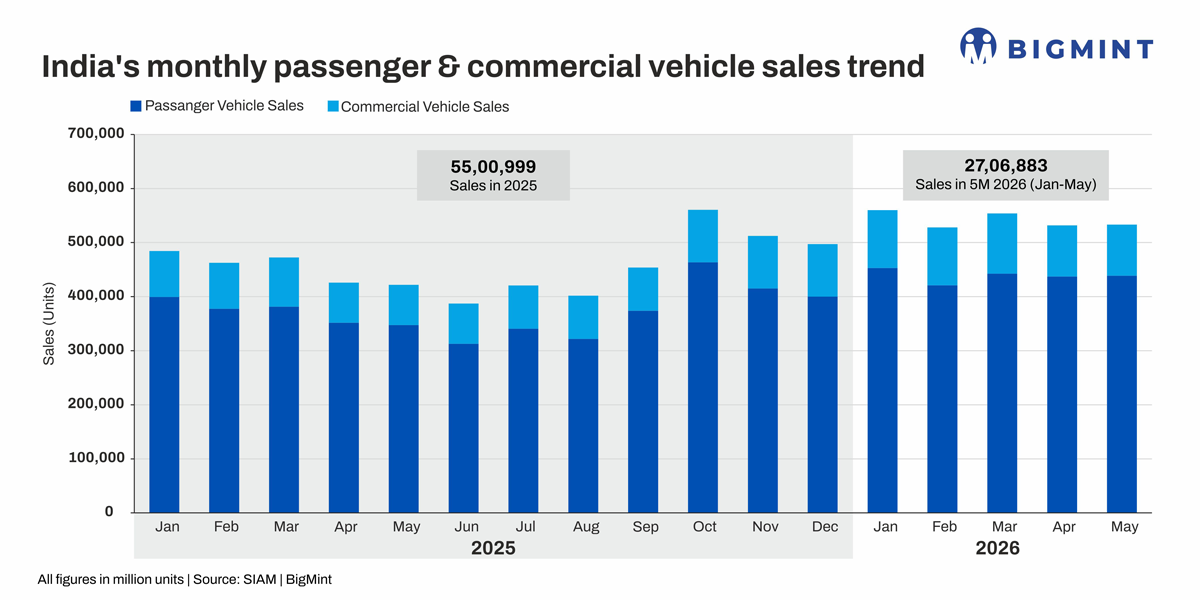
India’s automotive industry entered FY’27 from a position of sustained production growth. Passenger vehicle production remained above 420,000 units per month through much of the first half of 2026, while commercial vehicle output generally stayed above 90,000 units, despite moderating from the exceptionally strong replacement cycle that followed the pandemic.
FADA retail registrations also indicate that demand continues absorbing production without significant inventory imbalances, suggesting the market has transitioned from cyclical recovery to a more stable phase of structural expansion.
Not all vehicle segments contribute equally to steel demand. Passenger vehicles account for the largest share of flat steel consumption because of their production scale, while commercial vehicles consume substantially more steel per unit through heavier chassis, frames and structural assemblies. Two-wheelers dominate production volumes but contribute comparatively less to downstream steel demand, making passenger and commercial vehicle production the principal indicators of automotive steel consumption.
Production volumes alone, however, no longer explain the direction of steel demand. Vehicle manufacturers are simultaneously changing the composition of the vehicles entering production, altering the grades of steel required even where overall production growth becomes more moderate.
Changing vehicle mix altering steel demand
SUVs continue increasing their share of passenger vehicle sales, manufacturers are expanding electric and hybrid portfolios across multiple price segments, and successive safety regulations are raising structural performance requirements across new vehicle platforms. Each of these developments increases demand for advanced high-strength steels, galvanised products and specialised automotive grades capable of delivering higher crash performance, improved corrosion resistance and lower vehicle weight.
Electrification reinforces that shift rather than reducing steel demand. Battery enclosures, crash structures, chassis components and electric drivetrains continue requiring significant volumes of high-performance steel, while electrical steels become increasingly important as domestic EV production expands. The transition changes the composition of automotive steel demand more than the overall quantity of steel consumed.
Meeting those requirements depends less on expanding crude steel capacity than on producing steels capable of consistently meeting increasingly demanding automotive specifications. The changing vehicle mix is therefore reshaping not only what steel is consumed, but also the investments required to supply it.
Steelmakers repositioning for higher-value automotive demand
The shift in automotive steel demand is already influencing investment decisions across the domestic steel industry. Capacity additions increasingly target downstream processing rather than crude steel production, with producers expanding galvanising, continuous annealing and finishing facilities capable of supplying automotive-grade flat products. The objective is not simply to produce more steel, but to manufacture grades that meet increasingly demanding specifications for strength, formability, corrosion resistance and surface quality required by modern vehicle platforms.
Those investments reflect how procurement has evolved within the automotive industry. Vehicle manufacturers increasingly qualify steel suppliers over multiple years, requiring consistent metallurgical performance, dimensional accuracy and surface finish across successive vehicle programmes. Once approved, suppliers typically remain embedded within an OEM’s procurement system for the life of a vehicle platform, making technical capability and product consistency as important as production scale.
Government policy is reinforcing the same transition. The Production Linked Incentive (PLI) scheme for specialty steel aims to expand domestic production of value-added grades, including coated steels, advanced high-strength automotive steels and electrical steels that have traditionally relied on imports. As localisation deepens across vehicle manufacturing, wider domestic availability of these products is expected to reduce import dependence while strengthening India’s automotive supply chain.
The industry’s investment pipeline therefore reflects a structural shift in demand rather than a cyclical increase in vehicle production. Steelmakers are positioning themselves to supply a market that increasingly rewards specialised downstream capability over commodity flat steel production.
Localisation reshaping competition across steel value chain
The evolution of automotive manufacturing extends beyond vehicle assembly to the materials entering production. Global manufacturers continue increasing local content across Indian operations while expanding the country’s role as an export base for multiple vehicle platforms. That strategy requires suppliers capable of meeting global quality standards while maintaining resilient domestic supply chains.
For steel producers, localisation changes the basis of competition. Automotive procurement increasingly depends on qualification, traceability and long-term technical collaboration rather than transactional sales. The ability to supply certified automotive-grade steels consistently across multiple production programmes becomes a competitive advantage that is difficult to replicate once suppliers are embedded within an OEM’s manufacturing ecosystem.
The same trend is reshaping downstream investment. Galvanising, annealing and finishing capacity are becoming increasingly important because they determine whether domestic producers can manufacture the specialised grades specified by global vehicle platforms. As automotive manufacturing becomes more sophisticated, value increasingly shifts towards downstream processing and metallurgical capability rather than primary steel production alone.
Outlook
BigMint projects automotive steel demand to increase from 16 mnt in FY’25 to 23 mnt by FY’30, raising the sector’s share of India’s finished steel consumption from 11% to 12%. The increase is modest in terms of overall market share but more significant in terms of product mix, with demand increasingly concentrated in coated steels, advanced high-strength steels and electrical steels used across new vehicle platforms.
SIAM production trends and FADA retail data indicate that vehicle production should remain supported through FY’27 by passenger vehicle demand, infrastructure-led commercial vehicle activity, localisation and exports. Even if production growth moderates from the post-pandemic recovery period, changing vehicle architecture is expected to sustain demand for increasingly sophisticated automotive steel grades.
For Indian steelmakers, the commercial opportunity therefore lies less in supplying a larger share of India’s steel market than in increasing their participation within one of its highest-value end-use sectors. Automotive accounts for a relatively modest share of total steel consumption, but it continues to shape investment in downstream processing, specialty steel production and product development more than almost any other manufacturing segment because the competitive advantage increasingly lies in supplying better steel rather than simply more steel.
Leave a Reply