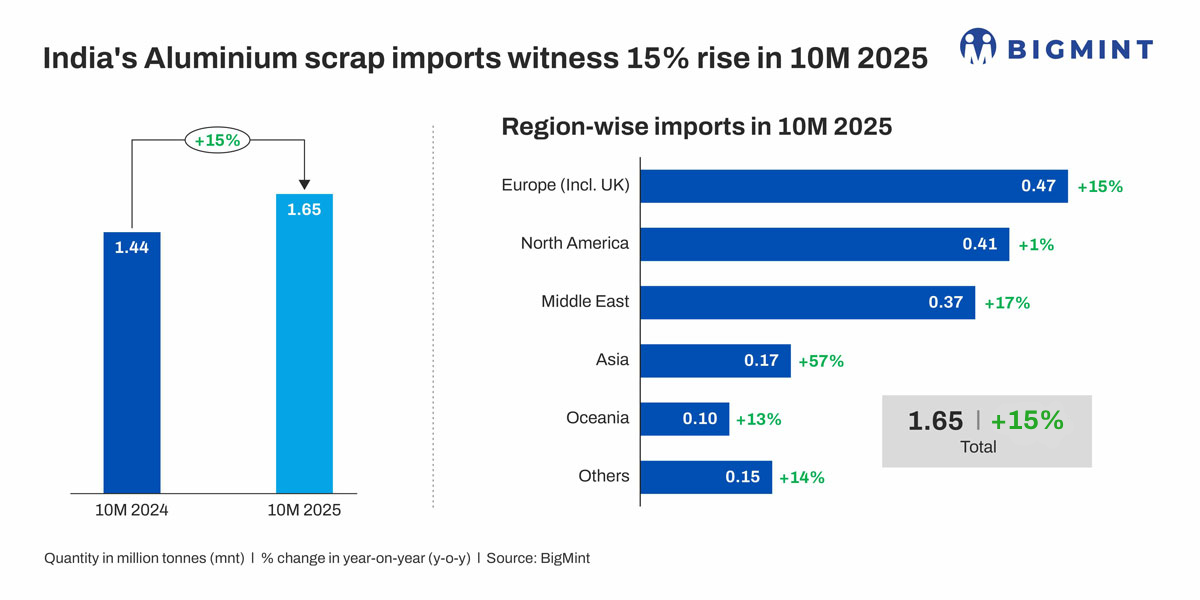
- Scrap imports from the EU + UK up 30% y-o-y
- ADC12 imports plunge over 50% y-o-y
- Landed scrap import costs lower than domestic
Morning Brief: India’s aluminium scrap market moved through the first 10 months of 2025 with a combination of resilience and urgency driven largely by global supply realignments and persistent domestic shortages. Over the first 10 months of the year (10MCY’25), the country imported 1.65 million tonnes (mnt) of aluminium scrap, marking a 15% increase from 1.44 mnt in the corresponding period of 2024. This came during a period of considerable volatility in international markets, amplified by recent US tariff actions and tightening global scrap availability.
The shift in trade patterns began early in the year when the US–traditionally India’s largest supplier–significantly reduced its outbound scrap shipments following tariff hikes and stronger domestic consumption. This abrupt contraction created a supply vacuum for Indian buyers compelling a strategic pivot toward alternative origins such as the UK, UAE, Saudi Arabia, Australia, and several EU nations.
Despite this redirection, the market continued to face supply shortages that pushed Indian manufacturers into aggressive imports of scrap.
Grade-wise imports
The majority of the aluminium scrap grades witnessed an increase in arrival in 10MCY’25 despite volatility in prices. This was majorly due to the rise in demand particularly in the backdrop of shortage of scrap and reduced supply from the US.

Country-wise imports
The country-wise breakdown of imports reveals a clear rebalancing of sourcing strategies. The US reduced its shipments due to the tariff regime introduced by President Trump–first a 25% duty, later raised to 50% from 4 June 2025. These duties altered US trade flows dramatically leading to a reduction in finished aluminium imports and greater reliance on domestic scrap. As finished aluminium imports dropped by 8%, from 1.5 mnt to 1.37 mnt, US smelters absorbed more domestic scrap.
Furthermore, US buyers increased their own scrap imports from Canada and the EU as scrap remained exempt from tariffs. Rising domestic demand, coupled with attractive pricing, ensured less material was available for export markets like India.
India compensated for this downturn by increasing procurement from the UK, Saudi Arabia, the UAE, Australia, and a broader group of smaller countries. Region-wise, Europe including UK stands as the largest supplier in 10MCY’25 which accounts over 30% of the overall supplies to India.
Domestic shortages reinforce import reliance
Within India, structural limitations in scrap collection have continued to hinder supply growth. The domestic market struggles with insufficient collection networks, low recycling efficiency and limited inflows of post-consumer scrap. These constraints become particularly evident when demand surges from alloy producers, especially those manufacturing ADC12–a critical grade for the automotive sector.
The shortage of both domestic and imported scrap led to firm prices across regions. Smelters in northern and southern India reported consistent supply tightness, prompting deeper dependence on the overseas markets to meet monthly requirements. The challenge was further aggravated by declining ADC12 imports due to certification hurdles.
ADC12 imports decline sharply

Despite strong demand, India witnessed a 51% drop in ADC12 ingot imports, which fell to 10,250 t in 10MCY’25 from 20,996 t in the year-ago period. This reduction was not driven by weak consumption but by regulatory barriers. Ongoing BIS certification issues prevented Indian buyers from sourcing material from Malaysia–the country’s largest ADC12 supplier–despite a Free Trade Agreement with that country.
This disruption forced manufacturers to rely even more heavily on raw scrap which further amplified import requirements of available grades.
Strong demand
One of the biggest drivers of the surge in imports was the sustained rise in consumption by secondary smelters, rolling mills and die-casting units. Expansion in automotive, foundry, electrical, and packaging sectors kept demand stable throughout the year. With producers operating at higher utilisation rates, imported scrap remained essential to ensuring consistent raw material availability.
Additionally, India’s secondary aluminium industry continued to scale up, pushing manufacturers to secure larger volumes of raw materials.
Price trends
Aluminium prices on the LME increased by $160/t y-o-y in 10MCY’25 reaching $2,590/t from $2,430/t. Meanwhile, stocks on LME saw a 39% drop in 10MCY’25 settling at 0.47 mnt as against 0.77 mnt.

Aligning with the rise in LME aluminium prices, imported as well as domestic scrap prices witnessed an increase y-o-y in 10MCY’25. As per BigMint’s assessment, major grades like US tense (6-7%) stood at $1,950/t CFR West Coast India, reflecting a 4% increase y-o-y from $1,867/t in 10MCY’24.
Domestic tense scrap prices rose 7% climbing to INR 189,473/t from INR 176,597/t ex-Delhi. Chennai mirrored this uptrend, posting an 8% increase. Despite the rise in domestic prices, buyers continued to favour imported scrap as landed cost remained more competitive–lower by INR 4,000-5,000/t. This price advantage supported higher arrivals of imported material during 10MCY’25.
What lies ahead for India?
India’s aluminium scrap imports are expected to maintain an upward trajectory over the remaining months of 2025, likely closing the year at 1.8-1.9 mnt. However, the outlook beyond 2025 introduces new challenges that could reshape supply chains.
The EU-27 is preparing to implement scrap export restrictions by spring 2026 to address leakage–an action that could significantly reduce availability for global buyers. Several Middle Eastern countries are also evaluating similar restrictions. Notably, India’s second largest supplier after the US is the EU-27, which accounted for over 30% of India’s imports in 10MCY’25.
India remains 85% import-dependent for aluminium scrap and must meet rising scrap obligations under its new EPR norms for non-ferrous metals. Unless India accelerates reforms in domestic scrap collection and formalises recycling infrastructure, the country risks deeper exposure to the uncertainties of global markets.
Leave a Reply