- India’s stainless steel capacity to increase to 9.3 mnt by CY’30
- Tightening export norms in key nations to challenge scrap availability
At the BIR World Recycling Convention & Exhibition 2025 in Bangkok, industry leaders discussed how shifting trade flows, new carbon policies, and slowing global consumption are reshaping the stainless steel and scrap markets.
While Europe and East Asia grapple with sluggish demand and competitive imports, India has reaffirmed its position as the fastest-growing stainless steel market, supported by robust economic fundamentals and expanding infrastructure investments.
In Europe, the imminent implementation of the Carbon Border Adjustment Mechanism (CBAM) from January 2026 is expected to reward low-carbon, scrap-based steelmaking. However, concerns persist over increased bureaucracy and competitiveness as mills face mounting pressure from low-cost slabs and nickel pig iron (NPI) imports-particularly from Indonesia.
Across Asia, stainless steel demand has stayed subdued, with mills in Taiwan and South Korea maintaining low scrap orders and Japan’s exports declining as local mills rely more on domestic feedstock. In China, mills have begun trimming production, yet elevated inventories continue to weigh on the market.
Chairing the Stainless Steel & Special Alloys Committee, Joost van Kleef of Oryx Stainless BV (Netherlands) described the market as challenging and uncertain, emphasising how globalisation is steadily giving way to regionalisation, with tariffs and trade restrictions reshaping traditional stainless scrap flows.
Adding to this, Vegas Yang, CEO of HSKU Raw Material Ltd (Taiwan), highlighted that China’s stainless sector continues to struggle under the weight of high inventories and lingering tariff impacts, while the US market remains “healthy,” operating above 80% melt capacity, supported by a 50% import tariff and strong domestic consumption. Yang also noted that Europe’s upcoming Carbon Border Adjustment Mechanism (CBAM), set for January 2026, could favor low-carbon, scrap-based producers but may also increase bureaucratic and compliance challenges.
From the US perspective, Emily Sanchez, Chief Economist at ReMA, warned that the world is moving toward increased “resource nationalism,” with recycled materials being treated as strategic commodities. She cautioned that rising export controls and license requirements risk creating fragmented markets and “a race to the bottom,” as retaliatory measures by other nations could entrench trade barriers.
Echoing concerns from processors, Mahiar Patel, Managing Director of Cronimet (Singapore), said the so-called “Trump effect” on US scrap retention has been slow to materialise but will likely tighten export flows in the coming years. He predicted that US stainless scrap will increasingly stay within domestic borders due to attractive incentive schemes, causing short-term production delays globally but strengthening US processors’ competitive edge-leaving Far East buyers with tighter access to US-origin scrap.
India: A bright spot
India, however, stood out as a bright spot in 2025. During H1 2025, the country’s stainless steel production surged 26% y-o-y, crossing 2 million tonnes (mnt), while stainless scrap imports jumped 40% to around 730,000 tonnes (t). Imports of Zurik scrap rose 24% to 139,500 t, underscoring the growing sophistication of India’s scrap segregation ecosystem. Despite volatility in currency and freight markets, India saw strong demand, aided by buoyant infrastructure spending and downstream expansion.
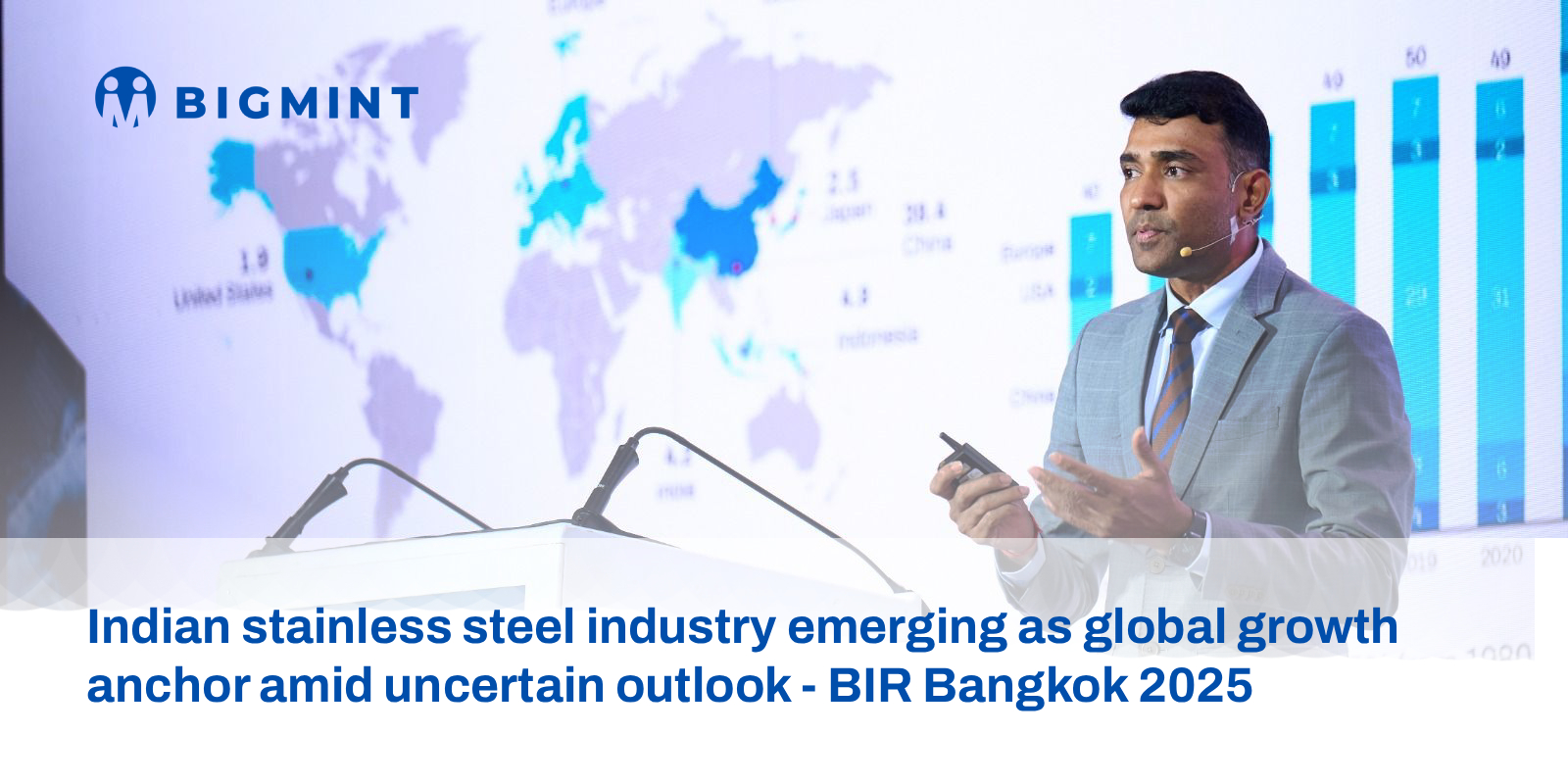
Speaking at the BIR forum, Dhruv Goel, CEO of BigMint, highlighted that India’s stainless steel capacity is expected to increase from 6.8 mnt to 9.3 mnt by 2030, and reach 12.5-12.7 mnt by 2040, in line with India’s projected 6.5-7% GDP growth. He emphasised that government initiatives under BIS standards and new import-prevention measures will bolster domestic output, while rising investments in nickel pig iron (NPI)-such as those by JSL-will strengthen India’s raw material security.
Goel noted that while imported stainless scrap will remain essential, tightening export regulations in key supplying nations could challenge availability. Upcoming European frameworks, such as C-MAP and CBAM, are expected to reshape global stainless trade dynamics from 2026 onward.
Outlook
With global stainless demand expected to stay muted into early 2026, India’s resilient growth, infrastructure-led consumption, and increasing self-reliance in raw materials position it as a stabilizing force for the global stainless steel industry amid an otherwise uncertain market landscape.
Leave a Reply