- EU’s new tariff quotas dent Indian silico manganese outlook
- Weak downstream demand limits impact of steel price increase
Domestic silico manganese prices, already under mild pressure, slipped further as exporters struggled to offload material amid weaker overseas buying. The fear of losing access to a key market like the EU created a ripple effect across India’s ferroalloy hubs where smelters found themselves sitting on higher inventories and thinner margins. Also, fluctuating steel prices has impacted domestic prices.
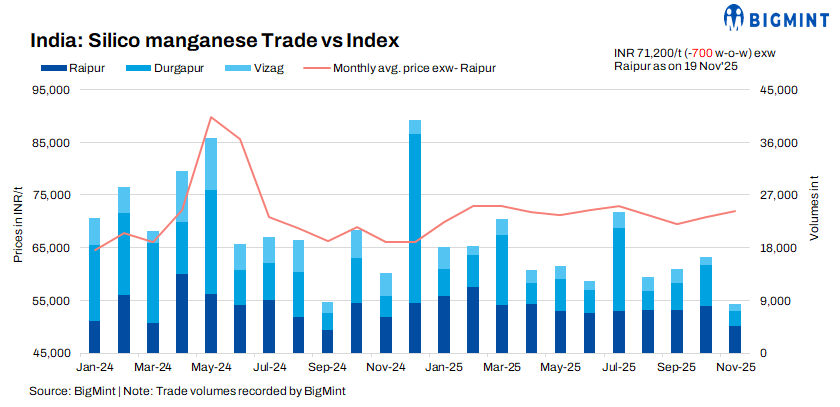
As per BigMint’s assessment on 18 November 2025, domestic prices of silico manganese (60-14 grade) witnessed a slight dip across key regions. In Raipur, prices reached INR 71,300/tonne (t) ($806/t) exw, reflecting a w-o-w decrease of INR 600/t ($7/t).
In Durgapur, rates were assessed at INR 71,300/t ($806/t), down by INR 500/t ($6/t). Prices in Vizag also dipped by INR 400/t ($5/t) to INR 71,000/t ($803/t). Meanwhile, prices in Raigarh fell by INR 600/t ($7/t) to INR 70,000/t ($791/t) exw.
The premium 60-15 grade dropped by INR 500/t ($6) w-o-w, trading around INR 73,000/t ($825/t), with some deals concluded below this level. Weekly trade volumes in Raipur also declined to around 1,200 t, down by nearly 700 t from last week’s 1,900 t.
Confirmed deals (as per BigMint)

Market overview
EU price thresholds trigger uncertainty: India’s silico manganese export volume, around 150,000 t annually, is expected to be significantly impacted as the new EU quotas put additional pressure on both exporters and smelters. Under the safeguard mechanism, each ferroalloy category has a tariff rate quota (TRQ) assigned to every exporting country. For the first year, the EU has allocated India a quota of ~126,800 t for ferro silico manganese with a minimum price threshold of €1,392/t, and ~69,900 t for ferro manganese with a price threshold of €1,316/t.
Imports within these quotas can enter duty-free. However, shipments exceeding the quota will remain duty-free only if they are priced above the threshold. Any cargo priced below the threshold will attract a price-based safeguard duty, calculated as the difference between the declared price and the benchmark threshold.
The measures apply to all third countries, including Norway and Iceland, with trimonthly reviews planned to avoid disruptions in Europe’s integrated value chain. This development has triggered panic among Indian smelters and has already begun affecting domestic prices, as the EU is a key buyer of Indian ferroalloys.
Steel price gains fail to boost sentiment: Billet prices edged up by INR 500/t ($6/t) w-o-w, reflecting cautious sentiment amid muted finished steel demand. Despite fewer offers, buying interest remained weak as buyers adopted a wait-and-watch approach. Soft cues from neighboring markets further pressured overall sentiment.
As of 19 November 2025, BigMint’s billet index stood at INR 35,500/t ($392/t) exw-Raipur. Limited buying activity and subdued downstream demand have kept billet movement slow, leaving domestic silico prices without meaningful support.
Outlook
Domestic silico manganese prices are expected to remain under pressure until there is more clarity on EU buying patterns and quota absorption. However, smelters may explore alternative export markets, and any recovery in domestic demand could provide support to prices in the near term.
Leave a Reply