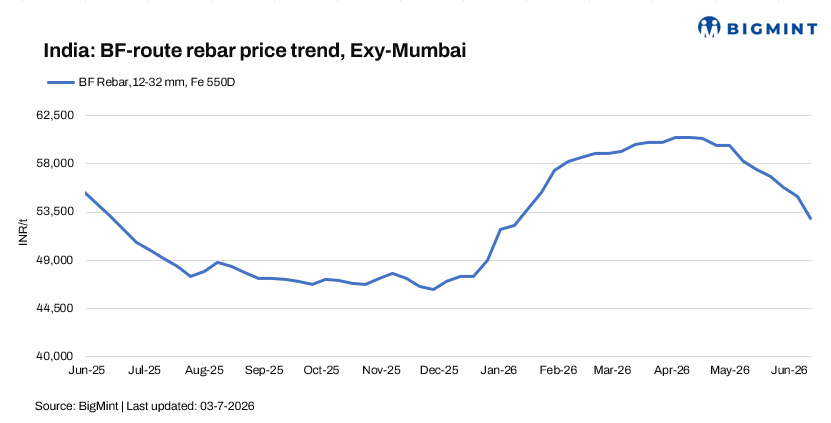
- BF-route rebar prices decline on elevated inventories
- Tier-1 mills may announce further price corrections
Trade-level BF rebar prices (distributor to dealer) declined by INR 200/t ($2/t) w-o-w to INR 49,800/t ($523/t) exy-Mumbai. Demand remained average across major regions, while northern India continued to witness weak buying interest, according to sources.
Higher inventory availability with distributors kept procurement sentiment cautious at prevailing prices, resulting in a mixed sentiment during the week. Indian tier-1 mills are yet to declare their list prices for early-July.
In the projects segment, rebar prices softened to INR 48,000-49,000/t ($504-514/t) FOR Mumbai, reflecting cautious buying activity despite the continuation of contractual supplies and infrastructure-led demand.
Property registrations in Mumbai increased by 16% y-o-y to 13,413 units in June, marking the highest registration level for the month in the past 14 years, according to Knight Frank data. This strong performance was primarily driven by sustained demand in the residential real estate segment, reflecting continued buyer confidence despite prevailing macroeconomic uncertainties.
Update on projects
Infrastructure and real estate investments continued to provide medium-term demand support to the steel sector across regions.
- South India: Karnataka announced the INR 1,139 crore Bengaluru Tunnel Road project connecting Hebbal and UAS. In the real estate sector, Puravankara signed a joint development agreement for a residential project with a gross development value of INR 1,000 crore, while Embassy Developments announced an investment of INR 1,500 crore in a commercial office project in Bengaluru.
- West India: Maharashtra approved the INR 1,722 crore connector project linking the Versova-Bandra Sea Link with the Savarkar Sea Bridge. Additionally, Aakshya Infra Projects secured the INR 1,381 crore Mumbai GMLR Phase IV junction project.
- East India: Odisha witnessed significant highway investments, with Patel Infrastructure and VRC Constructions securing Capital Region Ring Road packages worth over INR 2,900 crore. In Bihar, preparatory activities accelerated for the INR 2,160 crore Sahebganj-Bettiah four-laning project.
- North India: Ceigall India signed a concession agreement with NHAI for the INR 603 crore Ambala-Chandigarh-Zirakpur six-lane spur road project under the Hybrid Annuity Model (HAM).
Factors shaping market dynamics
- 1. IF-route rebar – IF route rebar prices declined across major markets this week, primarily tracking the weakness in billet and sponge iron prices. Trading activity remained limited as buyers restricted purchases to immediate requirements, while mills and traders offered discounts to stimulate demand amid slow buying interest. Mill inventories were maintained at around 10-15 days, with order booking visibility limited to approximately 3-5 days. In the near term, rebar prices are expected to trade within a narrow range, supported by cautious market sentiment and need-based buying. In Mumbai, IF-route rebar trade prices decreased by INR 800/t ($8/t) w-o-w to INR 44,500/t ($467/t) ex-works as of 03 July.
 Meanwhile, the BF-IF rebar price spread in Mumbai narrowed further w-o-w to INR 4,500/t ($47). IF rebar continues to dominate the Indian market with a 65-70% share.
- 2. Raw material prices exhibited mixed trends w-o-w. Prices of key steelmaking raw materials displayed mixed movements during the week. BigMint’s Odisha iron ore fines (Fe 62%) index remained unchanged w-o-w at INR 4,950/t ($53/t) ex-mines as of 27 June, while premium hard coking coal (PHCC) prices edged up by $1/t w-o-w to $263/t on a CNF Paradip basis, indicating marginal cost pressure for BF-route steelmakers.
Outlook
The domestic BF-route rebar market is expected to remain under pressure in the near term due to elevated inventory levels, subdued buying activity, and seasonal disruptions caused by the monsoon. According to market participants, upcoming price announcements by major producers may witness further corrections as mills seek to stimulate demand and align prices with prevailing market conditions.

Leave a Reply