- Chinese HRC shipments nearly double m-o-m to around 147,400 t in May
- Over 120 crude oil pipeline projects worth more than $9 bn under development across Middle East
- Export-oriented pipe producers using imported HRC under Advance Authorisation Scheme
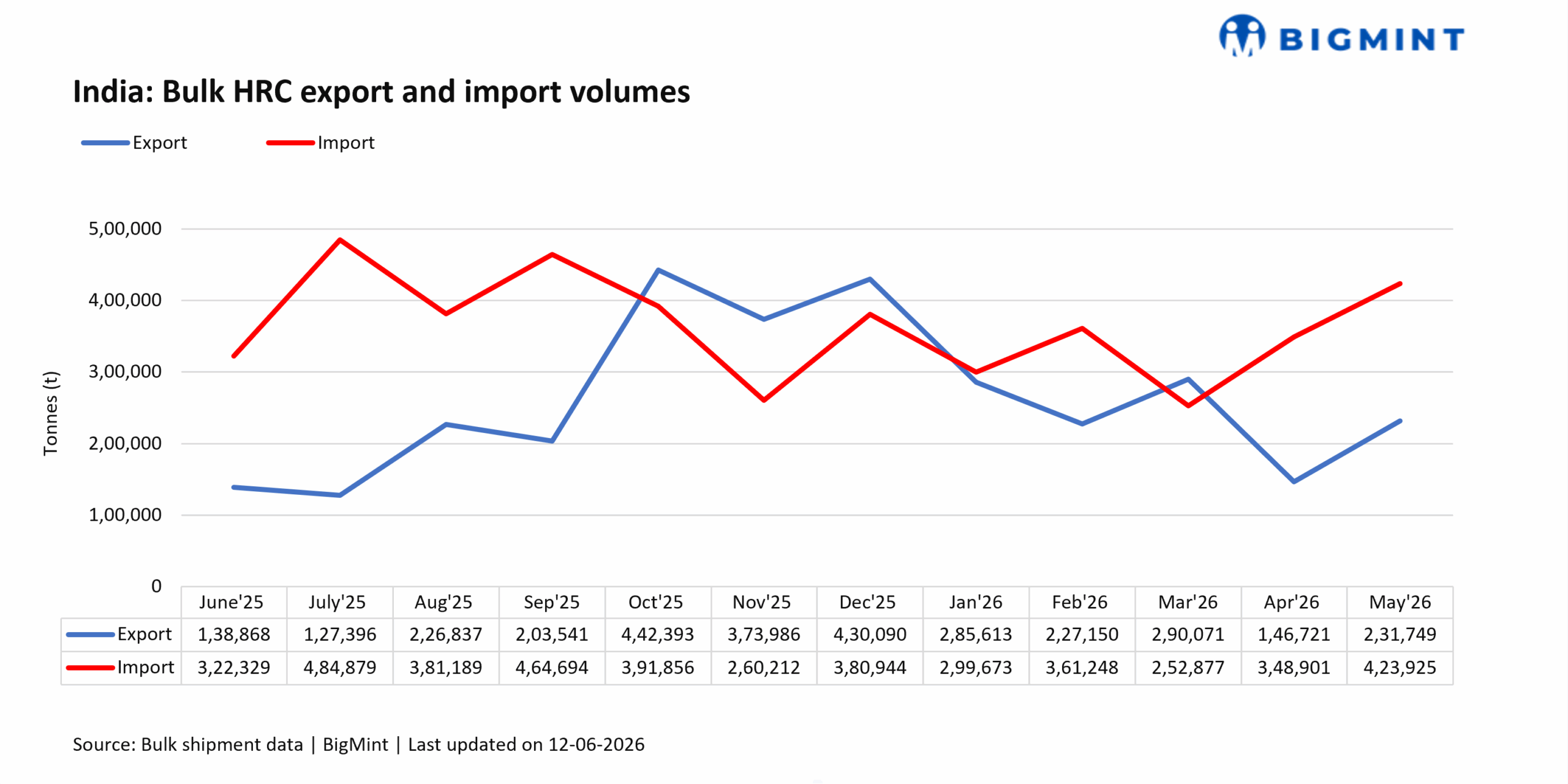
Data Deep Dive: Bulk hot-rolled coil (HRC) imports into India reached around 423,925 tonnes (t) in May’26, up 22% m-o-m from 348,901 t in April and 52% higher than 279,250 t recorded a year earlier, according to BigMint’s vessel line-up data. Chinese shipments rose particularly sharply, increasing 96% m-o-m to around 147,417 t, while South Korean imports grew 18% to 110,791 t. Imports from Japan, however, declined 39% m-o-m to 53,681 t.
While the increase in Chinese HRC arrivals may appear to reflect growing pressure from imported steel, industry participants indicated that a significant portion of these volumes is not intended for domestic consumption. Instead, imported HRC is increasingly being used as feedstock by Indian pipe and tube manufacturers operating under the Advance Authorisation Scheme, with the finished products subsequently exported to overseas markets, particularly the Middle East.

Why are Chinese HRC imports rising?
A large share of Chinese HRC arriving at Kandla and Mundra ports is understood to be destined for export-oriented downstream manufacturers. Under the Advance Authorisation Scheme, imported raw materials used for producing export goods are exempt from the customs and safeguard duties applicable to conventional imports, improving the economics of sourcing overseas feedstock for value-added manufacturing.
A leading pipe manufacturer told BigMint that Chinese HRC is primarily imported for producing pipes destined for export markets in the Middle East, while orders for destinations such as the US and Canada generally rely on feedstock sourced from countries including South Korea, Japan and Germany rather than China. The source added that production cycles for export orders can extend up to a year, requiring manufacturers to secure raw materials well ahead of final deliveries.
Why the Middle East matters
Growing investment in oil and gas, water transmission and energy infrastructure projects across the Middle East is providing sustained support for India’s pipe and tube exports. A leading steelmaker said India-made pipes are increasingly being supplied to the UAE and other countries in the region, with domestic manufacturers actively participating in large pipeline and infrastructure projects.
The broader investment cycle also points to a structural source of demand. According to media reports, the UAE is accelerating a new West-East oil pipeline project that could double export capacity through Fujairah by 2027, while industrial market intelligence providers are tracking more than 120 crude oil pipeline projects across the Middle East representing investments exceeding US$9 bn. These projects are expected to underpin demand for line pipes and related steel products over the medium term.
The increase in Chinese HRC arrivals also coincided with a sharp rise in India’s outbound steel shipments. Bulk HRC exports from India climbed to around 231,749 t in May’26, up 58% m-o-m and 61% higher than a year earlier, as export orders that had been delayed by shipping disruptions during March and April were gradually executed.
Industry participants indicated that improving logistics conditions and tighter trade restrictions on Chinese steel in several overseas markets created additional opportunities for Indian exporters.
The parallel increase in both HRC imports and exports reinforces the view that a growing share of imported feedstock is being channelled into export-oriented manufacturing rather than domestic consumption.
Advance Authorisation supports import economics
Imports under the Advance Authorisation Scheme follow a different economic logic from conventional steel imports. Since the material is intended for re-export after value addition, manufacturers are able to avoid the duties that would otherwise apply to steel entering the domestic market, making imported Chinese HRC commercially viable for export-oriented production.
Market participants indicated that Chinese HRC imported under the scheme can land in India at an effective cost of around INR 52,000-53,000/t, compared with domestic HRC prices of roughly INR 58,000-59,000/t. The cost advantage allows pipe manufacturers to remain competitive in overseas markets while using imported HRC as an intermediate input for higher-value exports.
Industry participants added that the scheme also allows manufacturers to align raw material procurement with long-duration export contracts, particularly for large-diameter line pipes supplied to energy and infrastructure projects. Since these orders are often executed over several months, buyers typically secure imported feedstock well in advance of final production schedules, reducing the importance of short-term fluctuations in domestic HRC prices and ensuring continuity of supply for export commitments.
The timing of import bookings also contributed to the higher arrivals in May. Imported HRC prices approached parity with domestic material during late March and early April, encouraging buyers to secure cargoes for future delivery. Many of these bookings were subsequently discharged during May, contributing to the increase in import volumes.
Outlook
Industry participants expect demand for export-oriented pipe production to remain healthy over the coming months. A leading pipe manufacturer indicated that order books remain strong, while additional demand linked to post-war reconstruction and infrastructure spending has yet to fully materialise. Since export programmes typically involve long production and delivery cycles, manufacturers are likely to continue securing imported feedstock in advance, supporting HRC import volumes under the Advance Authorisation Scheme.
As long as infrastructure investment across the Middle East continues to generate demand for Indian pipes and tubes, imports of Chinese HRC are expected to remain closely linked to India’s expanding role as a downstream manufacturing and export hub rather than purely domestic steel consumption.
Leave a Reply