- Policy changes needed to boost high-grade Mn ore supply in India
- MOIL eyes 32% share in India’s manganese ore market by 2030
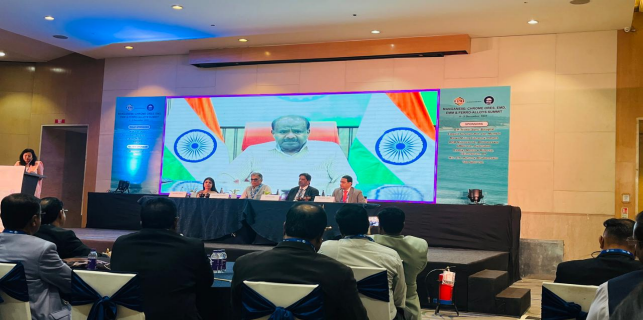
The Federation of Indian Mineral Industries (FIMI) hosted its Manganese/Chrome Ores, EMD, EMM, and Ferro Alloys Summit on 4-5 December 2025 in Visakhapatnam. This high-level event brought together policymakers, mining professionals, ferro alloy producers, global experts, and technology leaders to discuss technological innovations, sustainable production methods, and India’s expanding influence in the burgeoning battery materials sector. Key themes that emerged included limited availability of domestic high-grade ore, the decline in global silico manganese output, shifts in the global chrome and ferro chrome market, and concerns about the impact of EU safeguards on India.
Shantesh Gureddi, President of FIMI, inaugurated the summit, and AK Saxena, Vice President of FIMI and Chairman-cum-Managing Director of MOIL, emphasised the industry’s pivotal role in shaping the future of India’s mineral economy.
In a video address, HD Kumaraswamy, Honourable Minister of Steel and Heavy Industries, commended FIMI and MOIL for their efforts in establishing a collaborative platform at a time when India’s steel and ferro alloys sectors are undergoing a rapid and transformative phase.

Throughout the summit, speakers delved into critical themes in the manganese ore, alloys, chrome ore, and ferro chrome segments, with a focused discussion on India’s increasing contribution to global production and its strategic role in the evolving market.
Global silico manganese output trending down, FeMn production to rise
Sam Mitra from the International Manganese Institute (IMnI) provided an in-depth global outlook on steel, manganese ore, and alloys. He noted that there has been a 1.9% contraction in global crude steel production in January-October 2025, primarily driven by China’s slowdown, while India emerged as the fastest-growing producer, increasing its global share from 6% in 2019 to 8.5% in 2025.
On manganese alloys, global output declined to 16.5 million tonnes (mnt) in January-September 2025, with India posting the highest growth at 9%, raising its share to 18%. Global ferro manganese production rose 6% y-o-y to 4.4 mnt during the same period, while global silico manganese production remained stable at 12.2 mnt. India’s silico manganese exports peaked in 2022, FeMn family now approaching 45% of exports (43% of output).
MOIL eyes increasing share in India’s manganese ore market to 32% by 2030
Harpreet Singh from MOIL Ltd. presented an insightful outlook on India’s manganese ore market, emphasising MOIL’s pivotal role as the country’s largest producer. Operating 10 manganese mines across Maharashtra and Madhya Pradesh, the miner plans to expand its environmental clearance (EC) from 2.68 mnt in FY’25 to 5 mnt by FY’30.
The session highlighted India’s National Steel Policy 2017, which targets 300 mnt of steel capacity by 2030, requiring nearly 11 mnt of manganese annually. With this, MOIL plans to contribute to the tune of 32% of the requirement of the country, which is right now around 20-21%. MOIL aims to expand production to 3.5 mnt by 2030. The session also focused on MOIL’s sustainability efforts, including its renewable energy initiatives and the EMD plant, positioning MOIL to meet India’s growing steel needs while ensuring long-term resource security.
Limited availability of high-grade Mn ore in India spurs need for policy changes
Mr.Tushar Chakraborty from Deloitte explained India’s crude steel output consistently rising y-o-y, the consumption of manganese alloys will certainly jump. However, due to the limited availability of high- and medium-grade manganese ores in India, this will lead to raw material imports, which will increase the alloy production cost. As such, strategic reforms are required, including incentives (tax breaks, low-interest loans) for beneficiation plants and tailings reprocessing units and promotion of R&D and industry-academe partnerships (e.g. CSIR-IMMT, IITs) for the refining of low-grade ores. Steel and battery industries should secure offtake agreements with miners/processors, ensuring mine-to-market linkages. Policymakers must coordinate mineral, steel, and EV policies to ensure benefits for all sectors (e.g. scrap legislation, import tariffs on high-grade manganese ore can spur local upgrading).

Manganese mineralisation in Andhra Pradesh
Darshan Deep Bhardwaj from the Indian Bureau of Mines discussed manganese mineralisation in the Vizianagaram-Visakhapatnam manganese belt, part of the Eastern Ghats Mobile Belt. He highlighted the Precambrian host rocks and the syngenetic sedimentary formation of manganese, enriched by metamorphism. Ore minerals such as pyrolusite and psilomelane were identified, with manganese content ranging from 30-48%. Andhra Pradesh contributes approximately 30 mnt of India’s 504 mnt of manganese resources, emphasising its strategic role in steel production.
Paradigm shifts in global chrome industry supply landscape
Vaishnavi Jalal, Tata Steel Ltd, explained the structural changes taking place in the global chrome and ferro chrome market. South Africa remained the largest chrome ore producer at 20.4 mnt in CY’25, while China dominated consumption, importing nearly 20 mnt of chrome ore. Global ferro chrome production stands at 16 mnt/year, with China accounting for 50%. In CY’25, global ferro chrome supply is projected to decline by 9% (1.6 mnt) due to high power costs, weak prices, and production cuts by major players such as Samancor and Glencore.

China’s ferro chrome imports are expected to fall by 800,000 t in CY’25, as domestic capacity (1.3 mnt/year) ramps up, with output touching 900,000 t in November 2025. Europe may see a 2% y-o-y rise in stainless steel output, while the Indian ferro chrome industry faces export pressure from EU safeguard duties and increasing competition from Kazakhstan and South Africa. Key risks highlighted include South Africa’s power crisis, Zimbabwe’s potential ore export ban, CBAM, and shifting trade flows away from China, fundamentally reshaping global supply dynamics.
Imposition of EU safeguards likely to result in trade diversions
Nishtha Mukherjee Sinha from BigMint Technologies analysed India’s manganese alloy value chain, connecting steel demand, production, exports, and trade risks. With steel consumption projected to rise from 100 mnt in 2020 to 204 mnt by 2030, driven by infrastructure and urbanisation, manganese alloy consumption has grown 50% since FY’20.

India’s manganese alloys production stood at 4.8 mnt in FY’25, as per data maintained with BigMint. Exports held a share of nearly 40% (1.8 mnt) of India’s manganese alloys production. The European Commission has officially imposed definitive safeguard measures on imports of certain ferro alloys, concluding an 11-month investigation and stepping up efforts to protect the EU’s ferro alloy industry. The European Union currently accounts for around 15-20% of India’s total manganese alloys exports, but this share is expected to come under pressure following the implementation of safeguard measures.
However, the scope of Indian manganese alloys exports, which are not covered under the tariff rate quota, may be subject to threat. EU safeguard measures undoubtedly tighten export opportunities for Indian ferro alloy producers, especially in the ferro chrome and manganese alloy segments. However, the impact may not be that severe and may be to the extent of 5%.
Regulatory & operational challenges in chrome ore industry
Muthumari M. from Vedanta-FACOR discussed the challenges facing India’s chrome ore sector, highlighting declining production, rising imports, and increasing costs. Chrome ore production dropped from 3.9 mnt (2018-19) to 3.0 mnt (2024-25), while imports surged. Regulatory bottlenecks, particularly delays in forest and environmental clearances (1.5 years for ECs, 3-4 years for FCs), were identified as major constraints.

Key recommendations included auctioning composite blocks, facilitating smoother transitions from RP to PL to ML, and utilising NMET funding for private exploration. He also proposed adopting Dry Metric Tonne (DMT) for royalty calculations to prevent inflated payments and called for ease-of-doing-business measures such as single-window clearances, parallel appraisals, and better digital platforms. The session emphasised regulatory reforms to unlock chrome ore availability and ensure long-term competitiveness in ferro alloys.
Leave a Reply