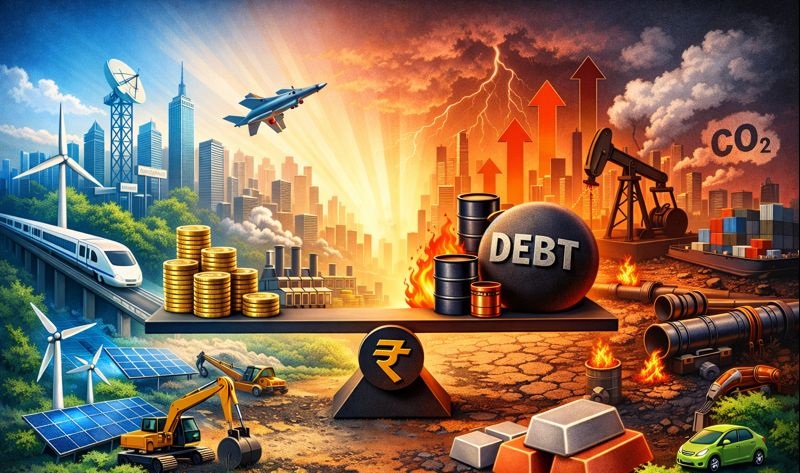
- Balancing infra-led development with fiscal discipline key
- Broad-based growth hinges on sustained private capex
An economy of contrasts in early 2026
The Indian economy presents a picture of robust headline growth clashing with underlying fragility and policy tension. Key indicators show a nation at a crossroads.
- Strong headline performance: The economy is officially in a ‘Goldilocks’ phase, characterised by high real GDP growth (inching towards 8%) and near-zero retail inflation (0.71% in November 2025). Sectors like automobiles, transport fuels, and retail reported decisive y-o-y growth in late 2025, driven by festive demand, GST rate cuts, and improved rural sentiment.
- Policy stimulus amidst growth: Despite the strong growth narrative, both fiscal and monetary authorities have deployed unusually aggressive stimulus. This includes cumulative repo rate cuts, large liquidity infusions, and a front-loaded 28% y-o-y increase in government capital expenditure for April-November 2025.
- Emerging strains & fragility: This stimulus highlights concerns. Reports indicate a “shrinking fiscal space” and warn the economy is trapped in a “policy gridlock.” Market reactions have been counterintuitive, with interest rates rising and the rupee weakening despite liquidity injections. Furthermore, power demand growth was a muted ~2% in FY’26, and natural gas consumption declined, pointing to softer-than-expected industrial activity.
- Sectoral divergence: A clear split is emerging. Sectors tied to domestic consumption and infrastructure capex – like EMS, telecom, industrials, and defence – are poised for strong earnings growth. In contrast, sectors like oil & gas, IT services, and FMCG are expected to lag.
Roots of the dichotomy
The current economic contradictions stem from a combination of cyclical factors, structural policies, and external pressures.
Post-pandemic policy normalisation: The GST 2.0 rationalisation (significant rate cuts) and income tax relief were designed to boost disposable income and consumption after demand was battered by the pandemic, explaining the strong auto and retail sales. However, the initial implementation caused temporary trade disruption and is now suppressing GST collection growth.
Infrastructure-forward strategy: The government is betting heavily on an investment-led growth model. The massive capex push (INR 11 lakh crore outlay) explains strong capital goods demand but also widens the fiscal deficit (up 15.4% y-o-y). The high fiscal multiplier of infrastructure spending is intended to crowd-in private investment over time.
External and commodity shocks: Global metals price surges (silver, copper, aluminium) are compressing margins for manufacturers and solar developers. The EU’s new Carbon Border Tax (CBAM) directly threatens the competitiveness of Indian steel and aluminium exports, creating a new trade headwind.
Monetary-fiscal coordination challenges: The RBI’s rate cuts and liquidity operations aim to support growth but, combined with high government borrowing, may be leading to crowding-out fears, pushing market interest rates higher and undermining the stimulus’s intent.
Weather and seasonal volatility: The early onset of monsoon and its extending till end October in 2025 significantly dampened power demand for cooling and irrigation, making FY’26 an outlier and masking underlying industrial energy consumption trends.
Outlook: Navigating the gridlock
The outlook hinges on whether current stimulus can successfully catalyse a broad-based private investment revival before fiscal constraints tighten further.
Near-term (next 6-18 months):
- Cautious optimism on consumption: Benefits from GST rate cuts are expected to fully reflect in consumption volumes by Q1FY’27, supporting FMCG and auto sectors. Rural demand should remain buoyant if crop prices hold.
- Persistent cost pressures: Industries will continue grappling with high raw material costs and CBAM compliance expenses, keeping corporate margins under pressure outside of a few favoured sectors.
- Fiscal consolidation test: The government will face a tough balancing act. With the fiscal deficit widening, sustaining high capex will require impeccable revenue mobilisation or a further rise in debt, which markets are already viewing warily.
Long-term (2-5 years and beyond):
- Private capex key: The single most important indicator will be a broad-based revival in private capital expenditure. Early signs are promising in sectors like defence, industrials, and construction, supported by the government’s infrastructure pipeline and ‘China+1’ supply chain shifts.
- Sectoral re-routing: The economy will see a sectoral rebalancing. Traditional laggards (oil & gas, some IT) may remain subdued, while sectors aligned with digitalisation, green energy, defence indigenisation, and infrastructure building are poised to lead the next growth phase.
- Energy-transition imperative: Long-term growth is inextricably linked to managing the energy transition. The success of reforms in nuclear (SHANTI Bill), solar, and power markets will determine the affordability and sustainability of the power needed for industrial growth.
In summary, the Indian economy has strong growth engines but is running on stimulus fuel which may be in limited supply. The transition from a government-led capex cycle to a sustained private investment boom – while navigating global commodity shocks and a complex energy transition – will define its trajectory over the coming years. The ‘Goldilocks’ narrative remains plausible but is increasingly fragile, demanding meticulous policy execution.
Leave a Reply