- Demand from zinc oxide units shows marginal uptick
- Stable scrap supply keeps price gains limited
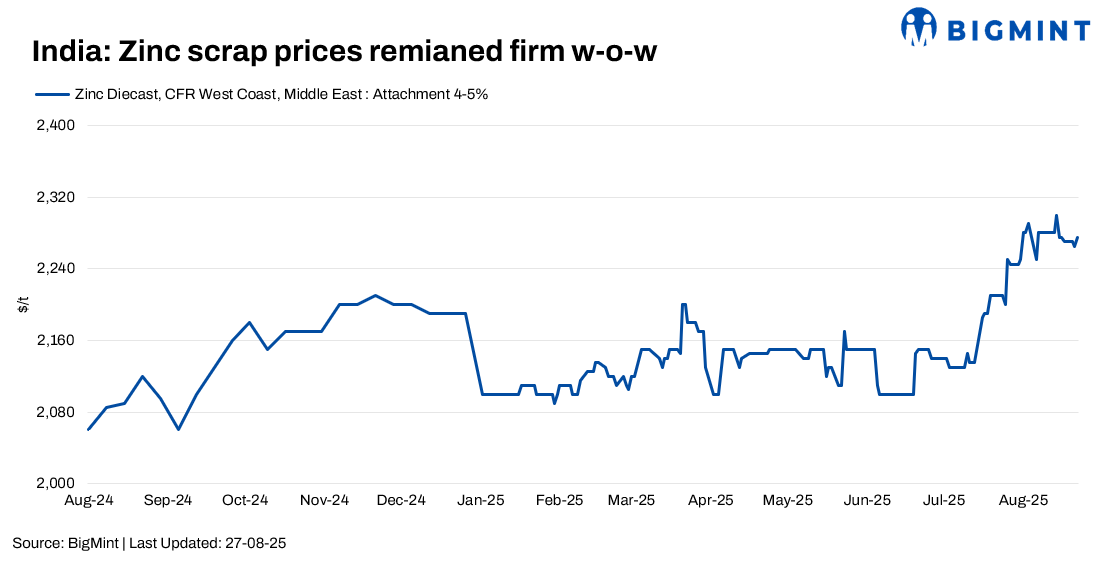
India’s zinc scrap and dross market remained steady this week, with prices moving in a narrow band. BigMint assessed zinc diecast scrap (Middle East origin) at $2,275/tonne (t) CFR west coast India, unchanged from the previous week amid balanced demand and supply conditions.
At the time of reporting, London Metal Exchange (LME) zinc prices stood at $2,772/t, down by $11/t from $2,783/t last week.
Zinc dross was assessed at INR 226,500/t ex-Delhi, up by INR 2,000/t w-o-w, as per BigMint’s latest assessment. In Mumbai, prices held relatively firm at INR 225,000/t ex-works, reflecting stable regional trade dynamics.
According to one importer, more market participants are shifting towards domestic sourcing for zinc scrap, citing better prices compared to imported lots.
In north India, big-sized zinc scrap (Tukdi, 97% Zn) was offered at around INR 222,000/t ex-Delhi, while mid-sized Tukdi (97-98% Zn) held steady at INR 210,000/t. Actual buying interest for mid-sized Tukdi was mostly heard in the INR 209,000/t range, indicating cautious procurement.
LME zinc stocks decline to lowest since 2023
LME zinc inventories have declined 72% since January, standing at 65,525 tonnes, the lowest since May 2023. Singapore currently holds 99% of registered zinc stocks, with warehouse listings increasing to 38 this year. Despite the reduction, zinc spreads remain in contango, suggesting balanced near-term supply. However, sanctions, tariffs, and changing trade flows continue to influence market dynamics, affecting physical availability and contributing to potential shifts in global zinc pricing.
Outlook
Zinc scrap and dross prices are expected to remain largely range-bound in the near term. Selective buying by zinc oxide units and secondary smelters will provide support, but stable scrap availability and cautious downstream sentiment may limit upside. Global cues from LME stocks and shifting trade flows will remain important drivers for near-term market direction.
Leave a Reply