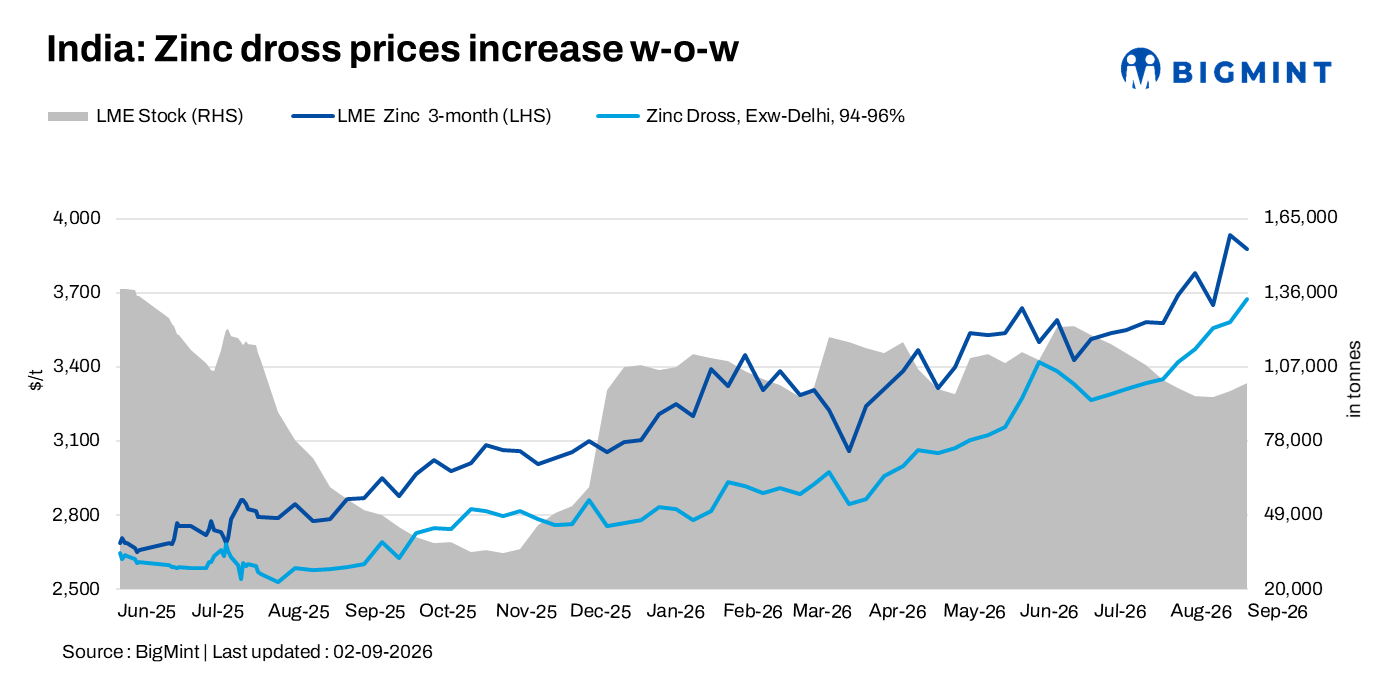
- Indian market experiences lagged impact of elevated replacement costs
- LME backwardation narrows as inventories cross 100,000 t
India’s zinc dross and oxide prices increased w-o-w in the week ended 2 September, despite a correction in international zinc prices. Domestic secondary prices continued to firm as the market absorbed the lagged impact of elevated primary zinc replacement costs, even though LME zinc retreated from the previous week’s highs.
Three-month LME zinc declined by $56/t, or 1.4%, w-o-w to $3,877/t on 2 September from $3,933/t on 26 August. The cash-settlement price fell by $107/t to $4,000/t.
The cash-to-three-month backwardation narrowed to $123/t from $174/t a week earlier, indicating comparatively easing nearby supply tightness. Meanwhile, LME inventories increased by 3,200 t to 100,525 t, crossing the 100,000-t mark and signalling improved exchange availability.
Zinc dross, oxide prices rise
Domestic zinc dross prices increased by INR 9,100/t w-o-w to INR 349,300/t ex-Delhi on 2 September, compared with INR 340,200/t a week earlier.
Zinc oxide (99% Zn) prices also rose by INR 5,200/t w-o-w to INR 330,000/t ex-Delhi from INR 324,800/t.
The increase in secondary zinc prices despite softer LME values reflected the delayed transmission of last week’s rally in primary zinc. Secondary prices had not fully adjusted to the earlier increase in replacement costs, allowing suppliers to revise offers upward during the assessment week.
Zinc scrap prices remain stable
In the north Indian zinc scrap market, big Tukdi (97-98% Zn) was heard at around INR 350,000/t ex-Delhi, broadly stable w-o-w.
Mid-sized Tukdi (97-98% Zn) was also reported at around INR 345,000/t, largely unchanged from the previous week.
Stable scrap prices contrasted with the increase in zinc dross and oxide values, indicating cautious downstream procurement. While elevated primary zinc prices continued to support replacement costs, limited demand absorption restricted further upside in Tukdi prices.
Domestic SHG zinc eases marginally
BigMint’s domestic SHG zinc assessment stood at INR 424,800/t ex-Delhi on 2 September, marginally lower than INR 426,000/t on 26 August.
The correction broadly tracked weaker LME prices. However, domestic primary zinc values remained elevated compared with levels before last week’s rally, continuing to support replacement costs for secondary zinc producers.
Hindustan Zinc’s latest benchmark price was heard at INR 429,500/t on 3 September, indicating that domestic primary zinc prices remained elevated despite recent volatility in the international market.
The movement in LME inventories and backwardation will remain important indicators for the secondary market. Rising stocks above 100,000 t and the narrowing backwardation suggest that immediate supply tightness has eased compared with the previous week, potentially limiting support for another sharp increase in primary zinc prices.
Outlook
Zinc dross and oxide prices may remain supported in the coming week by elevated domestic primary zinc values and the continued transmission of earlier replacement-cost increases into the secondary market.
However, softer LME zinc prices, rising exchange inventories and a narrowing cash-to-three-month backwardation indicate improving nearby availability. This may limit further upside if international zinc prices continue to weaken.
Stable Tukdi prices also point to cautious downstream buying and resistance to higher scrap offers. Further gains in zinc dross and oxide prices are therefore likely to depend on downstream demand absorption and whether domestic SHG zinc sustains current levels.
Leave a Reply