- Inventory levels are rising despite production cuts
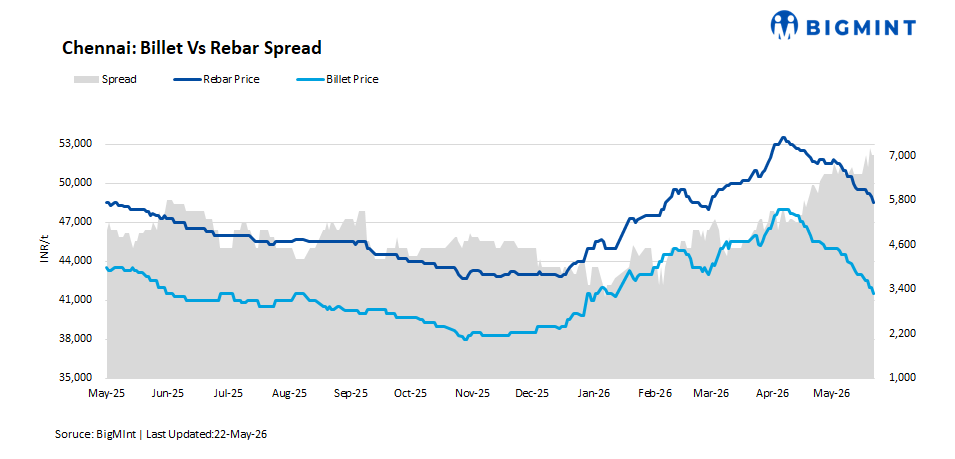
- M.S Billet prices down by INR 1,500/t w-o-w
Sponge Iron & Melting Scrap :
Sponge iron prices in the Bellary cluster have declined by INR 400/t week-on-week (w-o-w) to INR 25,400/t as of 22nd May 2026. The key reason behind this price correction is weak demand in the southern steel market, coupled with slow movement of rebar products, which has negatively impacted overall raw material sentiment.
Due to lower conversion margins and weak market conditions, several manufacturers have reduced their operating capacities, while a few mills have temporarily shut down operations for maintenance activities.
On the raw material front, Iron Ore Pellets (Fe 63%) prices are currently hovering around INR 10,450/t ex-Bellary, while RB2 Coal prices are at approximately INR 11,350/t ex-Gangavaram basis, as of 22nd May 2026.
Meanwhile, melting scrap prices in the Chennai region have also witnessed a slight decline of INR 500/t, reaching INR 33,800/t as of 22nd May 2026. Weak demand for finished steel products and lower prices of alternative commodities have prompted scrap suppliers to reduce their offers
The current imported HMS 80:20 scrap price of Australian origin is around $369/t CNF Chennai.

Billet :
Steel billet prices in the southern market have witnessed a significant decline of approximately INR 1,500/t week-on-week (w-o-w), particularly across the Hyderabad and Chennai markets. The downward price movement is mainly attributed to weak market realization and subdued demand conditions in the downstream steel segment.
As per market discussions, the slowdown in rebar demand has adversely impacted buying sentiment among re-rollers. Due to weak finished steel demand and lower conversion margins, re-rollers are showing limited interest in bulk procurement, leading to slower market activity.
Additionally, a few billet manufacturers are reportedly refraining from actively offering material in the merchant market amid the current weak demand environment. The lack of buying interest has further pressured manufacturers to revise their offers downward in order to maintain sales movement.
Currently, billet prices in the Hyderabad market are hovering around INR 40,500/t.
Rebar :
Rebar prices across the South Indian markets have also witnessed a decline of around INR 1,000/t in most regions due to weak demand conditions and sluggish movement in both project and retail segments.
The slowdown in construction activity and lower offtake from end-users have continued to impact market sentiment. Despite several mills reducing their operating capacities, inventory levels are steadily increasing on a day-to-day basis due to weaker demand and slower dispatches.
Market movement has also been affected by logistics-related challenges. Long-distance vehicle movement is facing disruptions due to fuel-related issues, while labour shortages have further complicated the situation. Owing to extreme weather conditions and other factors, many workers are reportedly returning to their hometowns, impacting loading, unloading, and overall trade movement activities.
Currently, Induction route Fe500 grade rebar prices are hovering around INR 46,000/t as of 22nd May 2026.
Meanwhile, Blast Furnace (BF) route rebar prices are currently hovering at approximately INR 57,500/t ex-Hyderabad.
Leading steel manufacturers continue to offer induction route rebars in the local market at prevailing price levels, although selective discounts are being extended in offers to attract buying interest of customers :

Outlook :
Steel prices are likely to remain under pressure in the near term unless there is a meaningful improvement in finished steel demand and market movement. Weak buying sentiment across both project and retail segments, coupled with slower offtake from end-users, continues to affect overall market realization.
Further, the upcoming monsoon season may continue to weigh on steel demand, particularly in the construction and infrastructure sectors. Construction activities generally slow during the monsoon period, which impacts consumption of long steel products such as rebar and billets.
Leave a Reply