- Class 1 nickel used in aircraft turbines, marine engineering, EV batteries
- Vedanta expects India’s Class 1 nickel demand to reach 100,000 t by 2030
Vedanta’s proposed 50,000-tonne (t) nickel refinery will produce both nickel sulphate and nickel cathode, both Class 1 nickel products, with a nickel content of more than 99.8%, to be used in green technologies due to their high purity, said the head of public policy at Vedanta, Aditya Menon, at a recent event hosted by the Ministry of Mines.
In addition, the refinery will produce battery-grade cobalt sulphate as a by-product, roughly 3,000 t or about 6% of the proposed nickel refinery’s capacity. Magnesium sulphate will also be produced in smaller quantities as a by-product. While nickel has been used primarily to improve anti-corrosion properties of stainless steel and other corrosion-resistant alloys, Class 1 nickel is used for aircraft turbines, marine engineering, and EV batteries.
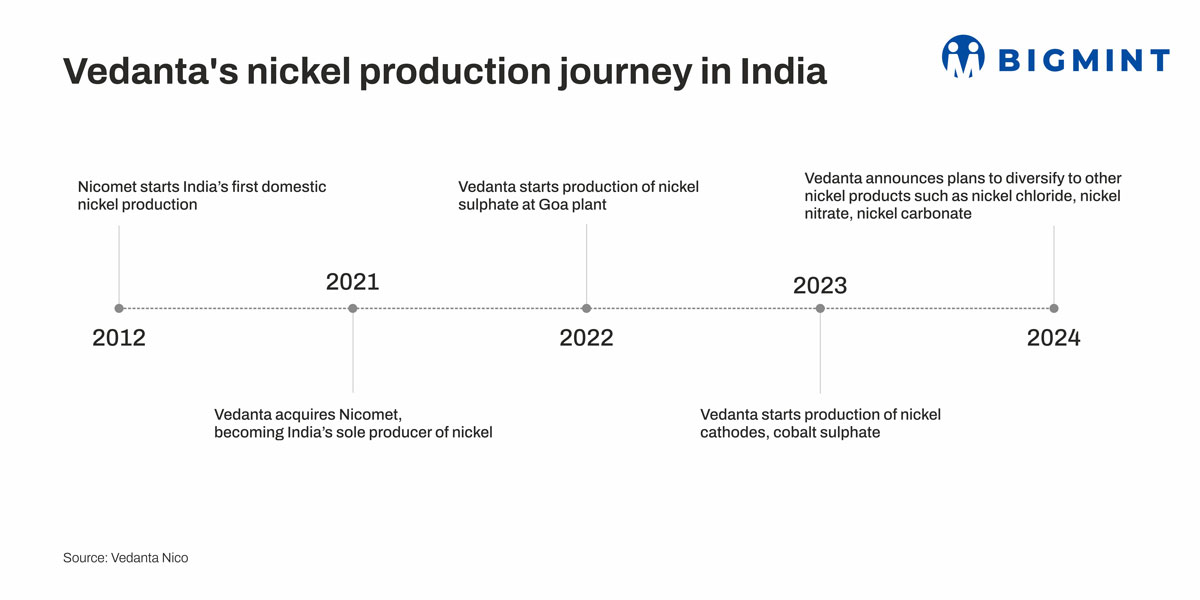
Vedanta’s journey with nickel and cobalt began in 2021 with the acquisition of Nico, a bankrupt unit sold through the NCLT process for approximately INR 55 crore. Over the following year, Vedanta invested around INR 100 crore to operationalise the plant, which now has a capacity of around 6,000 t of nickel equivalent, said Menon.
Over the past five years, Menon said Vedanta had learned three key lessons, which have been incorporated into designing their proposed 50,000-t nickel refinery: the need to address raw material risk, product risk, and demand risk.
Unlike a conventional copper-processing industry where 90% of the input is copper concentrate, available in reasonably stable volumes, the raw material supply for nickel and several other critical minerals is more constrained and fragmented. To address the first risk, the proposed nickel facility is being designed to process four different types of raw materials, with each stream contributing roughly 35 to 40% of the blend. “This significantly mitigates supply risk by diversifying the basket of source countries and feedstock types,” Menon noted.
Premiums of nickel and cobalt end-products fluctuate significantly. To ensure long-term viability and predictable rates of return, the asset has been designed to produce both Class 1 products, lending it sufficient flexibility to adjust production to market demand and price signals.
Menon foresees 100,000 t of Class 1 nickel demand in India by 2030. However, there is an absence of large-scale domestic producers, which Vedanta with its first mover-advantage hopes to fill foreseeably.
With four years of experience operating in this segment, Vedanta has a meaningful first-mover opportunity, Menon said. The government could help with a targeted intervention aimed at bridging the opportunity cost of setting up a refinery for the 2-2.5 years it takes to set up a plant, he added. He clarified the industry was not looking for long-term dependency and would ultimately become competitive on its own.
Vedanta has studied similar projects in Indonesia and New Caledonia, a French territory in the Pacific, and concluded that a combination of a targeted capital expenditure subsidy and a limited production-linked incentive in the initial phase and during ramp-up can help overcome initial barriers to entry.
Leave a Reply