- Retail US coal inventories drop to multi-year lows
- Indian imports of pet coke recover sharply in Jun’26
India’s market for US-origin solid fuels is entering a more competitive phase. Retail stocks of Northern Appalachian (NAPP) coal and Illinois Basin (ILB) coal have fallen to multi-year lows, but a heavy programme of incoming NAPP cargoes is set to replenish availability. At the same time, imported pet coke has regained competitiveness after correcting sharply from April-May highs.
Recent commentary from major cement producers provides important context. Cement demand and pricing remain relatively resilient, but fuel costs are expected to rise during the monsoon quarter. Producers are therefore continuing to optimise between domestic coal, imported coal, NAPP, pet coke and alternative fuels rather than committing to a single fuel.
Retail US coal stocks fall sharply
Combined retail lifting of NAPP and ILB coal totalled about 2.46 million tonnes (mnt) during January-June 2026, down around 15% from the corresponding period of 2025. June lifting stood at 385,927 t, below 432,056 t a year earlier, although May was comparatively strong at 546,614 t.
The more significant development has been the decline in ground stocks. Combined NAPP and ILB inventories fell from 365,902 t in January to 234,840 t in June, before easing further to 193,000 t in July. This was less than one-third of the 602,004 t recorded in July 2025.
Low retail availability would ordinarily support prices. However, the incoming cargo schedule points to a sizeable near-term replenishment.
Heavy NAPP arrivals could cap retail prices
At least 16 NAPP cargoes, generally between 55,000 t and slightly above 100,000 t, were scheduled to arrive between late July and end-August at Ennore, Tuna, Kandla, Paradip, Dahej, Kakinada, and other ports.
Receivers include UltraTech Cement, Dalmia Cement, Shree Cement, JSW and Wonder Cement, while several cargoes were still awaiting nomination.
The vessel programme confirms that large cement users continue to value NAPP despite improving pet coke economics. It also suggests that the low retail inventory position partly reflects cargo timing rather than a structural withdrawal of US coal from India.
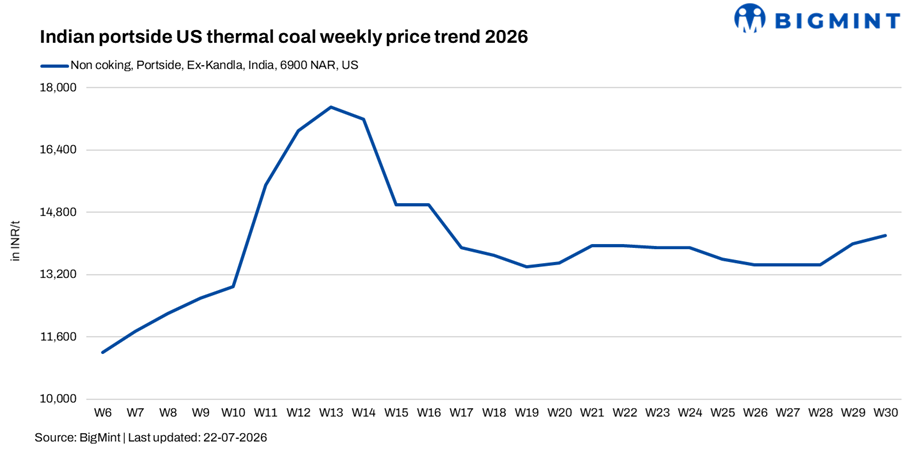
Indian retail NAPP has recently been assessed broadly around INR 13,000-14,000/t, depending on port, parcel size and commercial terms. Low stocks may support values immediately, but the arrival pipeline could reduce scarcity and weaken retailer pricing power if cargoes are not absorbed quickly.
Cement demand stays firm, but fuel costs remain a concern
Recent guidance from JK Cement and UltraTech Cement suggests that underlying cement demand remains supportive.
JK Cement expects FY’27 grey cement volumes of 22.5-23 mnt, implying double-digit growth, while maintaining its 40 mnt capacity target for FY’28. UltraTech also continues to target double-digit volume growth after reporting domestic growth well ahead of the broader industry during the first quarter.
Both companies expect cement prices to remain broadly stable during the monsoon, supported by resilient demand and elevated industry costs. This reduces the risk of an immediate collapse in fuel consumption even as seasonal construction activity moderates.
However, fuel economics are becoming more important. JK Cement expects its blended fuel cost to rise from INR 1.53/kcal in Q1 to around INR 1.75/kcal in Q2, contributing to an expected INR 100/t sequential increase in power and fuel costs. UltraTech similarly expects total costs to rise by around INR 130-140/t q-o-q, although it believes inventory coverage should contain the immediate impact.
The comments reinforce that cement producers are not choosing fuels solely on current spot prices. Inventory already purchased, plant location, freight, sulphur limits, kiln design and alternative-fuel availability all influence the final fuel mix.
Fuel strategies vary significantly by region
JK Cement’s operating mix illustrates the plant-specific nature of fuel procurement.
Its central Indian plants currently rely only on domestic coal, while southern units consume pet coke and alternative fuels. Northern operations use a combination of domestic coal, pet coke and alternative fuels. Management indicated an overall mix of roughly 40% pet coke, 45% imported coal, and the balance alternative fuels.
UltraTech’s perspective is somewhat different. Following the correction in pet coke prices, the company indicated that coal remained economically attractive and that domestic coal was currently preferred to imported pet coke on a fuel-cost basis.
These positions are not necessarily contradictory. They show that the relative economics of NAPP, domestic coal, and pet coke vary significantly by plant and region.
A coastal cement plant with suitable sulphur tolerance may continue to favour pet coke. A northern or inland plant may prefer domestic coal because of lower delivered logistics costs. NAPP can remain attractive where users require high calorific value, consistent quality and lower sulphur than fuel-grade pet coke.
Pet coke corrects from second-quarter highs
Average CFR India prices for US Gulf Coast pet coke increased from $117/t in January to $154/t in April, before easing to $150/t in May and $133/t in June. Venezuelan and Saudi prices followed a similar pattern, with major origins assessed near $136/t by mid-June.
Domestic refinery prices also declined. Reliance Industries’ basic price fell from INR 21,000/t in May to INR 19,330/t in June and INR 17,650/t in July. Nayara’s price eased from INR 19,750/t in May to INR 17,760/t in July.
The correction has restored pet coke’s competitiveness, particularly on an energy-adjusted basis. However, high sulphur, grinding characteristics, emissions compliance and kiln chemistry limit the quantity that many plants can consume.
NAPP therefore remains important both as a primary fuel and as a blending component that allows cement producers to manage sulphur while maintaining high thermal efficiency.
Pet coke imports rebound in June, but H1 remains weak
India imported 1.085 mnt of pet coke in June, up 60% from May and rising 34% y-o-y. Yet first-half imports totalled only 4.82 mnt, down 34% from 7.33 Mnt in January-June 2025.
The pattern reflects buyer price sensitivity. High international prices earlier in the year discouraged procurement and encouraged greater use of coal and inventories. As pet coke values corrected, June arrivals recovered sharply.
The US remained the dominant origin, supplying 2.58 mnt, or 54%, of first-half imports. US pet coke arrivals reached 613,152 t in June, more than three times the year-earlier level and 71% above May.
Cement remains the key swing consumer
Cement accounted for 51% of India’s pet coke imports during January-June 2026, but sectoral imports fell almost 54% y-o-y to 2.46 mnt.
June cement imports recovered to 466,899 t, up 47% from May, with US-origin material accounting for 328,901 t.
By contrast, gasification imports rose 73% y-o-y to 959,720 t, while calcination demand remained broadly stable. Cement’s share of total imports consequently declined from 75% in 2025 to 51% during the first half of 2026.
Despite this diversification, cement remains the marginal price-setting sector for fuel-grade pet coke and the main battleground between pet coke and US coal.
BigMint assessment
India’s US Northern Appalachian (NAPP) coal market has entered an atypical monsoon-quarter phase, with domestic seller indications rising INR 200/t w-o-w to INR 14,200/t despite subdued portside lifting, seasonally weak industrial demand and largely stable international prices. The increase has been driven by tightening prompt retail availability, higher freight costs and concerns over limited retail supply from incoming cargoes, while steady cement-sector demand continues to provide underlying support.
The outlook for NAPP and pet coke will be shaped less by absolute prices than by cement producers’ efforts to minimise delivered fuel cost without compromising kiln performance.
Low NAPP retail stocks provide near-term support, but the heavy July-August cargo pipeline should improve availability and cap a sustained rise in prices. Pet coke’s correction has restored its competitiveness and triggered a strong recovery in June imports, although first-half volumes show that buyers remain willing to switch away when prices become excessive.
Cement demand remains sufficiently strong to support fuel consumption, but rising Q2 costs are likely to encourage more active fuel optimisation. Producer commentary suggests there is no single preferred fuel across the industry: domestic coal is gaining favour at some plants, pet coke remains important at sulphur-tolerant coastal units, and NAPP continues to serve users seeking high calorific value and consistent performance.
The market is therefore likely to remain characterised by tactical purchases and frequent fuel switching. Pet coke upside may face resistance above the mid-$130s/t CFR, while NAPP values will be constrained by the arrival pipeline and competition from domestic coal. For suppliers, maintaining competitiveness on a delivered energy basis will be more important than defending headline prices.

Leave a Reply