- Karaikal records sharpest inventory drawdown
- Dhamra, Navlakhi register strongest inventory gains
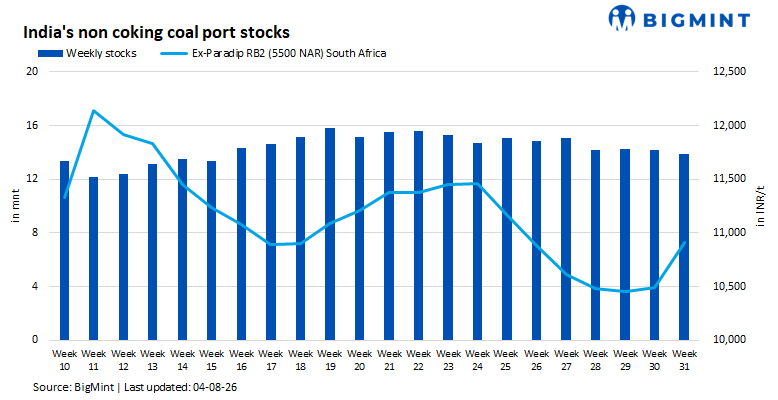
India’s thermal coal inventories at major ports declined by 2.46% week-on-week (w-o-w) to 13.86 million tonnes (mnt) in Week 31 from 14.21 mnt in Week 30. The decline was driven by inventory drawdowns across Karaikal, Vizag, Magdalla, Tuticorin, Hazira, and other minor ports, which more than offset fresh replenishment at Kandla, Mundra, Dhamra, Navlakhi, Dahej, and Paradip.
The overall reduction indicates that cargo evacuations marginally exceeded fresh import arrivals during the week as buyers continued to restrict purchases to immediate operational requirements. Comfortable domestic coal availability, regular Coal India dispatches, and ample fuel stocks continued to reduce dependence on imported coal despite firm international replacement costs.
Dhamra, Navlakhi register strongest inventory gains
Among the major ports, Dhamra and Navlakhi recorded the highest percentage increase, with inventories rising 13% w-o-w to 0.54 mnt and 0.60 mnt, respectively, reflecting fresh cargo arrivals and selective stock replenishment. Mundra and Kandla each witnessed an 8% increase, with inventories reaching 1.08 mnt. Dahej rose 5% to 1.05 mnt, while Paradip recorded a 4% increase to 1.41 mnt, indicating steady inflows at key import hubs. Mangalore remained unchanged at 0.60 mnt, suggesting balanced cargo arrivals and evacuations.
Karaikal records sharpest inventory drawdown
Inventory levels declined across several ports during the week, led by Karaikal, where stocks plunged 86% w-o-w to 0.06 mnt from 0.42 mnt, reflecting significant cargo evacuation. Vizag registered an 11% decline to 0.33 mnt, while Magdalla and Tuticorin each fell 10% to 0.88 mnt and 0.74 mnt, respectively. Hazira slipped 2% to 2.48 mnt, while inventories at other minor ports eased 3% to 3.01 mnt, indicating steady offtake across multiple consumption centres.

Adani Enterprises retains largest inventory position
Adani Enterprises remained the largest holder of imported non-coking coal inventories at Indian ports, maintaining stocks of 4.97 mnt. AM/NS India retained the second position with 1.24 mnt, while Agarwal Coal continued to be the largest independent coal trader with inventories of 0.77 mnt.
Among other major inventory holders, JSW Steel held 0.42 mnt, followed by Adani Power with 0.42 mnt and NTPL with 0.40 mnt. Tata Steel maintained 0.39 mnt, while Mohit Minerals, Aditya Birla, JSW Mineral and Tata International held inventories ranging between 0.23-0.31 mnt. Jindal Steel and Power continued to maintain relatively lean inventories of around 0.20 mnt, reflecting its requirement-based procurement strategy amid comfortable domestic coal supplies.

Market dynamics
India’s imported thermal coal market remained well supplied during Week 31, although port inventories declined slightly as cargo evacuations outpaced fresh arrivals. Buyers continued to procure imported coal only for immediate requirements, supported by comfortable domestic coal availability and regular Coal India dispatches. Weak demand from the steel and sponge iron sectors during the monsoon kept import buying subdued, while consumers continued to prefer domestic coal due to its cost advantage.
Globally, Indonesian and South African thermal coal prices remained broadly firm on supply-side support and higher freight rates, despite cautious buying. Overall, India’s domestic coal market sentiment remained positive, supported by strong domestic demand and firm auction premiums, while the global market remained cautious with subdued import demand balancing supportive supply fundamentals.
Outlook
Imported thermal coal demand is expected to remain selective over the coming weeks as consumers continue to rely on comfortable inventories and requirement-based procurement. Domestic coal is likely to remain the preferred fuel due to its cost competitiveness, uninterrupted Coal India supplies and healthy domestic availability. International thermal coal prices are expected to remain supported by firm freight rates and supply-side constraints, although a meaningful recovery in import demand is likely only after post-monsoon improvement in industrial activity, steel production and sponge iron consumption. Consequently, India’s domestic coal market is expected to remain resilient, while the seaborne market is likely to stay cautious in the near term.

Leave a Reply